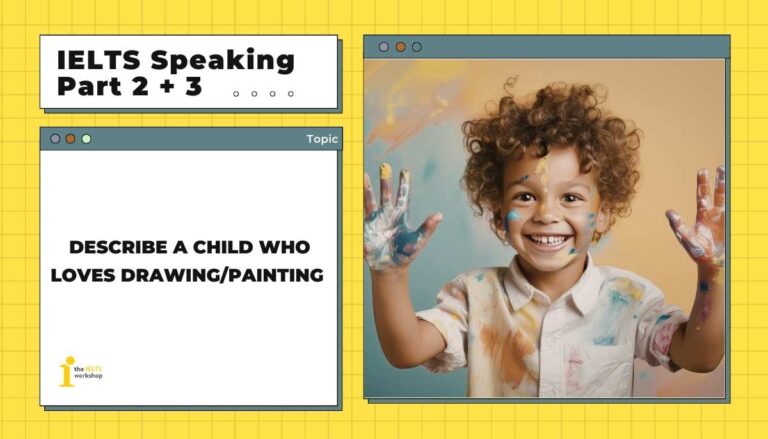
Trong bài giải mẫu lần này, thầy Đình Tân – giáo viên tại The IELTS Workshop sẽ hướng dẫn bạn trả lời topic Describe a child who loves drawing/painting trong IELTS Speaking Part 2. Cùng tham khảo sample, từ vựng và một vài cách diễn đạt ghi điểm trong phần thi IELTS Speaking nhé.
Part 2: Describe a child who loves drawing/painting
Đề bài: Describe a child who loves drawing/painting
You should say:
- Who he/she is
- How/when you knew him/her
- How often he/she draws/paints
- And explain why you think he/she loves drawing/painting
1. Bài mẫu (Sample)
I’d like to talk about my niece, who has shown a strong love for drawing and painting since she was very young. She is five years old now, but I first noticed her artistic talent when she was about two. While many children at that age simply scribble randomly, my niece was already trying to draw the people and objects around her, which really surprised our whole family.
One of her earliest drawings was a picture of her mother. Although it wasn’t very realistic, we could immediately recognise who she had drawn. She even included small details like her mother’s grey hair and lipstick colour.
As she has grown older, her love for art has only become stronger. She now spends hours each week colouring, sketching her family and animals, and recreating scenes from her everyday life. What’s more, she doesn’t just copy what she sees; she also uses her imagination to invent stories and characters.
For instance, she once drew her parents as superheroes saving the world, which was both creative and adorable. I think drawing gives her a way to express her thoughts and emotions, even when she cannot explain them verbally. The colours she chooses and the way she draws often reflect her mood. For example, when she uses many bright colours, it usually means she is happy, but when she uses a lot of red or darker tones, it may suggest she is upset or frustrated.
Ever since she first showed an interest in artistic activities, her parents have been very supportive. They encourage her to attend art classes and provide different materials such as watercolours and markers. As a result, her skills have improved considerably over time. I believe that, with the right encouragement and support, she might even be able to turn this hobby into a career in the future.
Sample by Dao Dinh Tan – IELTS Teacher at The IELTS Workshop
2. Từ vựng (Vocabulary)
- niece : cháu gái
- artistic talent : năng khiếu nghệ thuật
- scribble : vẽ nguệch ngoạc
- objects : đồ vật
- surprised : ngạc nhiên
- realistic : chân thực
- colouring : tô màu
- sketch / sketching : phác họa
- recreate / recreating : tái hiện
- imagination : trí tưởng tượng
- characters : nhân vật
- verbally : bằng lời nói
- reflect : phản ánh
- mood : tâm trạng
- bright colours : màu sáng
- darker tones : gam màu tối
- upset : buồn
- interest : sự quan tâm
- supportive : ủng hộ
- encourage : khuyến khích
- attend : tham gia
- career : sự nghiệp
Part 3:
1. What is the right age for a child to learn drawing?
As someone who practices drawing and painting almost weekly, I personally believe that children should start as early as possible, as early exposure can help foster creativity and self-expression.
That said, the “right” age really depends on what we mean by learning to draw. If we are referring to attending a formal class with teachers and classmates, then around the age of five would be appropriate. At that stage, children are generally capable of following basic instructions and sitting still for the duration of a lesson, which can be quite challenging for younger kids.
However, if learning simply means experimenting through trial and error, with some guidance from parents or older family members, then children should begin as soon as they are able to hold a pencil or a crayon, because of the developmental benefits I mentioned earlier. It may also help parents recognise their child’s natural abilities — and who knows, they might even discover a genuine artistic talent in the future.
- practise : luyện tập
- exposure : sự tiếp xúc
- foster : nuôi dưỡng
- creativity : sự sáng tạo
- formal class : lớp học chính quy
- appropriate : phù hợp
- instructions : hướng dẫn
- duration : khoảng thời gian
- guidance : sự hướng dẫn
2. Why do most children draw more often than adults do?
I think the main reason children draw more often than adults is that they have fewer inhibitions and a stronger sense of curiosity. For children, drawing is simply a form of play rather than a skill that is judged or compared. They are usually not afraid of making mistakes, so they feel freer to experiment with colours, shapes, and ideas.
Adults, on the other hand, tend to become more self-critical over time. Many people come to believe they are “not good at art,” either because they judge themselves too harshly or because of negative comments from others, and this often discourages them from drawing altogether. In addition, many adults are overwhelmed with responsibilities, such as work and family commitments, so creative activities gradually become less of a priority in their daily lives.
- form of play : hình thức vui chơi
- self-critical : hay tự phê bình
- judge : đánh giá
- negative comments : nhận xét tiêu cực
- discourage : làm nản lòng
- responsibilities : trách nhiệm
- priority : ưu tiên
3. Why do some people visit galleries or museums instead of viewing artworks online?
I believe there are two main reasons why some people prefer to see artworks in person at galleries or museums rather than view them on a screen.
The first reason is that experiencing art in real life creates a far more immersive experience. When people stand in front of an actual painting or sculpture, they can fully appreciate its scale, texture, brushstrokes, and intricate details. This makes the experience feel more authentic and personal.
Another important factor is the environment in which art is displayed. Galleries and museums are carefully designed spaces that encourage quiet reflection and focused attention. Visitors are more likely to slow down, observe carefully, and think deeply about what they are seeing. This mindset allows them to engage with the meaning and emotions behind the artwork. In contrast, when people view art online, they tend to scroll quickly and treat it like any other content on their screen, which may reduce the impact of the artwork.
- in person : trực tiếp
- scale : kích thước
- texture : kết cấu
- details : chi tiết
- authentic : chân thực / xác thực
- reflection : sự suy ngẫm
- impact : tác động
4. Do you think galleries and museums should be free of charge?
Yes, I strongly agree that galleries and museums should ideally be free of charge. As a patron of art, I feel that everyone should have the opportunity to appreciate artistic and cultural works regardless of their financial situation. Art is not just entertainment; it also plays an important role in education, as it helps people understand historical events, social values, and different perspectives through visual representation. By observing artworks, visitors can learn about the traditions, lifestyles, and beliefs of different periods and cultures in a way that textbooks alone often cannot convey. This makes learning more engaging and emotionally impactful.
That said, funding is still necessary to maintain these institutions, perhaps from the government or private sponsors. Many artworks are extremely old and require extensive preservation efforts, which undoubtedly cost money. Without proper care, many precious pieces could be lost over time.
- free of charge : miễn phí
- financial situation : tình hình tài chính
- entertainment : giải trí
- historical events : sự kiện lịch sử
- social values : giá trị xã hội
- perspectives : góc nhìn
- traditions : truyền thống
- lifestyles : lối sống
- beliefs : niềm tin
- funding : tài trợ
- government : chính phủ
- private sponsors : nhà tài trợ tư nhân
- preservation : bảo tồn
- precious : quý giá
5. How do artworks inspire people?
I think artworks inspire people mainly in two ways. First, artworks can evoke strong emotions, so they can be used effectively to raise awareness of social issues and encourage people to take action. When viewers see these themes represented visually, the message often feels more powerful and emotionally engaging than simply reading about them. As a result, people may become more aware of social problems, feel motivated to make changes, or even fight for what they believe is right. For example, when some artists in Brazil created sculptures of sea animals using plastic waste collected from local beaches to highlight how pollution was damaging marine ecosystems, it inspired entire communities to take part in beach clean-up activities.
Second, artworks inspire creativity and new ways of thinking. When people are exposed to different artistic styles, ideas, or techniques, they begin to realise that there is no single “correct” way to express something. This can encourage them to experiment, take risks, and approach problems more imaginatively, even outside the art world.
- inspire : truyền cảm hứng
- evoke : gợi lên
- raise awareness : nâng cao nhận thức
- take action : hành động
- themes : chủ đề
- engaging : thu hút
- motivated : có động lực
6. What are the differences between reading a book and visiting a museum?
I think the main difference lies in the type of experience they provide. Reading a book is usually a more personal and imaginative activity, because readers create images and interpretations in their own minds. The experience depends heavily on language and individual imagination, so people can engage with the content at their own pace and reflect deeply on ideas or stories. In contrast, visiting a museum is much more visual and immediate. People interact with real objects, artworks, or historical artefacts, which can create a stronger sense of realism and emotional impact because they are seeing something authentic rather than imagining it.
- personal : cá nhân
- imaginative : giàu trí tưởng tượng
- interpretations : cách hiểu
- pace : tốc độ
- reflect deeply : suy ngẫm sâu
- visual : trực quan
- immediate : tức thì
- artefacts : hiện vật
- realism : tính chân thực
- authentic : xác thực
Tạm kết
Hy vọng bài mẫu trên đã giúp bạn hình dung rõ cách triển khai ý tưởng và sử dụng ngôn ngữ phù hợp khi gặp chủ đề Describe a child who loves drawing/painting trong IELTS Speaking Part 2 & 3. Tham khảo các nguồn tài liệu hữu ích như KHO BÀI MẪU IELTS SPEAKING và Bộ đề dự đoán IELTS Speaking cập nhật mới nhất.
HỌC IELTS MIỄN PHÍ – lớp học độc quyền chỉ có trên website của The IELTS Workshop. Đăng ký để bắt đầu lộ trình học bài bản cùng thầy cô tại TIW ngay nhé!