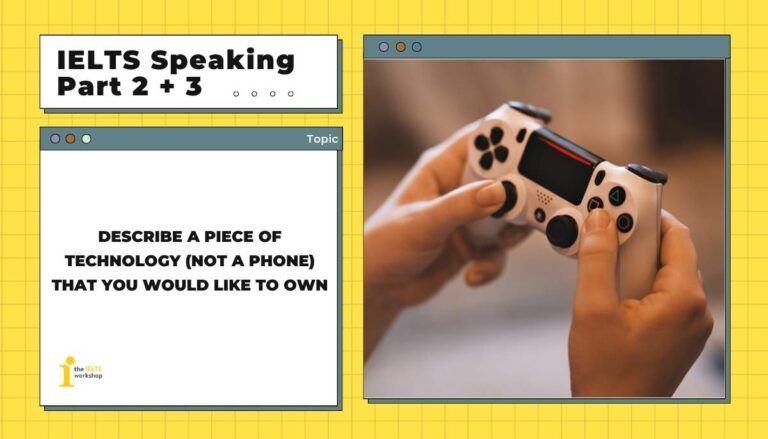
Trong bài giải mẫu lần này, thầy Tuấn Ngọc – giáo viên tại The IELTS Workshop sẽ hướng dẫn bạn trả lời topic Describe a piece of technology (not a phone) that you would like to own. Cùng tham khảo sample, từ vựng và một vài cách diễn đạt ghi điểm trong phần thi IELTS Speaking nhé.
Part 2: Describe a piece of technology (not a phone) that you would like to own
Đề bài: Describe a piece of technology (not a phone) that you would like to own
You should say:
- What it is
- How much it costs
- How you knew it
- And explain why you would like to own it
1. Bài mẫu (Sample)
One thing that I have been longing to possess for a long time is a PlayStation 5, which is one the most popular and latest gaming console.
In terms of cost, the PS5 is fairly expensive for an entertainment device. Of course, prices depend on the version and whether it comes with extra accessories or games. Although it is quite a big purchase, many gamers consider it a worthwhile investment because of the powerful performance and high-quality gaming experience it offers.
I first learned about the PS5 through gaming videos and online tech reviews when it was officially released. At that time, it created a huge buzz in the gaming community because of its advanced graphics, ultra-fast loading speed, and realistic gameplay. I also had the chance to try it once at a friend’s house, and the experience was incredibly immersive. The graphics were stunning, and the controller felt very responsive and smooth.
The main reason I would like to own a PS5 is that it would be a great way for me to relax and unwind after work. My job can sometimes be mentally demanding, so playing story-driven or adventure games would help me relieve stress and temporarily escape from daily pressure. In addition, gaming is also a social activity, as I could play online with friends, which would make the experience more enjoyable and engaging.
Overall, even though the PS5 is quite costly, I believe it would bring me both entertainment and relaxation, making it a piece of technology I would truly value.
Sample by Tuan Ngoc – IELTS Teacher at The IELTS Workshop
Part 3:
1. What are the differences between the technology of the past and that of today?
In the past, technology was mainly mechanical and relatively slow, often designed to assist with basic physical tasks such as transportation or manufacturing. Today, however, technology is largely digital, highly automated, and deeply integrated into everyday life. Modern devices are faster, smarter, and interconnected through the internet, allowing instant communication and access to vast amounts of information. Another key difference is portability. Previously, technology was bulky and location-bound, whereas now most tools are compact and mobile, enabling people to work and communicate from virtually anywhere.
- integrated /ˈɪn.tɪ.ɡreɪ.tɪd/
Meaning: fully combined into something
Example: Technology is fully integrated into modern education.
- automated /ˈɔː.tə.meɪ.tɪd/
Meaning: operated by machines with little human control
Example: Many factories are now fully automated.
- portability /ˌpɔː.təˈbɪl.ə.ti/
Meaning: easy to carry or move
Example: The portability of laptops allows people to work anywhere.
- location-bound /ləʊˈkeɪ.ʃən baʊnd/
Meaning: restricted to one place
Example: Old computers were location-bound and not mobile.
2. What technology do young people like to use?
Young people tend to gravitate toward interactive and entertainment-driven technologies. Smartphones are by far the most popular because they combine communication, social media, gaming, and content creation in a single device. Many also enjoy platforms like social networking apps, streaming services, and online games, as these allow them to connect with peers and express themselves creatively. Recently, wearable devices and AI-powered tools have also gained popularity, especially for fitness tracking, studying, and content creation.
- gravitate toward /ˈɡræv.ɪ.teɪt/
Meaning: be naturally attracted to
Example: Teenagers gravitate toward social media platforms.
- interactive /ˌɪn.təˈræk.tɪv/
Meaning: involving active participation
Example: Interactive apps make learning more engaging.
- wearable devices /ˈweə.rə.bəl dɪˈvaɪsɪz/
Meaning: technology worn on the body
Example: Smartwatches are popular wearable devices.
- content creation /ˈkɒn.tent kriˈeɪ.ʃən/
Meaning: producing videos, posts, or media
Example: Many young people enjoy content creation on TikTok.
3. What are the differences between online and face-to-face communication?
The most obvious difference lies in the level of human connection. Face-to-face communication allows people to read body language, facial expressions, and tone more accurately, which makes interactions more personal and emotionally rich. Online communication, on the other hand, is more convenient and time-efficient, especially across long distances, but it can sometimes feel impersonal or misunderstood due to the lack of non-verbal cues. Additionally, online conversations are often more concise and fast-paced, whereas in-person discussions tend to be deeper and more spontaneous.
- non-verbal cues /ˌnɒnˈvɜː.bəl kjuːz/
Meaning: body language, facial expressions, gestures
Example: Non-verbal cues help us understand emotions.
- impersonal /ɪmˈpɜː.sən.əl/
Meaning: lacking human warmth
Example: Emails sometimes feel impersonal.
- concise /kənˈsaɪs/
Meaning: short but clear
Example: Online messages are usually concise.
- spontaneous /spɒnˈteɪ.ni.əs/
Meaning: natural and unplanned
Example: Face-to-face talks are more spontaneous.
4. Do you think technology has changed the way people communicate?
Yes, profoundly. Technology has made communication faster, more frequent, and less restricted by geography. People can now maintain relationships across continents in real time, which was unimaginable in the past. However, it has also shifted communication toward shorter, more informal exchanges, such as texting or voice messages, rather than long conversations. In some cases, people prioritise convenience over depth, which has subtly transformed how relationships are built and maintained.
- profoundly /prəˈfaʊnd.li/
Meaning: deeply, significantly
Example: Technology has profoundly changed society.
- restricted by geography /rɪˈstrɪk.tɪd/
Meaning: limited by distance or location
Example: Communication is no longer restricted by geography.
- prioritise /praɪˈɒr.ɪ.taɪz/
Meaning: treat as more important
Example: People prioritise speed over quality online.
- subtly /ˈsʌt.li/
Meaning: in a small but noticeable way
Example: Social media has subtly changed behaviour.
5. What negative effects does technology have on people’s relationships?
One major drawback is reduced quality of interaction. When people rely heavily on digital communication, they may spend less meaningful time together in person, which can weaken emotional bonds. Technology can also create distractions. For example, excessive phone use during conversations may make others feel ignored or undervalued. Furthermore, social media sometimes fosters unrealistic comparisons or misunderstandings, which can lead to jealousy, insecurity, or conflict in relationships.
- drawback /ˈdrɔː.bæk/
Meaning: disadvantage
Example: One drawback of smartphones is distraction.
- emotional bonds /ɪˈməʊ.ʃən.əl bɒndz/
Meaning: emotional connection between people
Example: Spending time together strengthens emotional bonds.
- undervalued /ˌʌnˈvæl.juːd/
Meaning: not appreciated enough
Example: People feel undervalued when ignored.
- fosters /ˈfɒs.təz/
Meaning: encourages something to develop
Example: Social media sometimes fosters insecurity.
6. What are the differences between making friends in real life and online?
Friendships formed in real life are often deeper and more stable because they are built through shared experiences, physical presence, and genuine emotional interaction. In contrast, online friendships are easier and faster to establish, especially with people who share similar interests, regardless of location. However, they may lack authenticity or long-term commitment since online identities can be selective or even misleading. That said, online friendships can still be meaningful, particularly when they eventually transition into real-world connections.
- authenticity /ˌɔː.θenˈtɪs.ə.ti/
Meaning: being real or genuine
Example: Real-life friendships have more authenticity.
- commitment /kəˈmɪt.mənt/
Meaning: willingness to maintain something long-term
Example: Strong friendships require commitment.
- misleading /ˌmɪsˈliː.dɪŋ/
Meaning: giving a wrong impression
Example: Online profiles can be misleading.
- transition into /trænˈzɪʃ.ən/
Meaning: gradually change into
Example: Some online friendships transition into real ones.
Tạm kết
Hy vọng bài mẫu trên đã giúp bạn hình dung rõ cách triển khai ý tưởng và sử dụng ngôn ngữ phù hợp khi gặp chủ đề Describe a piece of technology (not a phone) that you would like to own trong IELTS Speaking Part 2 & 3. Tham khảo các nguồn tài liệu hữu ích như KHO BÀI MẪU IELTS SPEAKING và Bộ đề dự đoán IELTS Speaking cập nhật mới nhất.
HỌC IELTS MIỄN PHÍ – lớp học độc quyền chỉ có trên website của The IELTS Workshop. Đăng ký để bắt đầu lộ trình học bài bản cùng thầy cô tại TIW ngay nhé!