
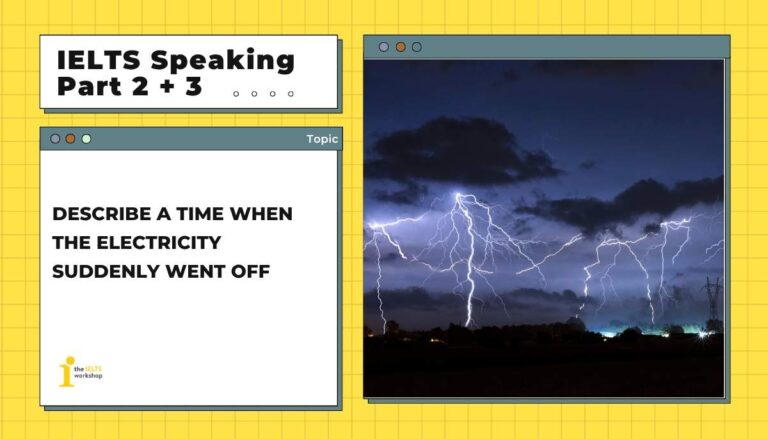
Bài mẫu chủ đề “Describe a time when the electricity suddenly went off” của giáo viên Kiều Trinh cung cấp ý tưởng mạch lạc, từ vựng đa dạng và chiến lược trả lời hiệu quả cho IELTS Speaking Part 2.
Part 2: Describe a time when the electricity suddenly went off
You should say:
- When/where it happened
- How long it lasted
- What you did during that time
- And explain how you felt about it
1. Bài mẫu (Sample)
One memorable power outage at my home was last summer, during a really intense thunderstorm.
It happened in the evening while my family and I were having dinner. Out of the blue, all the lights went out, and the whole neighborhood was plunged into complete darkness. Apparently, a strong gust of wind had caused a branch to fall onto the power lines, snapping them and cutting off the electricity supply.
At first, we used candles and the flashlight on our phones to light up the room. My younger brother was a little frightened, so I told him some funny stories to help calm him down. Since we couldn’t watch TV or use our devices, we just sat together and chatted. To my surprise, it into a really enjoyable family bonding experience, as we rarely get to spend quality time like that without screens.
After the storm had passed, a few workers from the electricity company came to set up temporary generators while attempting to reinstate the power supply. The blackout lasted for only about two hours, but felt like an eternity because the weather was so hot and humid.
As inconvenient and uncomfortable as it was, I actually enjoyed the experience. It reminded me of how dependent we are on electricity and technology, and it made me appreciate the simple moments I shared with my family. In a way, it was a blessing in disguise.
Sample band 7.0 by Kieu Trinh, IELTS Teacher at The IELTS Workshop
2. Từ vựng (Vocabulary)
- power outage (n phr): mất điện
- intense thunderstorm (n phr): cơn giông mạnh, dữ dội
- out of the blue (idiom): một cách bất ngờ, không báo trước
- went out (v): bị tắt (đèn, điện)
- plunged into complete darkness (phr): chìm trong bóng tối hoàn toàn
- a strong gust of wind (n phr): một luồng gió mạnh
- power lines (n): đường dây điện
- snapping them (v phr): làm đứt chúng (dây điện)
- candles (n): nến
- flashlight (n): đèn pin
- light up the room (v phr): làm sáng căn phòng
- frightened (adj): sợ hãi
- calm him down (v phr): làm dịu cậu ấy
- to my surprise (phr): điều khiến tôi bất ngờ là
- family bonding experience (n phr): trải nghiệm gắn kết gia đình
- spend quality time (v phr): dành thời gian chất lượng
- temporary generators (n phr): máy phát điện tạm thời
- reinstate the power supply (v phr): khôi phục nguồn điện
- blackout (n): sự cúp điện
- felt like an eternity (idiom): cảm giác như kéo dài vô tận
- appreciate the simple moments (v phr): trân trọng những khoảnh khắc đơn giản
- blessing in disguise (idiom): trong cái rủi có cái may
Xem thêm: Cách học từ vựng IELTS hiệu quả từ thầy Đặng Trần Tùng 9.0
Part 3:
1. Which is better, electric bicycles or ordinary bicycles?
Both electric and conventional bicycles offer distinct advantages depending on the user’s purpose. Electric bikes are particularly advantageous for urban commuters, as they reduce physical exertion and increase travel efficiency, especially in areas with heavy traffic or hilly terrain. In contrast, ordinary bicycles are often preferred for fitness and recreational purposes due to their simplicity and affordability, making them more suitable for casual riders or those seeking physical activity.
- conventional bicycles (n phr): xe đạp truyền thống
- urban commuters (n phr): người đi lại trong thành phố
- physical exertion (n phr): sự gắng sức về thể chất
- travel efficiency (n phr): hiệu quả khi di chuyển
- hilly terrain (n phr): địa hình đồi dốc
- recreational purposes (n phr): mục đích giải trí
- simplicity (n): sự đơn giản
- affordability (n): khả năng chi trả / tính vừa túi tiền
- casual riders (n phr): người đạp xe không chuyên / đạp xe thư giãn
2. Do you think electric bicycles will replace ordinary bicycles in the future?
The likelihood of electric bicycles replacing traditional ones is largely context-dependent. In densely populated urban areas, where people prioritize convenience and time-saving, e-bikes are becoming increasingly popular. For instance, many delivery drivers and office workers now opt for electric alternatives to avoid physical fatigue. However, in rural settings or among individuals who cycle for exercise or environmental reasons, ordinary bicycles are still more desirable due to their low maintenance and health benefits. Therefore, a complete replacement seems improbable in the near future.
- context-dependent (adj): phụ thuộc vào hoàn cảnh
- densely populated urban areas (n phr): khu vực đô thị đông dân
- prioritize (v): ưu tiên
- delivery drivers (n phr): người giao hàng
- electric alternatives (n phr): phương tiện điện thay thế
- physical fatigue (n phr): sự mệt mỏi thể chất
- rural settings (n phr): môi trường nông thôn
- low maintenance (n phr): ít tốn công bảo dưỡng
- complete replacement (n phr): sự thay thế hoàn toàn
- improbable (adj): khó xảy ra, không chắc sẽ xảy ra
3. Which is better, electric cars or petrol cars?
While both electric and petrol cars have their merits, electric vehicles are generally considered more sustainable due to their zero-emission output and lower operating costs. For instance, electric cars reduce air pollution and offer long-term savings on fuel and maintenance. Nevertheless, petrol cars still maintain a practical advantage in regions where charging infrastructure is underdeveloped. In such cases, conventional vehicles remain a more feasible choice for long-distance travel or areas with limited technological support.
- zero-emission output (n phr): lượng khí thải bằng 0
- operating costs (n phr): chi phí vận hành
- long-term savings (n phr): tiết kiệm về lâu dài
- practical advantage (n phr): lợi thế thực tế
- charging infrastructure (n phr): cơ sở hạ tầng sạc điện
- conventional vehicles (n phr): phương tiện truyền thống (chạy xăng/dầu)
- feasible choice (n phr): lựa chọn khả thi
4. How did people manage to live without electricity in the ancient world?
In the absence of electricity, people in ancient times adapted by relying on natural resources and manual labor. Daily activities were synchronized with daylight, while evenings were illuminated using candles, oil lamps, or firewood. For instance, meals were often cooked over open flames, and perishables were preserved using underground cellars. Although this lifestyle was undoubtedly labor-intensive, it fostered a more self-sufficient and community-oriented way of life that many modern societies have gradually moved away from.
- manual labor (n phr): lao động thủ công
- synchronized with (v phr): đồng bộ, phối hợp nhịp nhàng với
- illuminated (v): được chiếu sáng
- open flames (n phr): ngọn lửa trần (lửa từ củi, bếp…)
- perishables (n): thực phẩm dễ hỏng
- underground cellars (n phr): hầm chứa ngầm (để bảo quản thực phẩm)
- labor-intensive (adj): đòi hỏi nhiều công sức, nhân lực
- self-sufficient (adj): tự cung tự cấp
- community-oriented (adj): hướng tới cộng đồng, đề cao tính tập thể
5. Is it difficult for the government to replace all petrol cars with electric cars?
Replacing all petrol-powered vehicles with electric alternatives presents significant challenges for most governments. It requires substantial financial investment to expand charging infrastructure, provide incentives for electric vehicle adoption, and support domestic car manufacturers. For example, countries such as Norway have implemented tax reductions and free charging stations, which have led to a noticeable increase in EV ownership. However, in developing nations, cost barriers and technological limitations continue to hinder progress.
- petrol-powered vehicles (n phr): phương tiện chạy bằng xăng
- substantial financial investment (n phr): khoản đầu tư tài chính lớn
- charging infrastructure (n phr): cơ sở hạ tầng trạm sạc điện
- incentives for adoption (n phr): các ưu đãi để khuyến khích sử dụng
- domestic manufacturers (n phr): các nhà sản xuất trong nước
- tax reductions (n phr): việc giảm thuế
- cost barriers (n phr): rào cản về chi phí
- technological limitations (n phr): hạn chế về công nghệ
- hinder progress (v phr): cản trở sự tiến bộ
6. Do people use more electricity now than before?
Undoubtedly, electricity consumption has increased dramatically over recent decades due to technological advancement and lifestyle changes. People now rely on electricity not only for basic needs such as lighting and cooking but also for digital communication, climate control, and entertainment. For instance, households often operate multiple high-energy devices simultaneously, including laptops, smartphones, and air conditioners. In an increasingly digitized society, the demand for electricity will likely continue to rise.
- electricity consumption (n phr): mức tiêu thụ điện
- technological advancement (n phr): sự phát triển công nghệ
- climate control (n phr): điều hòa nhiệt độ
- digitized society (n phr): xã hội số hóa
- demand for electricity (n phr): nhu cầu sử dụng điện
Tạm kết
Hy vọng bài mẫu trên đã giúp bạn hình dung rõ cách triển khai ý tưởng và sử dụng ngôn ngữ phù hợp khi gặp chủ đề Describe a time when the electricity suddenly went off trong IELTS Speaking Part 2 & 3. Tham khảo các nguồn tài liệu hữu ích như KHO BÀI MẪU IELTS SPEAKING và Bộ đề dự đoán IELTS Speaking cập nhật mới nhất.
HỌC IELTS MIỄN PHÍ – lớp học độc quyền chỉ có trên website của The IELTS Workshop. Đăng ký để bắt đầu lộ trình học bài bản cùng thầy cô tại TIW ngay nhé!