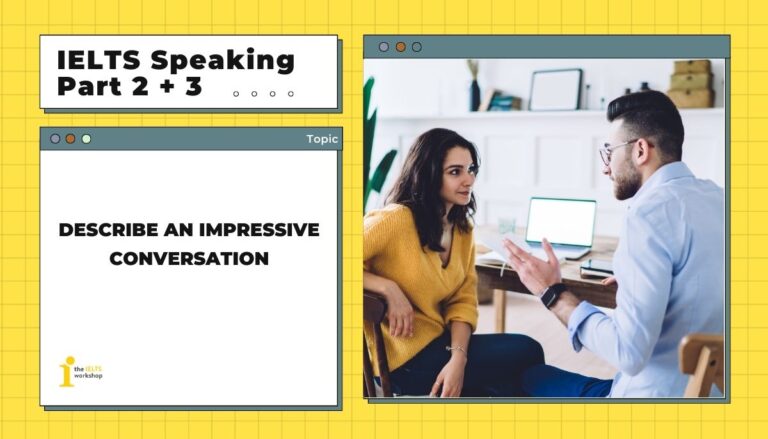
Bài mẫu chủ đề Describe an impressive conversation của giáo viên Kiều Trinh cung cấp ý tưởng mạch lạc, từ vựng đa dạng và chiến lược trả lời hiệu quả cho IELTS Speaking Part 2.
Part 2: Describe an impressive conversation you had that you remember well
You should say:
- Who you talked to
- When and where you had it
- What you talked about
- And explain why you think it was impressive
1. Bài mẫu (Sample)
One meaningful conversation I had was with my older cousin. It took place more ten years ago when I was struggling with a major decision – whether to study abroad or stay in my home country for university. Although we usually chatted casually, that day turned into a deep, thought-provoking talk that really helped shape my mindset.
We sat on the balcony at night, and the setting made it easier to open up. I shared my fears about leaving my family, adapting to a foreign culture, and falling behind academically. My cousin listened patiently and responded with insightful questions, rather than immediate advice. That active listening made me feel truly heard.
What made the conversation so impressive was her ability to challenge my assumptions without sounding critical. She said, “If you never take risks, you might always wonder what you missed.” That sentence hit me hard. Although I had expected reassurance, she gave me a wake-up call instead. Had she just agreed with me, I might not have reconsidered my path.
Another thing that stood out was her use of real – life examples – people who thrived after taking bold steps and others who regretted staying in their comfort zones. Had it not been for that conversation, I would have stayed in a safe bubble. But her words gave me the courage to apply abroad, and that decision changed the course of my life entirely.
Looking back, that talk wasn’t just helpful – it was transformative. It showed me how a heart-to-heart conversation can shift one’s direction completely. Even though we didn’t come to a clear decision that night, the way she guided me to reflect was something I’ll never forget.
Sample band 7.0+ by Kieu Trinh, IELTS Teacher at The IELTS Workshop
2. Từ vựng (Vocabulary)
- meaningful conversation (n phr): cuộc trò chuyện có ý nghĩa
- major decision (n phr): quyết định quan trọng
- chat casually (v phr): trò chuyện một cách thoải mái
- a deep, thought-provoking talk (n phr): cuộc trò chuyện sâu sắc, gợi suy ngẫm
- shape one’s mindset (v phr): định hình tư duy
- open up (v phr): cởi mở, chia sẻ cảm xúc thật
- insightful questions (n phr): những câu hỏi sâu sắc, có tính gợi mở
- immediate advice (n phr): lời khuyên đưa ra ngay lập tức
- active listening (n phr): lắng nghe chủ động
- challenge one’s assumptions (v phr): thách thức những định kiến sẵn có
- hit one hard (idiom): khiến ai đó suy nghĩ nhiều
- give one a wake-up call (idiom): cho ai đó một lời cảnh tỉnh
- take bold steps (v phr): thực hiện bước đi táo bạo
- stay in one’s comfort zones (v phr): ở trong vùng an toàn của bản thân
- staye in a safe bubble (v phr): ở trong vỏ bọc an toàn, không dám thay đổi
- give one the courage (v phr): cho ai đó dũng khí
- transformative (adj): mang tính thay đổi mạnh mẽ, bước ngoặt
- heart-to-heart conversation (n phr): cuộc trò chuyện chân thành
- come to a clear decision (v phr): đi đến một quyết định rõ ràng
Xem thêm: Cách học từ vựng IELTS hiệu quả từ thầy Đặng Trần Tùng 9.0
Part 3:
1. What topics do young people like to talk about?
Young people tend to discuss topics that reflect their current interests, lifestyle, and concerns. One common theme is popular culture, which includes conversations about music, fashion, movies, or social media trends that dominate their daily lives. This form of communication helps them establish social identity and stay connected with their peers. In addition, many young individuals engage in discussions about personal development, such as career choices, academic pressure, or mental health. These conversations often arise in educational or counseling contexts, where emotional support and future planning are necessary. Overall, the topics may vary widely but usually revolve around shared experiences and aspirations.
- popular culture (n phr): văn hóa đại chúng
- establish social identity (v phr): xây dựng bản sắc xã hội
- peers (n): bạn bè đồng trang lứa
- personal development (n phr): sự phát triển bản thân
- arise in (v phr): nảy sinh trong (một tình huống, bối cảnh)
- revolve around (v phr): xoay quanh (một chủ đề cụ thể)
- shared experiences (n phr): những trải nghiệm chung
- aspirations (n): khát vọng, hoài bão
2. Is it important to have good communication skills at work?
Yes, strong communication skills are essential in the workplace as they directly affect collaboration, efficiency, and workplace harmony. For example, clear verbal communication allows team members to exchange ideas effectively, reducing misunderstandings and increasing productivity. Additionally, written communication, such as emails and reports, needs to be concise and professional to maintain workflow. Beyond task-based exchanges, communication plays a key role in conflict resolution and team building, helping employees manage disagreements constructively and foster a more supportive environment. Without these skills, professional relationships can suffer, potentially leading to decreased performance and job dissatisfaction.
- workplace harmony (n phr): sự hòa hợp trong môi trường làm việc
- verbal communication (n phr): giao tiếp bằng lời nói
- productivity (n): năng suất
- written communication (n phr): giao tiếp bằng văn bản
- concise and professional (adj phr): ngắn gọn và chuyên nghiệp
- maintain workflow (v phr): duy trì quy trình làm việc
- task-based exchanges (n phr): các trao đổi liên quan đến công việc
- conflict resolution (n phr): giải quyết xung đột
- team building (n phr): xây dựng tinh thần đồng đội
- manage disagreements constructively (v phr): xử lý bất đồng một cách xây dựng
- job dissatisfaction (n phr): sự không hài lòng trong công việc
3. What are the differences between talking with friends online and face-to-face?
Talking with friends online and face-to-face presents both similarities and differences in interaction and emotional expression. On the one hand, online communication is more convenient and flexible, allowing people to stay in touch regardless of distance or time zones. It is especially useful for quick updates, shared content, and asynchronous replies. However, face-to-face communication offers richer emotional cues through body language, tone of voice, and facial expressions, which can deepen understanding and strengthen relationships. While digital platforms enable constant connectivity, they often lack the personal touch that comes from in-person interactions.
- stay in touch (v phr): giữ liên lạc
- time zones (n phr): múi giờ
- quick updates (n phr): những cập nhật nhanh
- asynchronous replies (n phr): phản hồi không đồng bộ (không xảy ra cùng lúc)
- richer emotional cues (n phr): tín hiệu cảm xúc phong phú hơn
- body language (n phr): ngôn ngữ cơ thể
- tone of voice (n phr): tông giọng
- facial expressions (n phr): biểu cảm khuôn mặt
- constant connectivity (n phr): kết nối liên tục
- personal touch (n phr): sự gần gũi mang tính cá nhân
4. What are the differences between online and onsite meetings in a company?
Online and onsite meetings differ in terms of efficiency, engagement, and communication style. Online meetings are often more time-efficient, as they eliminate commuting and can be scheduled more flexibly. They are ideal for teams working remotely or in different time zones, though they rely heavily on technology and may face issues like poor connectivity. In contrast, onsite meetings offer greater interpersonal interaction and non-verbal communication, which can enhance collaboration and decision-making in complex discussions. Despite their convenience, virtual meetings may reduce team cohesion, while in-person ones help build rapport and maintain company culture.
- time-efficient (adj): tiết kiệm thời gian
- poor connectivity (n phr): kết nối kém (mạng chập chờn)
- onsite meetings (n phr): các cuộc họp trực tiếp
- interpersonal interaction (n phr): sự tương tác giữa các cá nhân
- non-verbal communication (n phr): giao tiếp phi ngôn ngữ
- complex discussions (n phr): những cuộc thảo luận phức tạp
- virtual meetings (n phr): các cuộc họp trực tuyến
- team cohesion (n phr): sự gắn kết nhóm
- build rapport (v phr): xây dựng mối quan hệ tốt
- maintain company culture (v phr): duy trì văn hóa doanh nghiệp
Tạm kết
Hy vọng bài mẫu trên đã giúp bạn hình dung rõ cách triển khai ý tưởng và sử dụng ngôn ngữ phù hợp khi gặp chủ đề Describe an impressive conversation trong IELTS Speaking Part 2 & 3. Tham khảo các nguồn tài liệu hữu ích như KHO BÀI MẪU IELTS SPEAKING và Bộ đề dự đoán IELTS Speaking cập nhật mới nhất.
HỌC IELTS MIỄN PHÍ – lớp học độc quyền chỉ có trên website của The IELTS Workshop. Đăng ký để bắt đầu lộ trình học bài bản cùng thầy cô tại TIW ngay nhé!