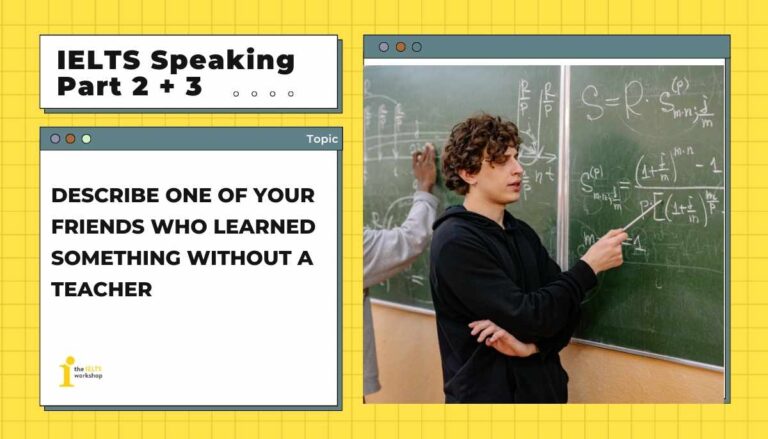
Trong bài giải mẫu lần này, thầy Tuấn Khang của The IELTS Workshop sẽ hướng dẫn bạn trả lời topic “Describe one of your friends who learned something without a teacher” trong IELTS Speaking Part 2. Cùng tham khảo sample, từ vựng và một vài cách diễn đạt ghi điểm trong phần thi IELTS Speaking nhé.
Part 2: Describe one of your friends who learned something without a teacher
Đề bài: Describe one of your friends who learned something without a teacher
You should say:
- Who he/she is
- What he/she learned
- Why he/she learned this
- And explain whether it would be easier to learn from a teacher
1. Bài mẫu (Sample)
I have a close friend named Duc, a wonderful fellow, he has a good job, great sense of humour, and a knack for planning hangouts. But despite all that, he didn’t have a single musical bone in his body.
He took up the guitar about a year ago. The reason behind this was simple; he received a nice acoustic guitar from his father as a gift, and instead of letting it sit in the corner as a decorative piece, he mustered the resolve to learn how to play. Since he was a busy university student at the time, he couldn’t commit to a fixed schedule with a private tutor, so he decided to take the reins himself.
He started by learning basic chords through a mobile app called MusicTuna and eventually progressed to complex picking patterns by watching slow-motion tutorials online. I vividly remember the callouses on his fingertips and his initial frustration when he couldn’t get the strings to sound clear.
Whether it would have been easier with a teacher is an interesting question. In my opinion, undoubtedly yes, in terms of technique. A teacher would have corrected him immediately, preventing some of the bad habits he developed early on. Learning music theory, which is notoriously dense and dry, is also much more manageable when you have someone to explain the “why” and the “how.”
That being said, because he learned independently, his style is incredibly unique. He wasn’t confined by a rigid curriculum, which allowed him to jump straight into the songs he actually loved. This kept his motivation levels sky-high, whereas many students who take formal lessons often quit because the exercises feel like a chore.
Sample by Tuan Khang – IELTS Teacher at The IELTS Workshop
2. Từ vựng (Vocabulary)
- a knack for: khả năng bẩm sinh
- didn’t have a single musical bone in his body: không có năng khiếu âm nhạc
- take the reins: nắm quyền điều khiển
- rigid curriculum: giáo trình cứng nhắc
Part 3:
1. Is it necessary to keep learning after graduating from school?
I believe so. In fact, I might go as far as saying that it is mandatory for any living person to keep on improving themselves outside of formal education. While classes in schools provide the basics upon one’s work skills, some jobs have their own niche that can not be learned in a standardized environment, but rather in the actual work itself. So yes, I think it is necessary to keep learning.
- formal education – giáo dục chính quy
- Niche – ngách, kỹ năng đặc thù
- standardized environment – môi trường tiêu chuẩn
2. Should teachers make learning in their classes fun?
In my view, it’s paramount for educators to integrate the so-called ‘fun’ elements into the curriculum. When students are engaged and entertained, their affective filter is lowered, making them more receptive to absorbing complex information. However, there’s a fine line to tread; the ‘fun’ shouldn’t overshadow the academic objectives. A teacher’s role is to act as a facilitator who balances stimulation with substance, ensuring that learning goals are met while maintaining a high level of student motivation.
- Paramount – quan trọng hàng đầu
- Receptive – dễ tiếp thu
- Overshadow – Che khuất
- Facilitator – Người điều phối
3. Do you think there are too many subjects for students to learn?
This is quite the dilemma. On one hand, the modern world is increasingly demanding, requiring a broad knowledge base. On the other, many argue that the current curriculum is overburdened, leading to cognitive overload for young learners. If students are juggling a dozen different subjects, they may only achieve a superficial understanding of each. I believe the quantity of subjects isn’t the problem as much as the depth of the delivery; we should perhaps prioritize quality of thought over a mere checklist of topics.
- Dilemma – nghịch lý
- Overburdened – Quá tải
- superficial understanding – hiểu biết bề nổi
4. Is it better to focus on a few subjects or to learn many subjects?
Both approaches have their merits, but it largely depends on the stage of education. For younger students, a multidisciplinary approach is essential to help them discover their interests and develop a well-rounded worldview. However, as one progresses to tertiary education, specialization becomes vital. In today’s competitive job market, being a ‘jack of all trades, master of none’ can be a disadvantage. To excel at a high level, one generally needs to narrow their focus and cultivate expertise in a specific niche.
- a multidisciplinary approach – Một phương pháp tiếp cận đa chiều
- tertiary education – giáo dục bậc đại học
5. Do you think enterprises should provide training for their employees?
Absolutely. In the fast-paced corporate landscape, skills become obsolete quite rapidly. Enterprises that invest in ‘upskilling’ their workforce tend to see higher levels of employee retention and productivity. From a strategic standpoint, it’s a win-win: the staff feel valued and improve their professional efficacy, while the company stays ahead of the curve by fostering a culture of continuous improvement.
- Obsolete – Lỗi thời
- professional efficacy – hiệu quả chuyên nghiệp
6. Do you think it is good for older adults to continue learning?
Without a doubt. As I’ve said before, it is mandatory for any living person to keep on improving themselves. Engaging in new intellectual challenges, such as learning a language or a digital skill, has been shown to stave off cognitive decline in elderly people. Furthermore, in an age where technology evolves at breakneck speed, staying educated allows older generations to remain integrated into society and maintain a sense of autonomy and purpose.
- breakneck speed – tốc độ chóng mặt
Tạm kết
Hy vọng bài mẫu trên đã giúp bạn hình dung rõ cách triển khai ý tưởng và sử dụng ngôn ngữ phù hợp khi gặp chủ đề Describe one of your friends who learned something without a teacher trong IELTS Speaking Part 2 & 3. Tham khảo các nguồn tài liệu hữu ích như KHO BÀI MẪU IELTS SPEAKING và Bộ đề dự đoán IELTS Speaking cập nhật mới nhất.
HỌC IELTS MIỄN PHÍ – lớp học độc quyền chỉ có trên website của The IELTS Workshop. Đăng ký để bắt đầu lộ trình học bài bản cùng thầy cô tại TIW ngay nhé!