Trong chuyên mục Giải đề IELTS Writing Task 2 tuần này, cô Khánh Huyền – giáo viên tại The IELTS Workshop sẽ cùng bạn khám phá chủ đề The tendency of human being to copy one another nhé!
1. Phân tích đề bài
1.1. Đề bài
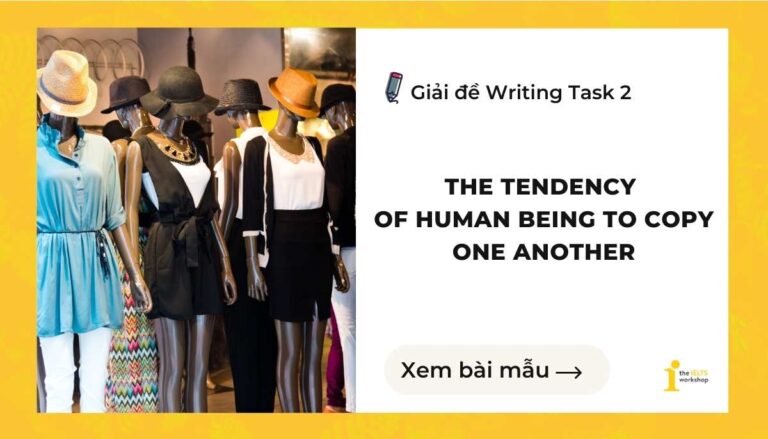
The tendency of human being to copy one another is shown in the popularity of fashion clothes and consumer goods. To what extent do you agree?
(Xu hướng con người bắt chước lẫn nhau được thể hiện rõ qua sự phổ biến của thời trang và các sản phẩm tiêu dùng. Bạn đồng ý với nhận định này ở mức độ nào?)
1.2. Phân tích đề bài
Dạng bài: Opinion essay
Từ khóa:
- Tendency to copy
- Fashion clothes
- consumer goods
Phân tích yêu cầu đề bài:
Với đề bài này, chúng ta cần làm rõ quan điểm đồng ý hoặc không đồng ý với nhận định được đưa ra, kèm theo đó là các phân tích, ví dụ để chứng minh.
Xem thêm: Cách viết dạng bài Opinion essay trong IELTS Writing Task 2
1.3. Dàn bài chi tiết
Introduction
- Provide the readers with context:
mimicking is not unusual among social animals
- State personal viewpoint:
human have the same predilection, amplified by technology
Body paragraph
- Argument 1: The propensity to imitation is most clearly demonstrated through fashion
- Exemplify: fedora & bandage mini dress
- Argue: imitation in fashion is deep rooted
- Explain: human’s desire to belong
- Extend: imitation in other aspects of life
- Argument 2: The internet allows amplified imitation through insights
- Explain: social media means interconnectedness
- Exemplify: international fashion houses and trends
- Refer: Friedman’s “The World is Flat”
- Argument 3: Industrialization allows amplified imitation by giving limited choices
- Impact: mass production at low cost
- Exemplify: synthetic fibers
- Extend: corporates give consumers fewer choices for their own benefits
Conclusion
- Restate your opinion: imitation is invaluable but risky
- Call to action:
- Learn marketing tactics,
- Practice cultural and critical thinking
2. Bài mẫu
From an evolutionary perspective, imitation is a valuable cognitive feature, allowing an individual to acclimate themselves to their environment and community. This has been repeatedly observed among social animals, especially primates, so it is not a surprise that humans demonstrate the same behavior. However, since the arrival of industrialization and the advent of high-speed internet, this particular trait has been amplified, manifested most clearly in fashion and other goods.
The propensity to imitation is undoubtedly most seen in the way people dress. One could easily recall the time when Western men were adorned with fedoras during the Mad Men era, just how the bandage mini dress used to be the latest must-have items among young women in the 2010s. One might criticize fad participation as mere conformity or even vanity, but I would argue that it is a deeply rooted behavior. Humans wish to belong to a certain clique, signifying this fact through visual cues, i.e. traditional attires. Beliefs, cuisines, dialects, and many more fall into the same sphere.
Technology, however, has taken this predilection to another level. The internet along with social medias, such as Instagram and TikTok, has made it much easier for fashionistas in New York to dress in the same style as Korean It-girls than it was for English noble women to imitate Parisian ladies in waiting. As Friedman has succinctly pointed out in his book, “The World is Flat”, global citizens can download and upload their culture to an unabridged and unrestricted space, steamrolling their lifestyles along the way.
Granted, industrialization has also contributed to this rather monotonous consumerism world. For the very first time in human history, textiles could be produced in masses and for the masses, and at a reasonable price too. Synthetic fibers such as rayon and tencel have dethroned cotton and silk as the preferred choice of manufacturers, helping them churn out seasonal and eventually monthly collection. Corporations’ lowering-cost and increasing-revenue approach is the culprit behind the repetitive options available to consumers. Too afraid to venture out of the guaranteed profit margins, they have marginalized themselves to the selective silver and charcoal for household appliances, or the trendy matcha flavor for their confectionery. As a result, shoppers now experience an illusion of choice, selecting from a range of seemingly abundant but actually similar products.
I firmly believe that imitation is undoubtedly an invaluable ability, but when generalizing indiscriminately, consumers often make poor decisions. Global citizens should familiarize themselves with phrases like appeals (authority appeals), bandwagon, and many other marketing jargon to navigate through contemporary life. At the same time, one must have the mindset of cultural sensitivity as well as critical thinking, otherwise risking individualism.
Sample by Khanh Huyen– IELTS Teacher at The IELTS Workshop
3. Vocabulary
- acclimate: thích nghi
- adorned with: được trang trí bằng
- advent: sự xuất hiện
- amplified: được khuếch đại
- appeals (authority appeals): sự kêu gọi (dựa vào quyền lực)
- bandwagon: xu hướng mà nhiều người chạy theo
- clique: nhóm nhỏ khép kín
- consumerism: chủ nghĩa tiêu dùng
- corporations: tập đoàn
- critical thinking: tư duy phản biện
- culprit: thủ phạm
- dethroned: lật đổ vị trí
- dialects: phương ngữ
- fad participation: việc chạy theo mốt
- illusion of choice: ảo tưởng về sự lựa chọn
- indiscriminately: một cách bừa bãi
- Mad Men era: thời kỳ Mad Men (liên quan đến phim và phong cách thập niên 1960)
- marginalized: thu hẹp phạm vi hoạt động
- monotonous: đơn điệu
- predilection: sự ưa thích đặc biệt
- propensity: xu hướng, khuynh hướng
- steamrolling: áp đảo, làm biến đổi mạnh mẽ
- succinctly: một cách ngắn gọn, súc tích
- synthetic fibers: sợi tổng hợp
- textiles: hàng dệt may
- vanity: sự phù phiếm
Xem thêm: Cách học từ vựng IELTS hiệu quả từ thầy Đặng Trần Tùng 9.0
Tạm kết
Mong rằng bài viết mẫu trên đã mang đến cho bạn một góc nhìn toàn diện và cách triển khai mạch lạc cho dạng bài Opinion trong IELTS Writing Task 2 với chủ đề The tendency of human being to copy one another.
Đừng quên theo dõi chuyên mục [Cập nhật liên tục] Tổng hợp đề thi IELTS Writing 2025 kèm bài mẫu và Bài mẫu Writing Task 2 để củng cố thêm kiến thức và kỹ năng xử lý dạng bài này
Đăng ký ngay HỌC IELTS MIỄN PHÍ tại Website của The IELTS Workshop để luyện tập cùng các giáo viên giàu kinh nghiệm và nhận được hướng dẫn cụ thể hơn nhé!