Trong bài viết sau, cô Lê Phương Anh sẽ hướng dẫn bạn cách làm bài Writing Task 1 chủ đề The types of communication training taken by employees. Bài viết sẽ giúp bạn triển khai ý tưởng một cách chặt chẽ, khoa học và logic hơn.
1. Phân tích và hướng dẫn
1.1. Đề bài
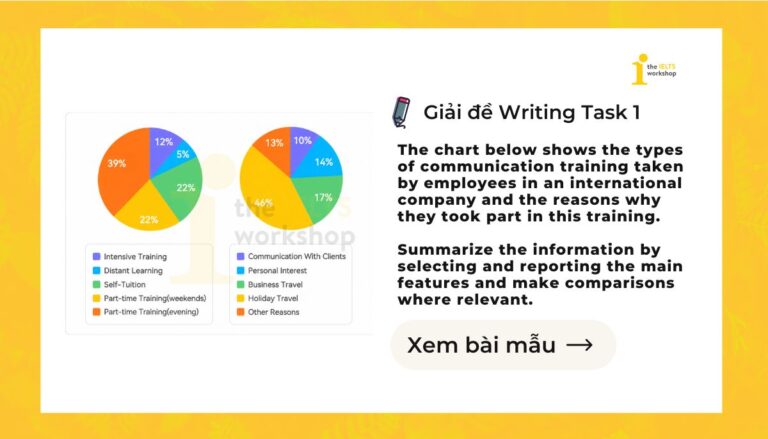
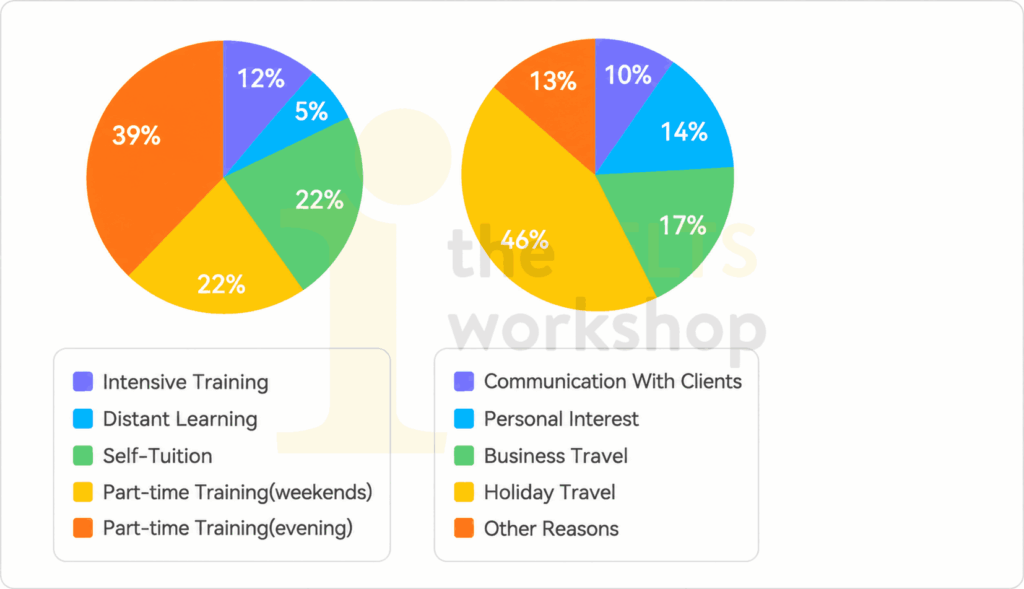
The chart below shows the types of communication training taken by employees in an international company and the reasons why they took part in this training. Summarize the information by selecting and reporting the main features and make comparisons where relevant.
(Biểu đồ dưới đây cho thấy các loại hình đào tạo về kỹ năng giao tiếp mà nhân viên trong một công ty quốc tế đã tham gia, cùng với những lý do khiến họ tham gia các khóa đào tạo này. Hãy tóm tắt thông tin bằng cách lựa chọn và trình bày những đặc điểm nổi bật, đồng thời đưa ra các so sánh liên quan.)
1.2. Phân tích đề bài
Dạng bài: Pie Charts
Từ khóa chính
- communication training: khóa đào tạo kỹ năng giao tiếp
- types of training: các hình thức đào tạo
- reasons for participation: lý do tham gia
- employees: nhân viên
- international company: công ty quốc tế
Từ đồng nghĩa
- Communication training = communication courses = communication programmes
- Distance learning = online learning = remote learning = e-learning
- Self-tuition = self-study = independent learning = autonomous learning
Phân tích yêu cầu đề bài
Đề bài yêu cầu:
- Mô tả hai biểu đồ tròn.
- So sánh các tỷ lệ.
- Chỉ lựa chọn những đặc điểm nổi bật.
Không được:
- Đưa ra ý kiến cá nhân.
- Giải thích tại sao nhân viên chọn những hình thức đó.
Xem thêm: Cách viết Writing Task 1 Pie Chart giúp bạn đạt điểm cao
1.3. Dàn bài chi tiết
Intro: Paraphrase đề bài.
Overview:
- Evening part-time training chiếm tỷ lệ cao nhất.
- Distance learning thấp nhất.
- Holiday travel là lý do phổ biến nhất.
- Communication with clients ít phổ biến nhất.
Body 1:
- Evening training: 39% (highest)
- Self-tuition: 22%
- Weekend training: 22%
- Intensive training: 12%
- Distance learning: 5% (lowest)
Body 2:
- Holiday travel: 46% (highest)
- Business travel: 17%
- Personal interest: 14%
- Other reasons: 13%
- Communication with clients: 10%
2. Bài mẫu
The charts illustrate the types of communication training undertaken by employees in an international company and the reasons why they participated in such training.
Overall, part-time training in the evening was the most popular form of communication training, whereas distance learning was the least preferred. Regarding the reasons for participation, holiday travel accounted for the largest proportion, while communication with clients represented the smallest share. In addition, the biggest difference can be seen between the most and least popular categories in both charts.
The proportion of employees attending part-time training in the evening was the highest, at 39%. This was followed by self-tuition and part-time training at weekends, with both figures standing at 22%. In contrast, intensive training was chosen by a much smaller percentage of employees, accounting for 12%, while distance learning was the least common method, at just 5%.
Regarding the reasons for taking part in communication training, holiday travel accounted for the largest proportion, at 46%, which far exceeded the figures for all other categories. Business travel and personal interest were considerably lower, at 17% and 14% respectively, while other reasons represented 13% of the total. Meanwhile, communication with clients accounted for only 10%, making it the least commonly cited reason for participating in the training.
Sample by Le Phuong Anh – IELTS Teacher at The IELTS Workshop
3. Từ vựng
- Communication training: đào tạo kỹ năng giao tiếp
- Intensive training: khóa đào tạo chuyên sâu
- Distance learning: học từ xa
- Self-tuition: tự học
- Part-time training: khóa học bán thời gian
- Weekend classes: lớp học cuối tuần
- Evening courses: khóa học buổi tối
- Communication with clients: giao tiếp với khách hàng
- Business travel: công tác
- Holiday travel: du lịch
- Personal interest: sở thích cá nhân
- Account for/ represent/ make up: chiếm
- Followed by: theo sau là
- Stand at: đạt mức
- Respectively: lần lượt
- An identical figure: cùng một tỷ lệ
- Far exceed: vượt xa
Tạm kết
Hy vọng rằng sau khi tham khảo bài mẫu chủ đề The distribution of employment among agriculture, services, industries trên, học viên sẽ hiểu rõ hơn cách triển khai và hoàn thiện một bài IELTS Writing Task 1 dạng Bar Chart một cách đầy đủ.
Tham khảo tài liệu: [Cập nhật liên tục] Tổng hợp đề thi IELTS Writing 2026 kèm bài mẫu và Bài mẫu Writing Task 1 trên website. Đây là nguồn tài liệu hữu ích để bạn luyện kỹ năng mô tả số liệu, rèn khả năng so sánh và nắm bắt xu hướng trong biểu đồ từ đó nâng cao hơn band điểm của mình.
Đừng quên tham khảo HỌC IELTS MIỄN PHÍ trên website để có cơ hội học trực tiếp cùng giảng viên giàu kinh nghiệm giảng dạy để nắm rõ các kĩ năng làm các dạng bài IELTS.