Bài viết sau, cô Vương Thị Việt Hoàn sẽ hướng dẫn bạn làm bài Writing Task 1 chủ đề Use of four different fuel types to generate electricity. Bài viết sẽ giúp bạn triển khai ý tưởng một cách chặt chẽ, khoa học và logic hơn.
1. Phân tích và hướng dẫn
1.1. Đề bài
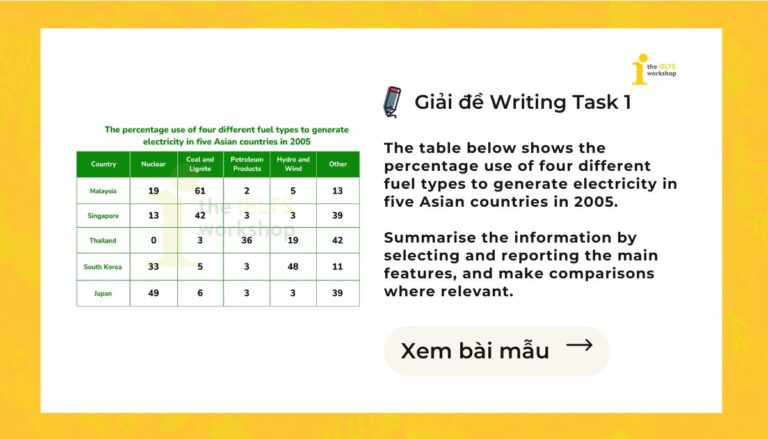
The table below shows the percentage use of four different fuel types to generate electricity in five Asian countries in 2005. Summarise the information by selecting and reporting the main features, and make comparisons where relevant.
(Bảng dưới đây cho thấy tỷ lệ sử dụng của bốn loại nhiên liệu khác nhau để sản xuất điện ở năm quốc gia châu Á vào năm 2005. Hãy tóm tắt thông tin bằng cách lựa chọn và trình bày những đặc điểm chính, đồng thời đưa ra những so sánh khi thích hợp.)
1.2. Phân tích đề bài
Dạng bài: Table
Từ đồng nghĩa:
- Fuel types: types of fuel / energy sources
- Generate electricity: produce electricity / generate electrical power
- Percentage use: proportion / percentage / share
- Coal and lignite: coal-based fuel / coal and lignite
- Petroleum products: petroleum-based fuels / petroleum
- Hydro and wind: renewable energy sources
- Other: other energy sources / unspecified sources
- Electricity generation: electricity production / power generation
Xem thêm: Hướng dẫn cách viết IELTS Writing Task 1 Table dễ đạt điểm cao
1.3. Dàn bài chi tiết
Intro: Paraphrase đề bài.
The table illustrates the proportions of five different energy sources used to generate electricity in five Asian countries in 2005.
Overview:
Ở bài này không có timeline, nên không dùng các từ kiểu increase, decrease, rise, fall. Thay vào đó, overview nên tập trung vào highest – lowest – dominant patterns – contrasts giữa các quốc gia.
Main features:
- Malaysia và Singapore phụ thuộc nhiều vào coal and lignite, lần lượt 61% và 42%.
- Japan và South Korea nổi bật với nuclear / hydro and wind, trong đó Japan có tỷ lệ nuclear cao nhất (49%) và South Korea có tỷ lệ hydro and wind cao nhất (48%).
- Thailand có cơ cấu khác biệt, với Other (42%) và petroleum products (36%) chiếm tỷ lệ lớn, trong khi không sử dụng nuclear power.
Body 1: Nuclear + Hydro and Wind
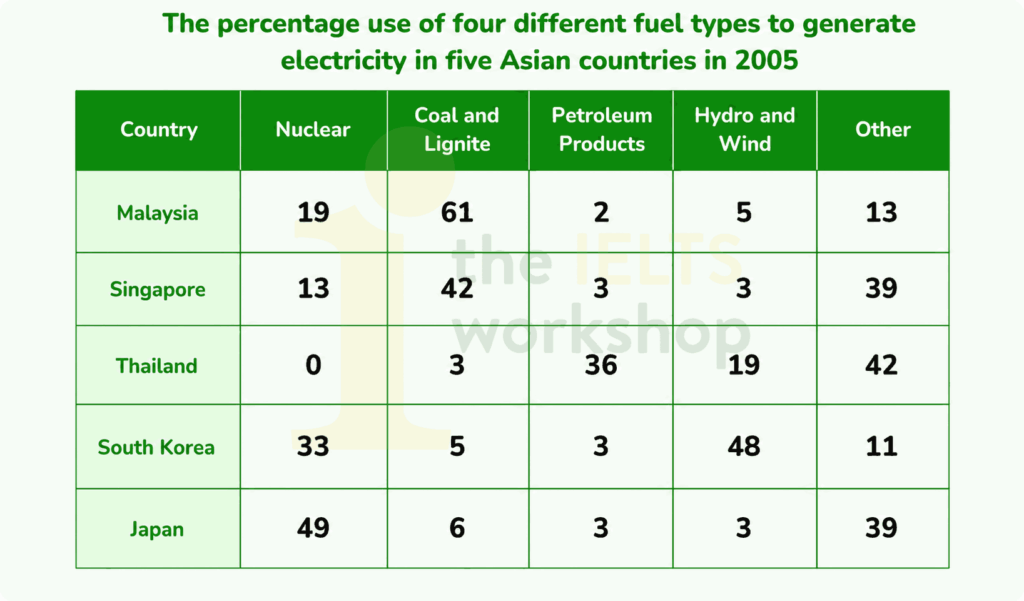
- Nuclear: Japan cao nhất (49%), tiếp đến South Korea (33%); Thailand = 0%.
- Hydro & Wind: South Korea cao nhất (48%), tiếp đến Thailand (19%); 3 nước còn lại ≤5%.
→ Japan thiên về nuclear, trong khi South Korea thiên về hydro & wind.
Body 2: Coal and Lignite + Petroleum Products + Other
- Coal & Lignite: Malaysia (61%) và Singapore (42%) cao nhất; các nước còn lại ≤6%.
- Petroleum: Thailand nổi bật (36%); các nước khác chỉ 2–3%.
- Other: Thailand cao nhất (42%), tiếp đến Singapore và Japan (39%); Malaysia và South Korea chỉ 11–13%.
2. Bài mẫu
The table illustrates the proportions of five different energy sources used to generate electricity in five Asian countries in 2005.
Overall, Malaysia and Singapore relied heavily on coal and lignite, whereas Japan and South Korea had much higher proportions of nuclear and hydro and wind power. Thailand stood out for its substantial use of petroleum products and other energy sources.
Regarding nuclear power, Japan recorded the highest proportion, at 49%, followed by South Korea at 33%. The figures were considerably lower in Malaysia and Singapore, at 19% and 13% respectively, while Thailand did not use nuclear power at all. In contrast, South Korea was the clear leader in hydro and wind power, with these sources accounting for 48% of its electricity generation. Thailand followed at 19%, whereas the corresponding figures for Malaysia, Singapore and Japan were 5% or less. Notably, Japan relied more heavily on nuclear power, while South Korea had a particularly high proportion of hydro and wind energy.
As for conventional fossil fuels, coal and lignite were predominant in Malaysia and Singapore, accounting for 61% and 42% respectively. By comparison, the remaining three countries used considerably less of these sources, at no more than 6%. Petroleum products featured prominently only in Thailand, at 36%, compared with just 2-3% elsewhere. Finally, other energy sources were most prevalent in Thailand, at 42%, closely followed by Singapore and Japan, both at 39%. In contrast, these sources accounted for only 13% in Malaysia and 11% in South Korea.
Sample by Vuong Thi Viet Hoan – IELTS Teacher at The IELTS Workshop
3. Từ vựng
- Rely heavily on: phụ thuộc nhiều vào
- Be predominant in: chiếm ưu thế ở
- Account for: chiếm / đóng góp
- The corresponding figure: con số tương ứng
- The clear leader: quốc gia đứng đầu rõ rệt
- Feature prominently: chiếm tỷ trọng đáng kể
- At no more than: không quá
- At 5% or below: ở mức 5% hoặc thấp hơn
- Substantial use of: mức sử dụng đáng kể
- Be considerably lower: thấp hơn đáng kể
- Conventional fossil fuels: nhiên liệu hóa thạch truyền thống
- The remaining countries: các quốc gia còn lại
- Stand out for: nổi bật bởi
- The predominant source: nguồn chiếm ưu thế
Tạm kết
Hy vọng bài mẫu chủ đề Use of four different fuel types to generate electricity trên sẽ giúp học viên hiểu rõ hơn cách triển khai và hoàn thiện một bài IELTS Writing Task 1 dạng Table một cách đầy đủ. Đừng quên ghi chú lại những kiến thức quan trọng để từng bước nâng cao kỹ năng viết tiếng Anh của mình nhé.
Tham khảo tài liệu: [Cập nhật liên tục] Tổng hợp đề thi IELTS Writing 2026 kèm bài mẫu và Bài mẫu Writing Task 1 trên website. Đây là nguồn tài liệu hữu ích để bạn luyện kỹ năng mô tả số liệu, rèn khả năng so sánh và nắm bắt xu hướng trong biểu đồ từ đó nâng cao hơn band điểm của mình.
Đừng quên tham khảo thêm HỌC IELTS MIỄN PHÍ trên website để có cơ hội học trực tiếp cùng giảng viên 8.0+ và nắm rõ các kĩ năng làm các dạng bài IELTS.