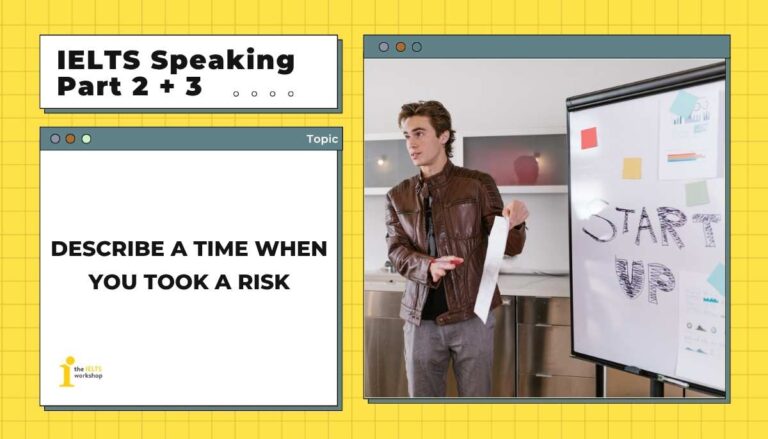
Trong bài giải mẫu lần này, thầy Lưu Trọng Đạt của The IELTS Workshop sẽ hướng dẫn bạn trả lời topic Describe a time when you took a risk and you knew something bad might happen, but it had a positive result trong IELTS Speaking Part 2. Cùng tham khảo sample, từ vựng và một vài cách diễn đạt ghi điểm trong phần thi IELTS Speaking nhé.
Part 2: Describe a time when you took a risk
Đề bài: Describe a time when you took a risk and you knew something bad might happen, but it had a positive result
You should say:
- What risk you took
- What bad thing you thought might happen
- Why you decided to take this risk
- And explain why the result of taking this risk was positive.
1. Bài mẫu (Sample)
One of the biggest risks I have ever taken was launching my own edtech startup focused on IELTS writing instead of continuing with a stable job at a language center.
At that time, I had a relatively secure position with a steady income and a clear career path. However, I felt that I had reached a plateau in terms of professional growth. The risk I took was investing both my time and savings into building a digital learning platform without any guaranteed income stream, which was extremely nerve-wracking.
The worst-case scenario I had in mind was severe financial instability. I was concerned that my product might not gain traction, that I would fail to attract enough users, and that the entire project would collapse, forcing me to go back to traditional teaching. There was also a significant amount of social pressure, as people around me believed that starting a business in such a competitive market was too risky.
Despite all these concerns, I decided to take the leap because I prioritized long-term growth over short-term security. I wanted to have full autonomy over my teaching methods and create a system that could genuinely help students improve in a structured way. More importantly, I aimed to build a recognizable personal brand in the IELTS education space.
Fortunately, the outcome turned out to be highly rewarding. My platform gradually gained users, and I was able to refine my materials based on real student feedback. Over time, I not only achieved a more sustainable income but also experienced a strong sense of fulfillment, as I could see the tangible impact of my work on learners’ progress.
Looking back, this decision was a major turning point in my career. It forced me to step out of my comfort zone and opened up opportunities that I would never have encountered if I had stayed in a conventional role.
Sample by Luu Trong Dat – IELTS Teacher at The IELTS Workshop
2. Từ vựng (Vocabulary)
- edtech startup: công ty khởi nghiệp giáo dục công nghệ
- stable job/steady income: công việc ổn định/thu nhập ổn định
- plateau: chững lại trong phát triển
- guaranteed income stream: nguồn thu nhập đảm bảo
- nerve-wracking: gây căng thẳng, áp lực
- financial instability: bất ổn tài chính
- social pressure: áp lực xã hội
- take the leap: dám mạo hiểm
- long-term growth over short-term security: ưu tiên phát triển dài hạn
- autonomy: sự tự chủ
- personal brand: thương hiệu cá nhân
- sense of fulfillment: cảm giác thỏa mãn
- turning point: bước ngoặt
- step out of one’s comfort zone: bước ra khỏi vùng an toàn
Part 3:
1. What risks do parents often tell their children to avoid?
Parents typically warn their children against risks that could have long-term consequences, particularly those related to safety, education, and social behavior.
For instance, they often discourage reckless behavior such as dangerous driving or engaging in extreme activities without proper precautions, as these can lead to serious injuries. In addition, many parents emphasize avoiding bad influences, especially peers involved in delinquency or harmful habits like substance abuse.
Another major concern is academic risk. Parents usually advise their children not to make decisions that could jeopardize their future, such as neglecting their studies or choosing unstable career paths too early. Overall, these warnings are rooted in a desire to prevent irreversible mistakes and ensure long-term stability.
- long-term consequences: hậu quả dài hạn
- reckless behavior: hành vi liều lĩnh
- bad influences: ảnh hưởng tiêu cực
- delinquency: hành vi lệch chuẩn/phạm pháp (của người trẻ)
- jeopardize: gây nguy hại
- irreversible mistakes: sai lầm không thể sửa
2. Should teachers read to children about danger in stories to avoid danger in real life?
Yes, I strongly believe that storytelling is a highly effective tool for raising risk awareness among children.
Stories create a safe and engaging environment where children can explore dangerous situations without facing real-world consequences. Through these narratives, they can better understand cause-and-effect relationships, which helps them anticipate the outcomes of their actions.
However, it is essential that such stories are age-appropriate and not overly alarming. If presented carefully, they can encourage critical thinking and help children develop a more calculated approach to decision-making, rather than acting impulsively.
- risk awareness: nhận thức về rủi ro
- cause-and-effect relationships: quan hệ nhân quả
- age-appropriate: phù hợp độ tuổi
- critical thinking: tư duy phản biện
- calculated approach / decision-making: tiếp cận / quyết định có tính toán
3. Why do older people take fewer risks than younger people?
There are several reasons why older individuals tend to be more risk-averse.
Firstly, they often carry greater responsibilities, such as financial obligations or family commitments, which makes them less willing to engage in uncertain ventures. This is especially true when stability becomes a priority over experimentation.
Secondly, their accumulated life experience leads to more calculated decision-making. Having encountered both successes and failures, they are more aware of potential downsides and therefore less inclined to take unnecessary risks.
In contrast, younger people generally have a higher tolerance for uncertainty and are more open to trying new things. Since they are at an earlier life stage, they can afford to take risks, which often leads to valuable learning experiences and personal growth.
- risk-averse: ngại rủi ro
- tolerance for uncertainty: khả năng chấp nhận sự không chắc chắn
- life stage: giai đoạn cuộc đời
Tạm kết
Hy vọng bài mẫu trên đã giúp bạn hình dung rõ cách triển khai ý tưởng và sử dụng ngôn ngữ phù hợp khi gặp chủ đề Describe a time when you took a risk and you knew something bad might happen, but it had a positive result trong IELTS Speaking Part 2 & 3. Tham khảo các nguồn tài liệu hữu ích như KHO BÀI MẪU IELTS SPEAKING và Bộ đề dự đoán IELTS Speaking cập nhật mới nhất.
HỌC IELTS MIỄN PHÍ – lớp học độc quyền chỉ có trên website của The IELTS Workshop. Đăng ký để bắt đầu lộ trình học bài bản cùng thầy cô tại TIW ngay nhé!