Trong bài giải mẫu lần này, cô Kiều Linh của The IELTS Workshop sẽ hướng dẫn bạn trả lời topic Describe a time when you read or heard something that you thought was not true. Cùng tham khảo sample, từ vựng và một vài cách diễn đạt ghi điểm trong phần thi IELTS Speaking nhé.
Part 2: Describe a time when you read or heard something that you thought was not true
Đề bài: Describe a time when you read or heard something that you thought was not true
You should say:
- where you read/heard this
- what you read/heard
- why you thought it was not true
- and explain how you felt about reading/hearing this thing that you thought was not true.
1. Bài mẫu (Sample)
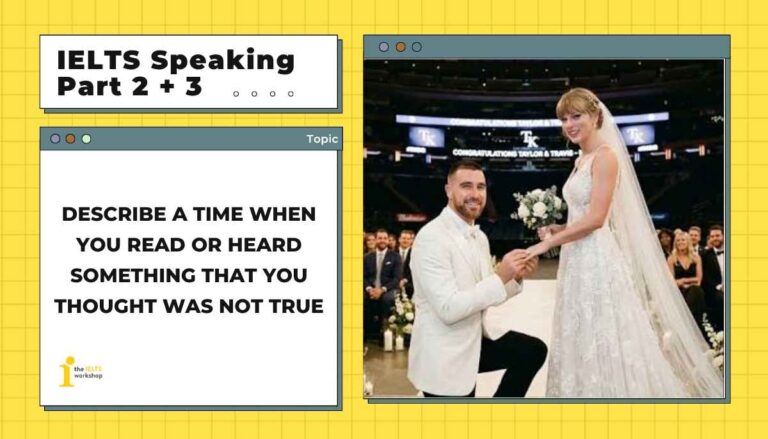
What immediately springs to mind is this absolutely wild rumour about Taylor Swift that I stumbled across while scrolling through my TikTok For You Page. It claimed that she was trying to buy another bride’s wedding date at a luxury venue in Rhode Island.
Apparently, Taylor and her fiance – Travis Kelce – wanted to get married at the Ocean House, but another couple had already booked the date they wanted. Gossipmongers and tabloids started spreading that Taylor had offered the bride a fortune to give up her slot so she could have the venue instead.
When I first saw it, I thought, “Yeah, I’m not buying that.” I mean, Taylor obviously has money to burn being a billionaire, but the story just didn’t add up to me. I’m a huge Swiftie and have followed her career for years, so even though I don’t know her personally, offering a stranger money to move her wedding just seemed completely out of character for her. And without any credible insider actually backing up the story, I was even more skeptical.
That said, curiosity got the better of me, so I went down a bit of a rabbit hole. After doing some digging, I found that the venue had denied the claim. So, as far as I could tell, the whole thing had been blown out of proportion online.
More than anything, I found it hilarious that so many people online were guillable enough to think there might be some truth to what was essentially Internet idle gossip. It really brought home to me how quickly rumours can take on a life of their own and anything can be treated as fact nowadays once enough people repeat it. So whenever I see some crazy celebrity story online, I always take it with a grain of salt.
Sample by Kieu Linh– IELTS Teacher at The IELTS Workshop
2. Từ vựng (Vocabulary)
- wild rumour (n phr): một tin đồn cực kỳ khó tin / gây sốc
- gossipmongers (n): những người chuyên lan truyền chuyện đồn thổi
- tabloids (n): báo lá cải
- I’m not buying that (idiom): tôi không tin chuyện đó
- not add up (idiom): nghe không hợp lý / có điều gì đó đáng ngờ
- a credible insider (n phr): nguồn tin nội bộ đáng tin cậy
- back up (phr v): đưa ra bằng chứng xác thực
- skeptical (adj): hoài nghi, không dễ dàng tin vào điều gì
- curiosity gets the better of someone (idiom): quá tò mò đến mức phải tìm hiểu
- go down a rabbit hole (idiom): bị cuốn vào việc tìm hiểu sâu một chủ đề
- do some digging (idiom): tìm hiểu/điều tra thêm
- deny the claim (v phr): bác bỏ một tuyên bố/tin đồn
- blow something out of proportion (idiom): thổi phồng một sự việc quá mức
- there might be some truth to something (phr): có thể một thông tin có phần nào là sự thật
- idle gossip (n phr): chuyện đồn thổi vô căn cứ / chuyện tầm phào
- bring something home to someone (idiom): khiến ai thực sự nhận ra hoặc thấm thía điều gì
- take on a life of one’s own (idiom): tự lan rộng và phát triển ngoài tầm kiểm soát
- take something with a grain of salt (idiom): nghe một thông tin với thái độ hoài nghi, không tin ngay
Part 3:
1. Do you think children are more honest than adults?
Generally, children tend to be more honest because they have less awareness of social expectations and the possible consequences of what they say. Young children, in particular, often express their thoughts directly, even when their comments might hurt someone’s feelings. Adults, by contrast, are usually more conscious of how their words affect others, so they may withhold certain information or tell white lies to avoid conflict or embarrassment. Therefore, I wouldn’t necessarily say adults are less honest, but rather their communication tends to be influenced by social considerations.
- social expectations (n phr): những kỳ vọng/chuẩn mực xã hội
- hurt someone’s feelings (v phr): làm tổn thương cảm xúc của ai
- withhold information (v phr): giữ lại/không tiết lộ thông tin
- white lies (n phr): những lời nói dối vô hại
- avoid conflict or embarrassment (v phr): tránh xung đột hoặc tình huống khó xử
- social considerations (n phr): những cân nhắc về mặt xã hội
2. Why do adults tell children it’s important to be honest?
I think the main reason is that honesty is a fundamental moral value that contributes to a child’s character development. Children who learn to tell the truth from an early age are more likely to develop a sense of responsibility for their actions. Honesty is also essential for building mutual trust. For example, parents need children to be truthful about problems they experience at school so that appropriate support can be provided. More broadly, teaching honesty prepares children to form healthy relationships and become responsible members of society as they grow older.
- fundamental moral value (n phr): giá trị đạo đức nền tảng
- character development (n phr): sự phát triển nhân cách
- develop a sense of responsibility (v phr): phát triển ý thức trách nhiệm
- build mutual trust (v phr): xây dựng lòng tin lẫn nhau
- form healthy relationships (v phr): xây dựng các mối quan hệ lành mạnh
- responsible members of society (n phr): những thành viên có trách nhiệm trong xã hội
3. Do you think there are sometimes good reasons for adults not to tell children the truth?
Yes, particularly when children are not emotionally mature enough to fully understand sensitive information. For example, if a family is experiencing serious financial difficulties or a relative is critically ill, parents may choose to limit the amount of information they share with a young child to avoid causing unnecessary anxiety. In such cases, adults are not necessarily trying to deceive children; they may simply present the truth in an age-appropriate manner. However, I think important information should not be deliberately concealed indefinitely, as this could undermine trust between children and adults. The key is to balance honesty with emotional protection, depending on the child’s age and level of maturity.
- emotionally mature (adj phr): trưởng thành về mặt cảm xúc
- sensitive information (n phr): thông tin nhạy cảm
- limit (v): giới hạn
- unnecessary anxiety (n phr): lo lắng không cần thiết
- age-appropriate manner (n phr): cách thức phù hợp với độ tuổi
- deliberately conceal (v phr): cố tình che giấu thông tin
- undermine trust (v phr): làm suy giảm lòng tin
- emotional protection (n phr): việc bảo vệ cảm xúc
Tạm kết
Hy vọng bài mẫu trên đã giúp bạn hình dung rõ cách triển khai ý tưởng và sử dụng ngôn ngữ phù hợp khi gặp chủ đề Describe a time when you read or heard something that you thought was not true trong IELTS Speaking Part 2 & 3. Tham khảo các nguồn tài liệu hữu ích như KHO BÀI MẪU IELTS SPEAKING và Bộ đề dự đoán IELTS Speaking cập nhật mới nhất.
HỌC IELTS MIỄN PHÍ – lớp học độc quyền chỉ có trên website của The IELTS Workshop. Đăng ký để bắt đầu lộ trình học bài bản cùng thầy cô tại TIW ngay nhé!