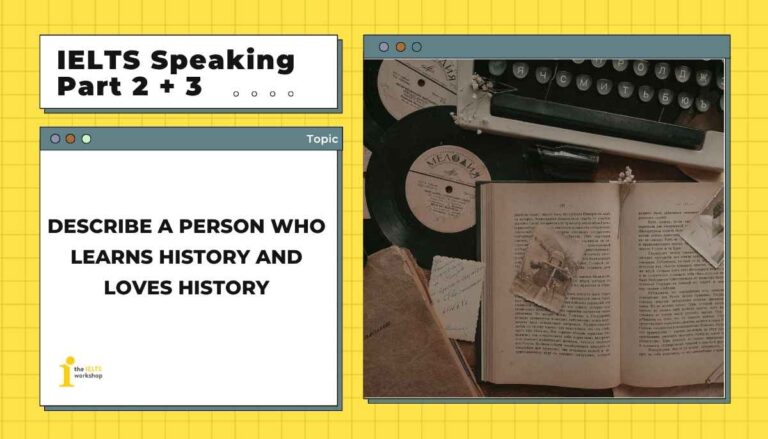
Trong bài giải mẫu lần này, giáo viên Minh Huyền của The IELTS Workshop sẽ hướng dẫn bạn trả lời topic Describe a person who learns history and loves history. Cùng tham khảo sample, từ vựng và một vài cách diễn đạt ghi điểm trong phần thi IELTS Speaking nhé.
Part 2: Describe a person who learns history and loves history
Đề bài: Describe a person who learns history and loves history.
You should say:
- Who this person is
- How he/she learns history
- Why he/she loves history
- And explain how you feel about him/her
1. Bài mẫu (Sample)
I’d like to talk about my grandfather, who is an absolute history buff. He is someone who not only learns about the past but lives and breathes it every single day.
Ever since I was young, I had always seen him surrounded by massive historical encyclopedias and biographies. He was a history teacher before he retired, so his passion for the subject runs incredibly deep. However, how he learns history is what makes him so unique. Instead of just reading dry textbooks, he tends to immerse himself in the past through various mediums. He watches historical documentaries every evening, visits local museums whenever there’s a new exhibition, and even travels to historical battlefields and ancient ruins across the country to see the sites with his own eyes.
The main reason he is so fascinated by history is that he firmly believes history is the greatest teacher. He often tells me that by understanding the triumphs and failures of our ancestors, we can avoid making the same mistakes in the present. To him, history is not just a collection of dates and dead people; it’s an ongoing story of human resilience and evolution.
Whenever we have a conversation, he always manages to connect a current global event to something that happened centuries ago. I have never met anyone who can make the past sound so incredibly thrilling and relevant.
Looking back at all the hours I’ve spent listening to him, I feel a profound sense of admiration and gratitude. Not only has his passion broadened my own knowledge, but his enthusiasm is also highly contagious. Even now, whenever I listen to his stories, I feel inspired to learn more about my own roots and the world around me.
Sample by Minh Huyen – IELTS Teacher at The IELTS Workshop
2. Từ vựng (Vocabulary)
- History buff: Người đam mê lịch sử
- Live and breathe something: Đam mê, sống hết mình vì điều gì đó
- Historical encyclopedias: Bách khoa toàn thư về lịch sử
- Run deep: (Cảm xúc, niềm đam mê) rất sâu sắc, mãnh liệt
- Immerse oneself in: Đắm chìm vào
- Historical documentaries: Phim tài liệu lịch sử
- Ancient ruins: Những tàn tích cổ đại
- Fascinated by: Bị lôi cuốn, hấp dẫn bởi
- Triumphs and failures: Những thành tựu và thất bại
- Resilience and evolution: Sự kiên cường và tiến hóa/phát triển
- Highly contagious: (Cảm xúc, sự nhiệt huyết) có tính lan tỏa cao
- Broaden one’s knowledge: Mở rộng kiến thức của ai đó
- Profound sense of admiration: Cảm giác ngưỡng mộ sâu sắc
- A sense of gratitude: Cảm giác biết ơn
- Thrilling and relevant: Hấp dẫn và có tính liên quan
Xem thêm: Tổng hợp 30+ chủ đề từ vựng IELTS thông dụng mà bạn cần biết
Part 3:
1. Do you think children should begin learning history from an early age?
Absolutely. I believe introducing history to children early on is crucial because it helps them build a strong sense of identity and cultural awareness. For one thing, learning about their ancestors and national heroes gives children a foundation of where they come from. Without this knowledge, they might feel disconnected from their own culture as they grow up. For example, schools could teach history through engaging storytelling or animated videos rather than memorizing dates, making it more digestible for young minds. Ultimately, I think early exposure to history helps children develop a deeper appreciation for their heritage and the society they live in.
- Crucial: Rất quan trọng, thiết yếu
- Sense of identity: Ý thức về bản sắc cá nhân
- Cultural awareness: Nhận thức về văn hóa
- Ancestors: Tổ tiên
- National heroes: Anh hùng dân tộc
- Feel disconnected from: Cảm thấy mất kết nối với
- Engaging storytelling: Kể chuyện lôi cuốn
- Digestible: Dễ tiếp thu, dễ hiểu
- Early exposure: Việc tiếp xúc từ sớm
- Appreciation for heritage: Sự trân trọng di sản
2. At what age do you think people should begin to learn history?
I think the ideal age to start formal history education is around primary school, specifically when children are 6 or 7 years old. At this stage, their cognitive abilities are developed enough to grasp simple narratives and the concept of time passing. It is the perfect window to introduce historical figures or myths without overwhelming them with complex political concepts. For instance, a 7-year-old might not understand the economic causes of a war, but they can easily understand a story about a brave king who defended his country. By starting at this age, educators can spark a natural curiosity about the past that will benefit their academic journey later on.
- Formal history education: Giáo dục lịch sử chính quy
- Cognitive abilities: Khả năng nhận thức
- Grasp simple narratives: Hiểu được những câu chuyện đơn giản
- Overwhelm someone with: Làm ai đó bị ngợp bởi
- Complex political concepts: Các khái niệm chính trị phức tạp
- Spark a natural curiosity: Khơi dậy sự tò mò tự nhiên
- Academic journey: Hành trình học thuật
3. How do children learn history before they attend school?
Before starting formal education, children primarily learn about the past through their families and the media they consume. Parents and grandparents often pass down knowledge by telling bedtime stories, sharing folk tales, or explaining the significance of traditional festivals. These everyday interactions act as their first history lessons. For example, during the Lunar New Year in Vietnam, children learn about the origins of traditional foods like Banh Chung through legends told by their parents. Additionally, educational cartoons or visits to historical monuments during family trips also play a big part. In this way, history is absorbed naturally and enjoyably before children even step foot in a classroom.
- Primarily: Chủ yếu
- Consume media: Tiếp thụ các phương tiện truyền thông
- Pass down knowledge: Truyền lại kiến thức
- Folk tales: Truyện dân gian
- Traditional festivals: Lễ hội truyền thống
- Everyday interactions: Tương tác hằng ngày
- Origins: Nguồn gốc
- Historical monuments: Di tích lịch sử
- Step foot in a classroom: Đặt chân vào lớp học
4. Is it important to learn how people in the past lived their lives?
Yes, I believe it is incredibly important to study the daily lives of people in the past, rather than just focusing on wars and rulers. Understanding how ordinary people lived—what they ate, how they worked, and what they believed—gives us a much more complete and realistic picture of human evolution. It helps us appreciate the conveniences we have today. For instance, learning about the harsh living conditions or lack of medical care in the Middle Ages makes modern generations realize the value of modern healthcare and technology. Therefore, studying daily historical life builds empathy and provides a richer context for the social progress we currently enjoy.
- Ordinary people: Những người bình thường
- Realistic picture: Bức tranh chân thực
- Human evolution: Sự tiến hóa/phát triển của con người
- Conveniences: Những tiện nghi
- Harsh living conditions: Điều kiện sống khắc nghiệt
- Middle Ages: Thời kỳ Trung cổ
- Build empathy: Xây dựng sự thấu cảm
- Social progress: Sự tiến bộ xã hội
5. Do you think people should learn ancient history before learning modern history?
I think there should be a balance, but starting with ancient history generally makes the most logical sense. Teaching history in chronological order allows learners to see the cause-and-effect relationships that shaped human civilization. You cannot fully understand the modern world without knowing the foundational empires, philosophies, and inventions that came before it. For example, modern democratic systems are heavily influenced by the political structures of ancient Greece and Rome. Without studying those ancient societies first, modern democracy might lack context. That said, teachers should frequently draw connections between ancient events and modern issues to keep the subject relevant and engaging for students.
- Chronological order: Trình tự thời gian
- Cause-and-effect relationships: Mối quan hệ nguyên nhân – kết quả
- Human civilization: Nền văn minh nhân loại
- Foundational empires: Những đế chế nền tảng
- Democratic systems: Các hệ thống dân chủ
- Political structures: Các cấu trúc/thể chế chính trị
- Lack context: Thiếu bối cảnh
- Draw connections: Rút ra những mối liên hệ
6. Besides big historical events, what else is important when learning history?
Apart from major events like wars and revolutions, I think the evolution of art, culture, and technology are equally crucial aspects of history. These elements reflect the true spirit and intellect of a society at a given time. While big events tell us who won or lost a territory, art and technological progress tell us how human thought and creativity developed. For instance, studying the Renaissance period isn’t just about political shifts; it’s heavily focused on the explosion of painting, literature, and scientific discoveries that completely changed human perspective. Ultimately, looking beyond just dates and battles ensures a more well-rounded and holistic understanding of our past.
- Revolutions: Các cuộc cách mạng
- True spirit and intellect: Tinh thần và trí tuệ đích thực
- Technological progress: Sự tiến bộ về công nghệ
- Renaissance period: Thời kỳ Phục hưng
- Political shifts: Những sự thay đổi về chính trị
- Scientific discoveries: Những khám phá khoa học
- Human perspective: Góc nhìn/nhận thức của con người
- Well-rounded and holistic understanding: Sự hiểu biết toàn diện và đầy đủ
Tạm kết
Hy vọng bài mẫu trên đã giúp bạn hình dung rõ cách triển khai ý tưởng và sử dụng ngôn ngữ phù hợp khi gặp chủ đề Describe a person who learns history and loves history trong IELTS Speaking Part 2 & 3. Tham khảo các nguồn tài liệu hữu ích như KHO BÀI MẪU IELTS SPEAKING và Bộ đề dự đoán IELTS Speaking cập nhật mới nhất.
HỌC IELTS MIỄN PHÍ – lớp học độc quyền chỉ có trên website của The IELTS Workshop. Đăng ký để bắt đầu lộ trình học bài bản cùng thầy cô tại TIW ngay nhé!