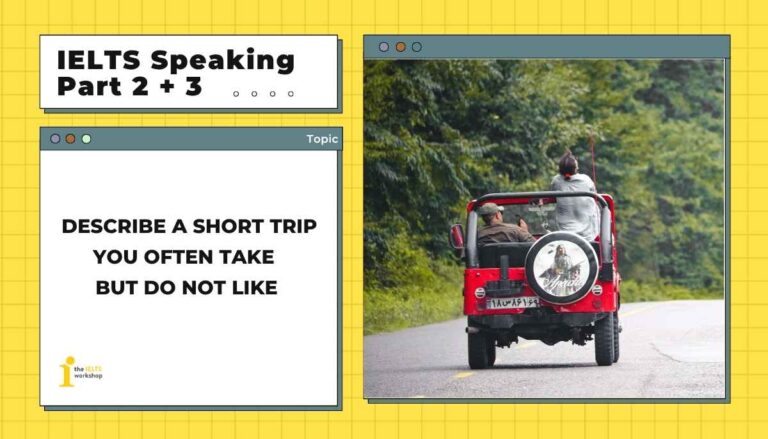
Trong bài giải mẫu lần này, giáo viên Hồng Linh của The IELTS Workshop sẽ hướng dẫn bạn trả lời topic Describe a short trip you often take but do not like. Cùng tham khảo sample, từ vựng và một vài cách diễn đạt ghi điểm trong phần thi IELTS Speaking nhé.
Part 2: Describe a short trip you often take but do not like
Đề bài: Describe a short trip you often take but do not like
You should say:
- Where you go
- When you go there
- Why you go there
- And explain why you do not like the trip
1. Bài mẫu (Sample)
I’d like to talk about my daily commute from home to my workplace. It’s not exactly a long journey, but somehow, it manages to ruin my mood before my day has even properly started!
I make this trip almost every weekday, usually in the morning and late afternoon. It takes me around 30 to 40 minutes by motorbike, although that can easily turn into an hour if the traffic is particularly bad. I normally leave home at around 7:30, which is probably the worst possible time because everyone seems to have the same idea of going somewhere at once!
The main reason I have to make this trip is work. Unfortunately, my workplace isn’t within walking distance, so I have no choice but to commute every day. I suppose it’s just part and parcel of having a job in a busy city.
What I dislike most about this journey is definitely the traffic congestion. During rush hour, the roads are absolutely packed, and sometimes I can spend ten minutes moving what feels like ten metres. At that point, I’m not even sure whether I’m commuting or participating in a motorbike parade! What’s worse is the constant honking. Some people seem to think that pressing their horns repeatedly will magically make the traffic disappear, which, obviously, never works.
On top of that, the heat, exhaust fumes and unpredictable weather make the whole experience even more unpleasant. If it rains, I get soaked; if it’s sunny, I feel like I’m being grilled. There’s apparently no winning!
Another thing that bothers me is that commuting takes away a considerable amount of my personal time. Instead of enjoying a peaceful morning or getting some extra sleep, I have to get up early and prepare myself for what feels like a daily survival challenge.
So, although this is technically just a short trip, I really can’t say I enjoy it. I guess it’s one of those necessary evils of living in a big city. If I could afford to live right next to my workplace, I’d do it in a heartbeat!
Sample by Hong Linh – IELTS Teacher at The IELTS Workshop
2. Từ vựng (Vocabulary)
- Daily commute (n): Việc đi lại hằng ngày (nhà – nơi làm việc).
- Ruin my mood (v): Làm hỏng tâm trạng của tôi.
- Part and parcel of (idiom): Một phần tất yếu của điều gì.
- Traffic congestion (n): Tình trạng ùn tắc giao thông.
- Rush hour (n): Giờ cao điểm.
- Packed (adj): Đông nghẹt, chật kín.
- Constant honking (n): Tiếng còi xe liên tục.
- Exhaust fumes (n): Khói thải từ phương tiện giao thông.
- Unpredictable weather (n): Thời tiết thất thường, khó dự đoán.
- Necessary evil (idiom): Điều không mong muốn nhưng buộc phải chấp nhận.
Xem thêm: Tổng hợp 30+ chủ đề từ vựng IELTS thông dụng mà bạn cần biết
Part 3:
1. Do Vietnamese people like travelling abroad?
Yes, I think travelling abroad has become increasingly popular among Vietnamese people, particularly those who can afford it. One reason is that international travel gives them an opportunity to broaden their horizons and experience different cultures, cuisines and lifestyles. For example, countries like Thailand, South Korea and Japan are popular destinations because they’re relatively accessible and offer plenty of attractions. Social media also plays a part, as people are constantly exposed to pictures and videos of beautiful destinations, which can fuel their wanderlust. However, I think the cost of international flights and accommodation can still be a major obstacle for many families.
- Increasingly popular (adj): Ngày càng phổ biến.
- Broaden one’s horizons (collocation): Mở rộng tầm hiểu biết.
- Play a part (collocation): Đóng một vai trò, góp phần.
- Fuel one’s wanderlust (collocation): Khơi dậy niềm đam mê du lịch, ham muốn khám phá.
- Major obstacle (n): Trở ngại lớn.
2. Who prefers travelling abroad? The young or the old?
I’d say young people are generally more enthusiastic about travelling abroad, mainly because they’re often more adventurous and willing to step outside their comfort zone. They’re also more likely to be influenced by social media trends and want to explore destinations they’ve seen online. However, I wouldn’t say older people don’t enjoy international travel. In fact, many of them have more financial stability and free time after retirement, so they may be able to afford longer and more comfortable holidays. The difference is probably that younger travellers tend to prioritise adventure and new experiences, while older people may prefer a more relaxed pace of travel.
- Enthusiastic about (adj): Hào hứng, nhiệt tình với điều gì.
- Step outside one’s comfort zone (idiom): Bước ra khỏi vùng an toàn.
- Be influenced by (collocation): Bị ảnh hưởng bởi.
- Financial stability (n): Sự ổn định về tài chính.
- Prioritise (v): Ưu tiên điều gì.
- A relaxed pace of travel (collocation): Nhịp độ du lịch thong thả, thoải mái.
3. How much time do you think people should spend on a trip abroad?
Personally, I think around one to two weeks is ideal for most international trips. This gives people enough time to explore the main attractions, try local food and get a feel for the local culture without feeling too rushed. If the destination is quite far away, spending just two or three days there might not be worth the time and money spent on flights. However, I think the ideal length also depends on people’s budgets and travel purposes. For instance, someone who’s travelling for a short city break might only need four or five days, whereas those who want to explore several regions may need a few weeks. Ultimately, I think it’s more important to make the most of the trip than simply stay abroad for as long as possible.
- Get a feel for (idiom): Cảm nhận, hiểu sơ bộ về điều gì.
- Worth the time and money (collocation): Đáng để bỏ thời gian và tiền bạc.
- Short city break (n): Chuyến du lịch ngắn ngày tại một thành phố.
- Make the most of something (idiom): Tận dụng tối đa, trải nghiệm trọn vẹn điều gì.
4. Which is better for knowing more about a country? Travelling or reading books about it?
I would say travelling is generally more effective because it allows people to experience a country first-hand rather than simply learn about it through written information. For example, when visiting a foreign country, tourists can interact with local residents, sample traditional dishes and observe everyday customs. These experiences can give them a much deeper understanding of the local culture. That said, I don’t think reading books should be overlooked. Books provide historical background and useful information that tourists might not come across during a short visit. So, in my opinion, the two approaches complement each other. Reading helps people build background knowledge, while travelling allows them to put that knowledge into practice.
- First-hand (adv/adj): Trực tiếp, tận mắt, tự mình trải nghiệm.
- Interact with local residents (collocation): Tương tác với người dân địa phương.
- Sample traditional dishes (collocation): Thưởng thức, nếm thử các món ăn truyền thống.
- Observe everyday customs (collocation): Quan sát những phong tục thường ngày.
- Overlook (v): Bỏ qua, không chú ý đến.
- Historical background (n): Bối cảnh lịch sử.
- Complement each other (collocation): Bổ trợ, bổ sung cho nhau.
- Background knowledge (n): Kiến thức nền tảng.
- Put something into practice (collocation): Áp dụng điều gì vào thực tế.
Tạm kết
Hy vọng bài mẫu trên đã giúp bạn hình dung rõ cách triển khai ý tưởng và sử dụng ngôn ngữ phù hợp khi gặp chủ đề Describe a short trip you often take but do not like trong IELTS Speaking Part 2 & 3. Tham khảo các nguồn tài liệu hữu ích như KHO BÀI MẪU IELTS SPEAKING và Bộ đề dự đoán IELTS Speaking cập nhật mới nhất.
HỌC IELTS MIỄN PHÍ – lớp học độc quyền chỉ có trên website của The IELTS Workshop. Đăng ký để bắt đầu lộ trình học bài bản cùng thầy cô tại TIW ngay nhé!