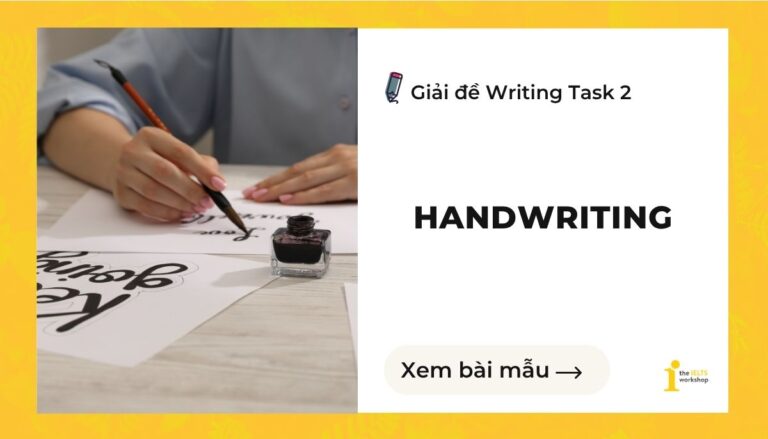
Trong chuyên mục Giải đề IELTS Writing Task 2 tuần này, bạn sẽ cùng thầy Phạm Duy Anh từ The IELTS Workshop khám phá cách xử lý đề bài về chủ đề Handwriting nhé.
1. Phân tích đề bài
1.1. Đề bài
Fewer and fewer people today write by hand using a pen, a pencil, or brush. What are the reasons for this? Is the decline in writing by hand a positive or negative development?
(Ngày nay, ngày càng ít người viết bằng tay bằng bút mực, bút chì hoặc bút lông. Nguyên nhân của điều này là gì? Việc suy giảm thói quen viết tay là một sự phát triển tích cực hay tiêu cực?)
1.2. Phân tích đề bài
Dạng bài:
- Type of Essay: 2-part questions – Cause & Opinion
- Topic: The use of stationery tools (pens; pencils; brushes) has declined.
Xem thêm: Hướng dẫn A – Z cách làm Two part Question Essay trong IELTS Writing Task 2
1.3. Dàn bài chi tiết
Introduction:
- Lead-in + Paraphrase the topic
- Directive statement
Body paragraphs:
- Body 1: Cause paragraph (advent of technology + busy schedules)
- Body 2: Balanced approach to the opinion essay (Positive – efficiency & convenience; Negative – lost of creative freedom / expression)
Conclusion
2. Bài mẫu
In the modern era, it is observed that the number of people using pens, pencils, or brushes for writing has decreased. This leads to discussions on whether this trend is a positive or negative development. This essay shall explore the causes that lead to this decline, and critically examine whether this brings about positive or negative implications.
The decline in people using stationery for writing can be attributed to several reasons. A primary reason can be found in the rise of technology. With the release of more advanced electronic devices that allow for multiple purposes, each implemented with a touch pad and stylus, users can write on their screens by using their thumbs and/or their electronic pens. Furthermore, because electronic devices are portable and more accessible compared to traditional pens or pencils, people gradually consider find them to be more reliable, eliminating the need to spend more money on stationery tools that might eventually run out. Another reason can be attributed to the time constraints induced by busier schedules in modern society. The modern era invites more hectic tasks, and demands more efficiency in working, thus carrying a notebook with pens or pencils to take notes has become redundant and time-consuming. For example, employees are often seen taking notes on their phones and tablets due to their portability and easy accessibility. As a result, people grow less dependent on stationery, and more on their devices.
The gradual detachment to stationery has positive and negative consequences. Regarding the positive consequences, more frequent use of technological devices allows for more efficiency in work, specifically when it comes to spreading and transferring information. From the outdated practice of letter writing and sending, which is time-consuming and a waste of resources, people can now type the information they want to relay, then send it to recipients to all parts of the world. Furthermore, typing words on electronic devices reduces the risk of illegibility, as handwriting can sometimes be hard to read. With the assistance of technology, writing can be conformed to legible fonts, and written information and be spread efficiently and conveniently. On the other hand, it should be acknowledged that overreliance on technology can diminish the importance of writing as an art. The number of individuals who view writing as an original artform are growing less, which might affect the authenticity of writing. As each person’s handwriting is different, losing it could imply that people are losing their ability to creatively express their individuality, thus conforming to the established fonts in their devices. For example, hand-written calligraphy is viewed as a dying art form, because not only people are growing less interested in them, but the practitioners also belong to the older generation. Consequently, writing, as a creative expression, may die out in favor of convenience.
In conclusion, it is found that the advent of technology and the burden of modern society contribute to the diminishing use of pens, pencils, or brushes for writing. Upon evaluation of both the good and bad outcomes, it can be considered that this development offers more benefits than drawbacks, making it an overall positive development. However, it should be noted that handwriting, as an art form, should be retained lest people lose another method to express their individuality.
Sample by Pham Duy Anh– IELTS Teacher at The IELTS Workshop
3. Từ vựng (Vocabulary)
- Stylus (n): bút điện tử
= electronic pen - Portable (adj): cầm được, đút túi được, mang đi được
= can be carried; compact - Hectic (adj): bận; rối loạn; hỗn loạn
= busy; chaotic; overwhelming - Efficiency (n): độ hiệu quả, hiệu suất
= effectiveness; coherence; productivity - Redundant (adj): không hữu ích
= being not useful; inefficiency - Recipient (n): người nhận
= sendee; receiver - Illegibility (n): không đọc được
= cannot be read and understood; being unclear - Diminish (v): phai đi
= fade away; die out; disappear - Individuality (n): sự độc đáo; sự cá nhân hóa
= uniqueness; originality - Calligraphy (n): thư pháp
= the art of handwriting
Xem thêm: Tổng hợp 30+ chủ đề từ vựng IELTS thông dụng mà bạn cần biết
Tạm kết
Hy vọng bài viết từ thầy Phạm Duy Anh đã giúp bạn hình dung rõ cách triển khai ý cho bài IELTS Writing Task 2 dạng two-part questions chủ đề Handwriting một cách chặt chẽ và thuyết phục.
Nếu bạn muốn luyện tập thêm các dạng bài tương tự, đừng quên theo dõi chuyên mục [Cập nhật liên tục] Tổng hợp đề thi IELTS Writing 2026 kèm bài mẫu và Bài mẫu Writing Task 2 từ The IELTS Workshop nhé!
Học IELTS ngay tại HỌC IELTS MIỄN PHÍ cùng các thầy cô 9.0 IELTS tại Website của The IELTS Workshop !