Làm thế nào để tìm đúng đáp án và tránh những bẫy thường gặp trong IELTS Reading? Cùng The IELTS Workshop tham khảo lời giải chi tiết IELTS VOL 9 Test 1 Reading Passage 3 với chủ đề Greek traders and coins dưới đây nhé!
Đáp án IELTS VOL 9 Test 1 Reading Passage 3
| Question | Đáp án |
| 27 | B |
| 28 | H |
| 29 | E |
| 30 | F |
| 31 | C |
| 32 | H |
| 33 | D |
| 34 | naringin |
| 35 | poisonous |
| 36 | genetic |
| 37 | supertasters |
| 38 | top |
| 39 | A |
| 40 | C |
Phân tích chi tiết đáp án IELTS VOL 9 Test 1 Reading Passage 3
Dạng bài: Matching information ▼
Câu 27
Đáp án: B
Câu hỏi: details of an experiment in taste comparison (chi tiết về một thí nghiệm so sánh vị giác)
Vị trí trong bài: Đoạn B
|
“In a test conducted by a biotechnology company, sets of two miniature white paper cups, labelled 304 and 305, were placed before five people seated around a conference table. Each person drank from one cup and then the other, cleansing their palates between tastes with water and a cracker. Even the smallest sip of 304 had grapefruit’s unmistakeable bite. But 305 was smoother […]”
|
Phân tích: Đoạn B mô tả cụ thể một thử nghiệm (“test” tương đương với “experiment”) do một công ty công nghệ sinh học thực hiện. Thí nghiệm đưa ra hai chiếc cốc 304 và 305 để 5 người nếm thử và so sánh vị gắt ban đầu của nước ép bưởi với vị êm dịu khi đã được xử lý bằng chất AMP.
Câu 28
Đáp án: H
Câu hỏi: examples of medications that could be improved using compounds that remove bitterness (các ví dụ về các loại thuốc men có thể được cải thiện bằng cách sử dụng những hợp chất loại bỏ vị đắng)
Vị trí trong bài: Đoạn H
|
“Bitter blockers could also be used in place of sugary cherry and grape flavourings in children’s cough syrups, and they could dampen the bitterness of drugs like antihistamines, antibiotics and other similar products.”
|
Phân tích: Đoạn H liệt kê hàng loạt các loại thuốc men (“medications”) có thể được giảm vị đắng và cải thiện mùi vị nhờ chất chặn vị đắng, bao gồm: si-rô ho của trẻ em (“children’s cough syrups”), thuốc kháng histamin (“antihistamines”) và thuốc kháng sinh (“antibiotics”).
Câu 29
Đáp án: E
Câu hỏi: a biological reason why some people don’t like bitter-tasting foods (một lý do mang tính sinh học giải thích tại sao một số người không thích thực phẩm có vị đắng)
Vị trí trong bài: Đoạn E
|
“People have varying capacities for tasting bitterness and the differences appear to be genetic […] Some people who have an unusually high number of taste buds, and are known as ‘supertasters’, are especially sensitive to these compounds. Supertasters tend to shun all kinds of bitter-tasting things, including vegetables, coffee, and dark chocolate.”
|
Phân tích: Đoạn E chỉ ra lý do sinh học khiến nhiều người né tránh (“shun” đồng nghĩa với “don’t like”) đồ ăn đắng là do yếu tố di truyền (“genetic”) và do họ sở hữu số lượng nụ vị giác nhiều bất thường trên lưỡi (“an unusually high number of taste buds”), khiến họ đặc biệt nhạy cảm với các hợp chất đắng.
Câu 30
Đáp án: F
Câu hỏi: an explanation of how the taste process works (lời giải thích về cách thức hoạt động của quá trình cảm nhận vị giác)
Vị trí trong bài: Đoạn F
|
“At the top is a group of receptors that captures the taste molecules, known as tastants, in food and drink. […] Once a bitter signal has been received, it is relayed via proteins known as G proteins. […] The protein triggers a cascade of chemical reactions that lead to ion concentrations within the cell. Ultimately, this delivers a signal to the brain that registers as bitter.”
|
Phân tích: Toàn bộ Đoạn F giải thích chi tiết cơ chế sinh học từng bước của quá trình nếm: từ việc các thụ thể ở nụ vị giác thu giữ phân tử vị giác, truyền tín hiệu qua protein G, kích hoạt chuỗi phản ứng hóa học dẫn truyền ion, cho đến khi tín hiệu được gửi lên não bộ để nhận diện vị.
Câu 31
Đáp án: C
Câu hỏi: why bitterness is more interesting commercially than other tastes (lý do tại sao vị đắng lại được quan tâm nhiều hơn về mặt thương mại so với các vị khác)
Vị trí trong bài: Đoạn C
|
“However, bitterness is of special interest to the food industry because it is present in so many different types of food.”
|
Phân tích: Ngành công nghiệp thực phẩm (“food industry” đại diện cho khía cạnh thương mại – “commercially”) đặc biệt chú ý đến vị đắng vì nó hiện diện trong rất nhiều loại thực phẩm khác nhau trong tự nhiên.
Câu 32
Đáp án: H
Câu hỏi: an example of how compounds that remove bitterness could indirectly benefit health (một ví dụ về việc các hợp chất loại bỏ vị đắng có thể mang lại lợi ích gián tiếp cho sức khỏe như thế nào)
Vị trí trong bài: Đoạn H
|
“Some taste researchers believe that, in time, compounds like AMP will help make processed foods less unhealthy. Consider, for example, that a single cup of canned chicken noodle soup contains 850 milligrams of sodium chloride, or table salt […] Part of the table salt could be replaced by another type of salt, potassium chloride, which tends to be scarce in some people’s diets because of its bitter taste. But that bitter taste could be eliminated with a dose of AMP.”
|
Phân tích: Đoạn H đưa ra ví dụ về món súp gà đóng hộp: muối ăn (chứa nhiều natri gây hại) thường được thêm vào để át vị đắng do nhiệt độ cao; nhờ có hợp chất khử đắng như AMP, nhà sản xuất có thể thay thế một phần muối ăn bằng kali clorua (loại muối bổ dưỡng nhưng trước đây bị hạn chế dùng vì đắng), từ đó gián tiếp giúp thực phẩm chế biến sẵn trở nên lành mạnh, có lợi hơn cho sức khỏe (“less unhealthy”).
Câu 33
Đáp án: D
Câu hỏi: a reason why people have different taste preferences from animals (lý do tại sao con người có sở thích vị giác khác biệt so với động vật)
Vị trí trong bài: Đoạn D
|
“Humans are the only species that enjoys a bitter taste’ […]. Every other species is averse to bitter because it means bad news. But we have learned to enjoy it. We drink coffee, which is bitter, and quinine (in tonic water) too. We enjoy having that spice in our lives.”
|
Phân tích: Trong khi các loài động vật đều có ác cảm và tránh xa vị đắng vì coi đó là dấu hiệu của chất độc hại (“means bad news”), con người lại là loài duy nhất học được cách thưởng thức vị đắng vì chúng ta thích có thêm hương vị mới lạ, kích thích đó trong cuộc sống (“enjoy having that spice in our lives”).
Dạng bài: Sentence Completion ▼
Câu 34
Đáp án: naringin
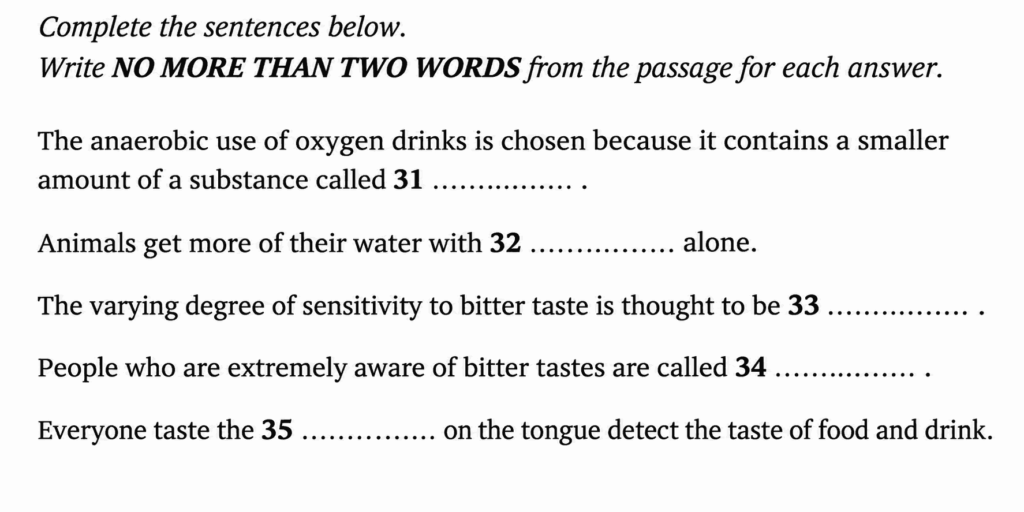
Câu hỏi: The grapefruit used to make drinks is chosen because it contains a smaller amount of a substance called 34………… (Bưởi được dùng để sản xuất đồ uống được lựa chọn vì nó chứa một lượng ít hơn của một chất gọi là ………….)
Vị trí trong bài: Đoạn A
|
“This is because a natural chemical compound found in grapefruit, naringin, has a bitter taste […] So juice packagers often select grapefruit with low naringin content […]”
|
Phân tích: Sau cụm “a substance called” cần một danh từ riêng.
Đoạn A giải thích lý do tại sao nước ép bưởi thường chỉ được uống từng ngụm nhỏ: do vị đắng tự nhiên của bưởi. Để chiều lòng số đông người tiêu dùng không thích vị đắng gắt, các nhà đóng hộp nước ép buộc phải chọn lọc những quả bưởi có hàm lượng chất đắng này ở mức thấp.
Cụm từ “The grapefruit used to make drinks” (bưởi dùng làm đồ uống) tương đương với “juice packagers select grapefruit” (các nhà đóng hộp nước ép chọn bưởi).
⇒ Từ cần điền là một hợp chất có tên gọi là naringin.
Câu 35
Đáp án: poisonous
Câu hỏi: Animals associate a bitter taste with 35………… plants. (Động vật liên tưởng vị đắng với các loài thực vật ………….)
Vị trí trong bài: Đoạn C
|
“They defend plants by warning animals away and protect animals by letting them know when a plant may be poisonous.”
|
Phân tích: Các hợp chất vị đắng trong tự nhiên bảo vệ động vật bằng cách cho chúng biết khi nào một loài thực vật có thể chứa chất độc (“a plant may be poisonous”). Do đó, động vật luôn liên hệ vị đắng với thực vật có độc.
⇒ Tính từ cần điền bổ nghĩa cho “plants” là poisonous.
Câu 36
Đáp án: genetic
Câu hỏi: Our varying degree of sensitivity to bitter tastes is thought to be 36 …………. (Mức độ nhạy cảm khác nhau của chúng ta đối với vị đắng được cho là mang tính………….)
Vị trí trong bài: Đoạn E
|
“People have varying capacities for tasting bitterness and the differences appear to be genetic.”
|
Phân tích: Đi sâu vào sự khác biệt sinh học giữa các cá thể người: khả năng cảm nhận vị đắng ở mỗi người là hoàn toàn khác nhau và các nhà khoa học đã tìm ra nguyên nhân bắt nguồn từ yếu tố di truyền trong bộ gen quy định số lượng nụ vị giác.
Cụm từ “varying degree of sensitivity to bitter tastes” (mức độ nhạy cảm khác nhau với vị đắng) diễn đạt lại ý “varying capacities for tasting bitterness” (khả năng nếm vị đắng khác nhau).
⇒ Tính từ cần điền là genetic.
Câu 37
Đáp án: supertasters
Câu hỏi: People who are extremely aware of bitter tastes are called 37………….. (Những người có khả năng nhận biết vị đắng cực kỳ cao được gọi là……………)
Vị trí trong bài: Đoạn E
|
“Some people who have an unusually high number of taste buds, and are known as ‘supertasters‘, are especially sensitive to these compounds.”
|
Phân tích: Bài đọc chỉ ra một nhóm cá nhân có số lượng nụ vị giác nhiều đột biến khiến họ cực kỳ mẫn cảm với vị đắng, và giới khoa học đặt riêng một thuật ngữ sinh học để định danh nhóm người này.
Paraphrase:
- “People who are extremely aware of bitter tastes” diễn đạt lại cụm “people who… are especially sensitive to these compounds” (những người đặc biệt nhạy cảm với các hợp chất đắng này).
- “are called” đồng nghĩa với “are known as” (được gọi là / được biết đến là).
⇒ Từ cần điền là supertasters.
Câu 38
Đáp án: taste buds
Câu hỏi: Receptors inside the 38…………. on the tongue detect the taste of food and drink. (Các thụ thể bên trong…………. trên lưỡi phát hiện ra mùi vị của thức ăn và đồ uống.)
Vị trí trong bài: Đoạn F
|
“The tongue is covered with taste buds. […] At the top is a group of receptors that captures the taste molecules, known as tastants, in food and drink.”
|
Phân tích: Bài đọc chỉ ra rằng trên bề mặt lưỡi có các nụ vị giác (“taste buds”), và ở đỉnh của mỗi nụ vị giác này có một nhóm thụ thể (“a group of receptors”) làm nhiệm vụ phát hiện các phân tử vị giác trong đồ ăn thức uống.
⇒ Vì vậy, vị trí chứa các thụ thể này chính là taste buds.
Dạng bài: Matching Sentence Endings ▼
Câu 39
Đáp án: A. is responsible for transmitting bitter tastes. (chịu trách nhiệm truyền các vị đắng.)
Câu hỏi: The G protein identified by Robert Margolskee (Protein G được Robert Margolskee xác định)
Vị trí trong bài: Đoạn F
|
“Once a bitter signal has been received, it is relayed via proteins known as G proteins. The G protein involved in the perception of bitterness, sweetness and umami was identified in the early 1990s by Robert Margolskee […] The protein triggers a cascade of chemical reactions […] Ultimately, this delivers a signal to the brain that registers as bitter.”
|
Phân tích:
A đúng vì bài đọc nêu rõ khi tín hiệu vị đắng được tiếp nhận, nó được truyền đi (“relayed” = “transmitting”) qua protein G, kích hoạt phản ứng để gửi tín hiệu lên não bộ ghi nhận vị đắng.
Loại các phương án sai:
- B sai vì các phản ứng hóa học kích hoạt nồng độ ion tế bào không hề được miêu tả là “nguy hiểm” (“dangerous”).
- C sai vì bài đọc nói các thụ thể (“the receptors”) mới hoạt động giống thụ thể thị giác và khứu giác, chứ không phải protein G.
- D sai vì protein G này tham gia vào việc cảm nhận cả vị đắng (“bitterness”), vị ngọt và umami chứ không phải “chỉ tìm thấy ở vị ngọt và umami” (“only in sweetness and umami”).
Câu 40
Đáp án: C. bitter-tasting when added to food (có vị đắng khi thêm vào thức ăn)
Câu hỏi: AMP is an organic compound which is (AMP là một hợp chất hữu cơ)
Vị trí trong bài: Đoạn G
|
“They tried AMP, an organic compound found in breast milk and other substances… AMP has no bitterness of its own… As effective as it is, AMP may not be able to dampen every type of bitter taste because it probably doesn’t attach to all 30 bitter-taste receptors.”
|
Phân tích:
C đúng vì bài đọc khẳng định AMP có tác dụng làm dịu/giảm bớt (“dampen” = “reduce”) vị đắng, dù nó có thể không làm giảm được mọi vị đắng vì không gắn vào toàn bộ 30 thụ thể (đồng nghĩa với việc nó làm giảm được một số vị đắng – “some bitter tastes”).
Loại các phương án sai:
- A sai vì ngoài sữa mẹ ra nó còn có trong các chất khác (“found in breast milk and other substances”).
- B sai vì bản thân AMP không có vị đắng (“has no bitterness of its own”).
- D sai vì nó liên kết/gắn vào thụ thể khi được đưa vào (“attaches to bitter-taste receptors”) chứ không phải tự nhiên được tìm thấy sẵn trong các thụ thể này.
Dịch chi tiết IELTS VOL 9 Test 1 Reading Passage 3
Creating a Better Grapefruit
Tạo ra một giống bưởi thơm ngon hơn
By blocking the right taste receptors, biotech researchers turn bitter into sweet
Bằng cách ngăn chặn đúng các thụ thể vị giác, các nhà nghiên cứu công nghệ sinh học biến vị đắng thành vị ngọt
A.
There is a reason why grapefruit juice is served in little glasses. Most people don’t want to drink more than a few ounces at a time. This is because a natural chemical compound found in grapefruit, naringin, has a bitter taste. Some people like that bitterness in small doses and believe it enhances the general flavour, but others would rather avoid it altogether. So juice packagers often select grapefruit with low naringin content, even though the compound has antioxidant properties that some nutritionists contend may help prevent many serious diseases.
Có một lý do khiến nước ép bưởi thường được phục vụ trong những chiếc ly nhỏ. Hầu hết mọi người không muốn uống nhiều hơn vài ounce mỗi lần. Điều này là do một hợp chất hóa học tự nhiên có trong bưởi, naringin, có vị đắng. Một số người thích vị đắng đó ở liều lượng nhỏ và tin rằng nó làm tăng thêm hương vị tổng thể, nhưng những người khác lại muốn tránh hoàn toàn. Vì vậy, các nhà đóng gói nước ép thường chọn những quả bưởi có hàm lượng naringin thấp, mặc dù hợp chất này có các đặc tính chống oxy hóa mà một số chuyên gia dinh dưỡng cho rằng có thể giúp ngăn ngừa nhiều căn bệnh nghiêm trọng.
Từ vựng cần nhớ:
- compound (n): hợp chất
- dose (n): liều lượng
- enhance (v): nâng cao, làm tăng thêm
- content (n): hàm lượng
- antioxidant (n): chất chống oxy hóa
- property (n): đặc tính, thuộc tính
- contend (v): cho rằng, khẳng định, quả quyết
B.
It is possible, however, to get the goodness of grapefruit without the bitter taste. In a test conducted by a biotechnology company, sets of two miniature white paper cups, labelled 304 and 305, were placed before five people seated around a conference table. Each person drank from one cup and then the other, cleansing their palates between tastes with water and a cracker. Even the smallest sip of 304 had grapefruit’s unmistakeable bite. But 305 was smoother; there was the sour taste of citrus but none of the bitterness of naringin. This juice had been treated with AMP, a compound that blocks the bitterness in foods without making them less nutritious.
Tuy nhiên, người ta hoàn toàn có thể hấp thụ các chất bổ dưỡng của bưởi mà không phải chịu vị đắng. Trong một thử nghiệm do một công ty công nghệ sinh học tiến hành, các bộ gồm hai chiếc cốc giấy trắng nhỏ nhắn, được dán nhãn 304 và 305, đã được đặt trước mặt năm người ngồi quanh một bàn hội nghị. Mỗi người uống từ một cốc rồi đến cốc kia, làm sạch vòm miệng giữa các lần nếm bằng nước lọc và bánh quy giòn. Ngay cả ngụm nhỏ nhất của cốc 304 cũng mang vị đắng gắt không thể nhầm lẫn của bưởi. Nhưng cốc 305 thì êm dịu hơn; có vị chua của họ cam chanh nhưng không hề có chút vị đắng nào của naringin. Loại nước ép này đã được xử lý bằng AMP, một hợp chất ngăn chặn vị đắng trong thực phẩm mà không làm chúng kém bổ dưỡng.
Từ vựng cần nhớ:
- goodness (n): dưỡng chất, sự bổ dưỡng
- biotechnology (n): công nghệ sinh học
- miniature (adj): nhỏ nhắn, thu nhỏ
- labelled (adj): được dán nhãn
- cleanse (v): làm sạch, tẩy sạch
- palate (n): vòm miệng, khẩu vị
- unmistakeable (adj): không thể nhầm lẫn
- citrus (n): cây/quả thuộc họ cam chanh
- nutritious (adj): bổ dưỡng, giàu dinh dưỡng
C.
Taste research is a booming business these days, with scientists delving into all five basics: sweet, bitter, sour, salty, and umami (the savory taste of protein). However, bitterness is of special interest to the food industry because it is present in so many different types of food. There are thousands of bitter-tasting compounds in nature. They defend plants by warning animals away and protect animals by letting them know when a plant may be poisonous. But the system isn’t foolproof. Grapefruit and bitter green vegetables like Brussels sprouts and kale are nutritious despite – and sometimes because of – their bitter-tasting components.
Nghiên cứu vị giác là một lĩnh vực kinh doanh đang bùng nổ hiện nay, khi các nhà khoa học đi sâu tìm hiểu cả năm vị cơ bản: ngọt, đắng, chua, mặn và umami (vị ngọt thịt của chất đạm). Tuy nhiên, vị đắng lại được ngành công nghiệp thực phẩm đặc biệt quan tâm vì nó hiện diện trong rất nhiều loại thực phẩm khác nhau. Có hàng ngàn hợp chất có vị đắng trong tự nhiên. Chúng bảo vệ thực vật bằng cách cảnh báo động vật tránh xa và bảo vệ động vật bằng cách cho chúng biết khi nào một loài cây có thể có độc. Nhưng hệ thống này không phải lúc nào cũng hoàn hảo không tì vết. Bưởi và các loại rau xanh có vị đắng như cải Brussels và cải xoăn vẫn rất bổ dưỡng bất chấp – và đôi khi là nhờ có – các thành phần có vị đắng của chúng.
Từ vựng cần nhớ:
- booming (adj): bùng nổ, phát triển nhanh chóng
- delve into (phr.v): đi sâu nghiên cứu, đào sâu tìm hiểu
- poisonous (adj): có độc
- foolproof (adj): hoàn hảo, không thể sai sót/hỏng hóc
- component (n): thành phần cấu thành
D.
‘Humans are the only species that enjoys a bitter taste,’ says Charles Zuker, a neuroscientist at the University of California School of Medicine at San Diego. ‘Every other species is averse to bitter because it means bad news. But we have learned to enjoy it. We drink coffee, which is bitter, and quinine (in tonic water) too. We enjoy having that spice in our lives.’ Because bitterness can be pleasant in small quantities but repellent when intense, bitter blockers like AMP could make a whole range of foods, drinks and medicines more palatable.
‘Con người là loài duy nhất thích vị đắng,’ Charles Zuker, một nhà khoa học thần kinh tại Trường Y thuộc Đại học California ở San Diego cho biết. ‘Mọi loài khác đều ác cảm với vị đắng vì nó đồng nghĩa với tin xấu. Nhưng chúng ta đã học cách thưởng thức nó. Chúng ta uống cà phê – thứ vốn có vị đắng, và cả quinine (trong nước tonic) nữa. Chúng ta thích có thêm gia vị đó trong cuộc sống.’ Bởi vì vị đắng có thể dễ chịu ở lượng nhỏ nhưng lại gây khó chịu khi quá gay gắt, các chất chặn vị đắng như AMP có thể làm cho hàng loạt loại thực phẩm, đồ uống và thuốc trở nên dễ nuốt hơn.
Từ vựng cần nhớ:
- neuroscientist (n): nhà khoa học thần kinh
- averse to (adj): ác cảm với, không thích
- repellent (adj): gây khó chịu, ghê sợ
- intense (adj): gay gắt, dữ dội, nồng độ cao
- palatable (adj): ngon miệng, dễ uống, dễ chịu
E.
People have varying capacities for tasting bitterness and the differences appear to be genetic. About 75% of people are sensitive to the taste of some well-identified bitter compounds. Those who are sensitive seem to be less likely than others to eat bitter vegetables, according to Stephen Wooding, a geneticist at the University of Utah. Some people who have an unusually high number of taste buds, and are known as ‘supertasters’, are especially sensitive to these compounds. Supertasters tend to shun all kinds of bitter-tasting things, including vegetables, coffee, and dark chocolate.
Mọi người có khả năng cảm nhận vị đắng khác nhau và sự khác biệt này dường như mang tính di truyền. Khoảng 75% số người nhạy cảm với vị của một số hợp chất đắng đã được nhận diện rõ ràng. Những người nhạy cảm dường như ít có xu hướng ăn các loại rau có vị đắng hơn những người khác, theo Stephen Wooding, một nhà di truyền học tại Đại học Utah. Một số người có số lượng nụ vị giác cao bất thường, được gọi là người siêu nhạy vị giác, đặc biệt nhạy cảm với các hợp chất này. Những người siêu nhạy vị giác có xu hướng né tránh mọi thứ có vị đắng, bao gồm rau củ, cà phê và sô-cô-la đen.
Từ vựng cần nhớ:
- capacity (n): khả năng, năng lực
- genetic (adj): thuộc về di truyền
- sensitive (adj): nhạy cảm
- geneticist (n): nhà di truyền học
- shun (v): né tránh, xa lánh
F.
The tongue is covered with taste buds. Under the microscope each one looks like an onion, consisting of 50 to 100 elongated cells running from the top of the taste buds to the bottom. At the top is a group of receptors that captures the taste molecules, known as tastants, in food and drink. The receptors function much like those for sight and smell. Once a bitter signal has been received, it is relayed via proteins known as G proteins. The G protein involved in the perception of bitterness, sweetness and umami was identified in the early 1990s by Robert Margolskee, at Mount Sinai School of Medicine in New York. The protein triggers a cascade of chemical reactions that lead to ion concentrations within the cell. Ultimately, this delivers a signal to the brain that registers as bitter.
Lưỡi được bao phủ bởi các nụ vị giác. Dưới kính hiển vi, mỗi nụ trông như một củ hành tây, bao gồm 50 đến 100 tế bào thon dài chạy từ đỉnh nụ vị giác xuống đáy. Ở trên đỉnh là một nhóm thụ thể có chức năng thu giữ các phân tử vị giác, được gọi là tastants, trong thức ăn và đồ uống. Các thụ thể này hoạt động tương tự như các thụ thể thị giác và khứu giác. Khi tín hiệu vị đắng được tiếp nhận, nó sẽ được truyền đi qua các protein được gọi là G-protein. G-protein tham gia vào quá trình cảm nhận vị đắng, vị ngọt và vị umami đã được Robert Margolskee tại Trường Y Mount Sinai ở New York xác định vào đầu những năm 1990. Protein này kích hoạt một chuỗi liên tiếp các phản ứng hóa học dẫn đến nồng độ ion bên trong tế bào. Cuối cùng, điều này gửi một tín hiệu đến não bộ để ghi nhận đó là vị đắng.
Từ vựng cần nhớ:
- elongated (adj): thon dài, kéo dài
- molecule (n): phân tử
- relay (v): chuyển tiếp, truyền đi
- perception (n): sự nhận thức, cảm nhận
- trigger (v): kích hoạt, khơi mào
- cascade (n): chuỗi liên tiếp (phản ứng), thác đổ
- concentration (n): nồng độ, sự tập trung
- register (v): ghi nhận, nhận diện
G.
Once they understood the taste mechanism, scientists began to think of ways to interfere with it. They tried AMP, an organic compound found in breast milk and other substances, that is created as cells break down food. AMP has no bitterness of its own, but when put in foods, as Margolskee and his colleagues discovered, it attaches to bitter-taste receptors. As effective as it is, AMP may not be able to dampen every type of bitter taste because it probably doesn’t attach to all 30 bitter-taste receptors.
Khi đã hiểu được cơ chế vị giác, các nhà khoa học bắt đầu nghĩ cách để can thiệp vào nó. Họ đã thử dùng AMP, một hợp chất hữu cơ được tìm thấy trong sữa mẹ và các chất khác, vốn được tạo ra khi các tế bào phân giải thức ăn. Bản thân AMP không có vị đắng, nhưng khi được đưa vào thực phẩm, như Margolskee và các đồng nghiệp phát hiện, nó sẽ liên kết với các thụ thể vị đắng. Dù hiệu quả là vậy, AMP có thể không thể làm giảm bớt mọi loại vị đắng vì nó có khả năng không gắn vào toàn bộ 30 thụ thể vị đắng.
Từ vựng cần nhớ:
- mechanism (n): cơ chế, cơ năng
- interfere with (phr.v): can thiệp vào, cản trở
- substance (n): chất, vật chất
- dampen (v): làm giảm bớt, kìm hãm, làm dịu đi
H.
Some taste researchers believe that, in time, compounds like AMP will help make processed foods less unhealthy. Consider, for example, that a single cup of canned chicken noodle soup contains 850 milligrams of sodium chloride, or table salt – more than a third of the recommended daily allowance. The salt masks the bitterness created by the high temperatures used in the canning process, which cause sugars and amino acids to react. Part of the table salt could be replaced by another type of salt, potassium chloride, which tends to be scarce in some people’s diets because of its bitter taste. But that bitter taste could be eliminated with a dose of AMP. Bitter blockers could also be used in place of sugary cherry and grape flavourings in children’s cough syrups, and they could dampen the bitterness of drugs like antihistamines, antibiotics and other similar products.
Một số nhà nghiên cứu vị giác tin rằng, theo thời gian, các hợp chất như AMP sẽ giúp thực phẩm chế biến sẵn bớt độc hại hơn. Hãy xem xét ví dụ, một chén súp gà đóng hộp chứa 850 miligam natri clorua, hay muối ăn – chiếm hơn một phần ba khẩu phần cho phép hàng ngày được khuyến nghị. Muối làm át đi vị đắng sinh ra do nhiệt độ cao trong quá trình đóng hộp, vốn khiến đường và các axit amin phản ứng với nhau. Một phần muối ăn có thể được thay thế bằng một loại muối khác là kali clorua, vốn có xu hướng thiếu hụt trong chế độ ăn của một số người vì vị đắng của nó. Nhưng vị đắng đó có thể được loại bỏ chỉ với một liều lượng AMP. Chất chặn vị đắng cũng có thể được sử dụng thay cho hương liệu anh đào và nho nhiều đường trong si-rô ho của trẻ em, và chúng có thể làm dịu đi vị đắng của các loại thuốc như thuốc kháng histamin, thuốc kháng sinh và các sản phẩm tương tự khác.
Từ vựng cần nhớ:
- processed (adj): được chế biến sẵn
- allowance (n): định mức, khẩu phần cho phép
- mask (v): che giấu, làm át đi
- scarce (adj): khan hiếm, thiếu hụt
- eliminate (v): loại bỏ, triệt tiêu
I.
A number of foodmakers have already begun to experiment with AMP in their products, and other bitter blockers are being developed. In a few years, perhaps, after food companies have taken the bitterness from canned soup and improved the taste of medicines, they can set their sights on something more useful: a bitter blocker in a bottle that any of us can sprinkle on our Brussels sprouts or stir into our grapefruit juice.
Một số nhà sản xuất thực phẩm đã bắt đầu thử nghiệm AMP trong các sản phẩm của họ, và các chất chặn vị đắng khác đang tiếp tục được phát triển. Trong vài năm tới, có lẽ sau khi các công ty thực phẩm đã loại bỏ được vị đắng khỏi súp đóng hộp và cải thiện hương vị của thuốc men, họ có thể đặt mục tiêu vào một điều gì đó hữu ích hơn: một chai chất chặn vị đắng mà bất kỳ ai trong chúng ta cũng có thể rắc lên cải Brussels hoặc khuấy vào ly nước ép bưởi của mình.
Từ vựng cần nhớ:
- set one’s sights on (idiom): đặt mục tiêu vào, quyết tâm hướng đến
- sprinkle (v): rắc lên, rải nhẹ
- stir (v): khuấy, đảo
Series giải đề IELTS VOL 9
- Đáp án IELTS VOL 9 & Lời giải chi tiết: Test 1 đến Test 11
- Giải chi tiết IELTS VOL 9 Test 1 Listening Part 1
- Giải chi tiết IELTS VOL 9 Test 1 Listening Part 2: Spring Down Junior School
- Giải chi tiết IELTS VOL 9 Test 1 Listening Part 3: Forensic Linguistics
- Giải chi tiết IELTS VOL 9 Test 1 Listening Part 4
- Giải chi tiết IELTS VOL 9 Test 1 Reading Passage 1: The Baobabs of Madagascar
- Giải chi tiết IELTS VOL 9 Test 1 Reading Passage 2: Coins – the first form of money
- Giải chi tiết IELTS VOL 9 Test 1 Reading Passage 3: Greek traders and coins
Trên đây là đáp án và lời giải chi tiết bài đọc Greek traders and coins. Hãy ghi lại những lỗi sai và ôn tập các từ vựng mới để cải thiện kết quả trong những lần luyện đề tiếp theo.
Đừng quên tham gia khóa học IELTS miễn phí của The IELTS Workshop để tiếp cận phương pháp học hiệu quả và củng cố kiến thức IELTS cùng giáo viên 9.0 nhé!