Trong chuyên mục Giải đề IELTS Writing Task 2 tuần này, bạn sẽ cùng cô Nguyễn Khánh Huyền từ The IELTS Workshop khám phá cách xử lý đề bài về chủ đề Provide enough homes in large cities trong IELTS Writing Task 2 nhé.
1. Phân tích đề bài
1.1. Đề bài
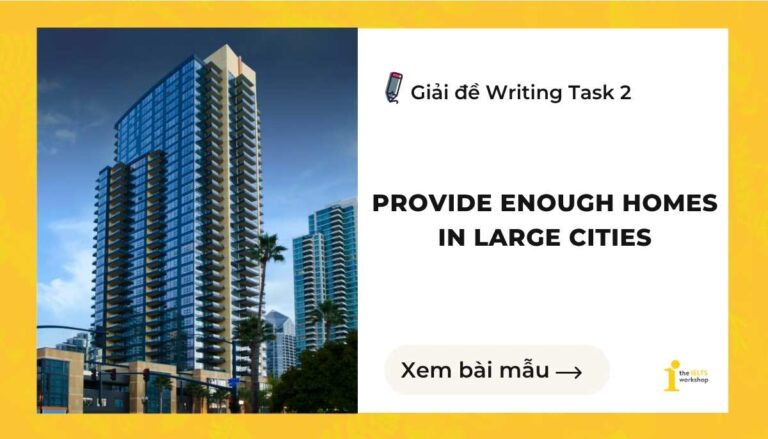
The best way to provide enough homes in large cities is to build tall apartment blocks. To what extent do you agree or disagree with this statement?
(Cách tốt nhất để cung cấp đủ nhà ở tại các thành phố lớn là xây dựng các tòa nhà chung cư cao tầng. Bạn đồng ý hay không đồng ý với quan điểm này ở mức độ nào?)
1.2. Phân tích đề bài
Dạng bài: chứng minh / phản bác quan điểm được đề ra
Từ khóa:
- Provide
- large cities
- Talk appartment blocks
Phân tích yêu cầu đề bài: Với đề bài này, chúng ta cần đưa ra các lập luận để chứng minh hoặc phản bác quan điểm xây nhà cao tầng giúp đáp ứng nhu cầu sinh hoạt tại các thành phố lớn, đi kèm các dẫn chứng thuyết phục.
2. Dàn bài chi tiết
Introduction
- Lead in: shortage in housing in many large cities
- Give direct answer to the idea: the proposal to build tall apartment building is ineffective and unfeasible
- Give outline to the essay: explain why the suggestion is not the most optimal approach, and briefly suggest another measure
Body paragraphs
- Argument 1: building more apartment block cannot solve housing problem
- Misconception: urban migration continues, demand for housing increases
- Rebuttal: the majority struggle to own property due to high prices, which does not base on the actual availability of residential buildings
- Evidence: real estate bubbles in megacities
- Argument 2: it is nearly impossible to build more apartment blocks
- Clarification: few areas are available for construction, also housing options need diversity (low-rise residential neighborhood with houses and garden, etc.)
- Argument 3: decentralization is the way to move forwards
- Clarification: invest in suburban and rural areas to reduce urban migration
Conclusion
- Restate: skyscrapers for residential building is not the only or optimal measure
- Summarize: the suggestion is impractical and inefficient
- Predict/Suggest: decentralize urban areas
2. Bài mẫu
Granted, the construction of tall apartment blocks can accommodate a considerable number of residents within a limited area, making it an attractive proposal for densely populated cities. Nevertheless, I would argue that relying on high-rise residential buildings as the primary solution to housing shortages is both ineffective and impractical. This essay will explain why increasing the number of apartment towers cannot address the root causes of the housing crisis before suggesting decentralization as a more sustainable alternative.
The belief that constructing more apartment blocks will solve housing shortages is based on a common misconception. Supporters of this approach often argue that large cities continue to attract migrants seeking employment and educational opportunities, thereby creating an ever-growing demand for housing. While this observation is correct, it overlooks a more fundamental issue. In many metropolitan areas, the majority of residents struggle to purchase or rent homes not because of a lack of available properties but because of increasingly unaffordable prices. This phenomenon can be observed in numerous global megacities where real-estate bubbles have emerged. Despite thousands of apartment units being built every year, housing prices continue to rise far beyond the purchasing power of ordinary citizens. Consequently, the housing problem is frequently a matter of affordability rather than supply alone, rendering the construction of additional apartment towers an incomplete solution.
Furthermore, the proposal itself is becoming increasingly difficult to implement. One reason is the scarcity of suitable land for new developments in established urban centers. Most large cities have already undergone extensive construction, leaving few vacant sites available for further expansion. Demolishing existing neighborhoods to make room for skyscrapers would not only be costly but also disruptive to local communities. Another overlooked consideration is the need for diverse housing options. Not all households wish to reside in high-rise apartments. Families with children, for instance, may prefer low-rise residential neighborhoods that provide access to private gardens, parks, and quieter surroundings. Excessive dependence on apartment towers risks creating overly homogeneous urban landscapes that fail to accommodate the varied preferences of city residents.
It is perhaps more practical to address housing shortages through decentralization rather than further densification. Instead of concentrating on economic opportunities exclusively within major cities, governments could invest in suburban districts and rural regions. By improving transportation networks, educational institutions, healthcare facilities, and employment opportunities outside metropolitan areas, authorities could reduce the incentive for people to migrate to overcrowded urban centers in the first place. Such an approach tackles the problem at its source by easing population pressure on cities. Moreover, it promotes more balanced regional development and helps prevent social and infrastructural strains commonly associated with excessive urban concentration.
In conclusion, although tall apartment blocks can contribute to housing provision, they are neither the only nor the most effective solution to urban housing shortages. This proposal is limited by issues of affordability and practical implementation, while also neglecting the importance of housing diversity. Therefore, future policies should place greater emphasis on decentralizing economic growth and encouraging development beyond major cities, thereby creating a more sustainable balance between population distribution and housing demand.
Sample by Nguyen Khanh Huyen – IELTS Teacher at The IELTS Workshop
3. Từ vựng (Vocabulary)
- accommodate: đáp ứng nhu cầu chỗ ở; chứa được
- affordability: khả năng chi trả
- decentralization: sự phi tập trung hóa; phân bổ ra ngoài trung tâm
- densification: sự tăng mật độ xây dựng/dân cư
- disruptive: gây xáo trộn, gây gián đoạn
- fundamental issue: vấn đề cốt lõi, vấn đề nền tảng
- housing shortages: tình trạng thiếu nhà ở
- implementation: sự thực hiện, triển khai
- incentive: động lực, sự khuyến khích
- metropolitan areas: khu vực đô thị lớn; vùng đại đô thị
- overcrowded urban centers: các trung tâm đô thị quá đông đúc
- overlooks: bỏ qua, không chú ý đến
- real-estate bubble: bong bóng bất động sản
- scarcity: sự khan hiếm, thiếu hụt
- sustainable alternative: giải pháp thay thế bền vững
Xem thêm: Tổng hợp 30+ chủ đề từ vựng IELTS thông dụng mà bạn cần biết
Tạm kết
Hy vọng bài viết trên đã giúp bạn hình dung rõ cách triển khai ý cho bài IELTS Writing Task 2 dạng opinion essay chủ đề Provide enough homes in large cities một cách chặt chẽ và thuyết phục.
Nếu bạn muốn luyện tập thêm các dạng bài tương tự, đừng quên theo dõi chuyên mục [Cập nhật liên tục] Tổng hợp đề thi IELTS Writing 2026 kèm bài mẫu và Bài mẫu Writing Task 2 từ The IELTS Workshop nhé!
Học IELTS ngay tại HỌC IELTS MIỄN PHÍ cùng các thầy cô 9.0 IELTS tại Website của The IELTS Workshop !