Trong chuyên mục Giải đề IELTS Writing Task 2 tuần này, bạn sẽ cùng thầy Hoàng Hưng từ The IELTS Workshop khám phá cách xử lý đề bài về chủ đề Customs and traditional ways of behavior nhé.
1. Phân tích đề bài
1.1. Đề bài
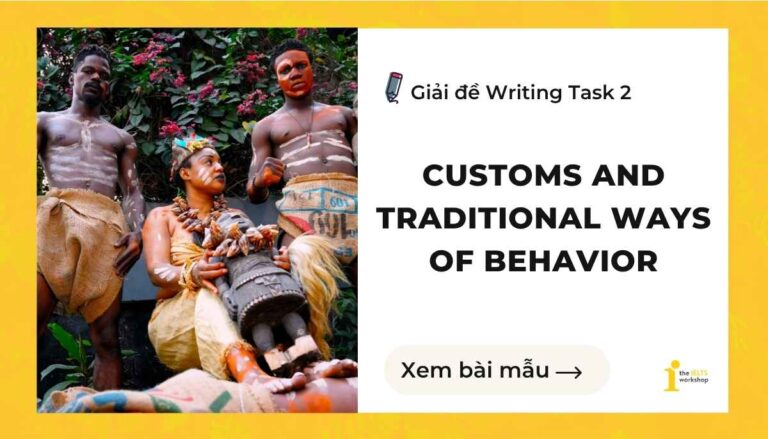
Many customs and traditional ways of behavior are no longer relevant to modern life and not worth keeping. Do you agree or disagree?
(Nhiều phong tục và cách ứng xử truyền thống không còn phù hợp với cuộc sống hiện đại và không đáng để giữ lại. Bạn đồng ý hay không đồng ý?)
1.2. Phân tích đề bài
Dạng bài: Opinion (Agree or Disagree).
Từ khóa chính: Many customs and traditional ways of behavior, no longer relevant, not worth keeping
Xem thêm: Hướng dẫn chi tiết cách viết dạng bài Opinion trong IELTS Writing task 2
1.3. Dàn bài chi tiết
Mở bài: paraphrase đầu bài + cho rằng bạn ủng hộ quan điểm đầu bài
Thân bài 1: Giải thích tại sao một số người lại ủng hộ việc giữ lại tất cả các customs và behavioural norms, sau đó phản biện.
Thân bài 2: Tiếp tục chứng minh nên bỏ các truyền thống, quan niệm cổ hủ đi vì việc giữ chúng sẽ có hại cho social and economic development.
Kết bài: Khẳng định lại quan điểm của bạn.
2. Bài mẫu
Opinions differ on whether many traditional customs and behavioural norms have become obsolete and are no longer worth preserving. I completely agree with this view, as such practices are not only incompatible with modern values but also undermine social and economic progress.
Advocates of preserving all traditions often argue that customs play a vital role in maintain cultural identity and guiding people on how to behave appropriately within a society. They may cite examples such as traditional festivals, forms of greeting, or respect for elders, which help foster a sense of belonging and continuity across generations. Without these practices, societies might risk losing their cultural identity and becoming increasingly homogeneous. This line of reasoning, however, overlooks a crucial point: not all traditions are inherently beneficial or relevant in contemporary contexts. Certain outdated behavioural norms, such as rigid gender roles that discourage women from pursuing careers, stand in stark contrast to modern ideals of equality and personal autonomy. In this sense, continuing to uphold such customs does not preserve cultural identity in any meaningful way, but rather perpetuate outdated mindsets that modern societies are trying to move beyond.
Another important point is that retaining irrelevant traditions can take a toll on both social well-being and economic growth. With regard to the former, adherence to outdated customs can restrict personal autonomy and limit individuals’ ability to make choices that align with their own aspirations. This is particularly evident in societies where traditional expectations dictate career paths or life decisions, thereby stifling creativity and innovation. As for economic growth, certain long-standing practices, such as lavish ceremonies or obligatory social events, can impose unnecessary financial burdens on individuals and families, especially in lower-income communities, as they may feel pressured to do so just to keep up appearances. Resources that could otherwise be invested in education, healthcare, or business development are instead spent on maintaining traditions that offer little practical value.
In conclusion, I strongly agree that many traditional customs and behaviours have lost their relevance and are not worth maintaining. Only when outdated practices are critically reassessed and gradually phased out can societies truly move forward in a way that promotes equality, efficiency, and sustainable development.
Sample by Hoang Hung– IELTS Teacher at The IELTS Workshop
3. Từ vựng (Vocabulary)
- become obsolete: trở nên lỗi thời
- no longer worth preserving: không còn đáng để duy trì
- incompatible with modern values: không phù hợp với giá trị hiện đại
- undermine social and economic progress: làm suy yếu tiến bộ xã hội và kinh tế
- maintain cultural identity: duy trì bản sắc văn hóa
- foster a sense of belonging: nuôi dưỡng cảm giác thuộc về
- inherently beneficial: vốn dĩ có lợi
- stand in stark contrast to: hoàn toàn trái ngược với
- perpetuate outdated mindsets: duy trì những tư duy lỗi thời
- take a toll on: gây ảnh hưởng tiêu cực đến
Xem thêm: Tổng hợp 30+ chủ đề từ vựng IELTS thông dụng mà bạn cần biết
Tạm kết
Hy vọng bài viết từ thầy Hoàng Hưng đã giúp bạn hình dung rõ cách triển khai ý cho bài IELTS Writing Task 2 dạng Opinion chủ đề Customs and traditional ways of behavior một cách chặt chẽ và thuyết phục.
Nếu bạn muốn luyện tập thêm các dạng bài tương tự, đừng quên theo dõi chuyên mục [Cập nhật liên tục] Tổng hợp đề thi IELTS Writing 2026 kèm bài mẫu và Bài mẫu Writing Task 2 từ The IELTS Workshop nhé!
Học IELTS ngay tại HỌC IELTS MIỄN PHÍ cùng các thầy cô 9.0 IELTS tại Website của The IELTS Workshop !