
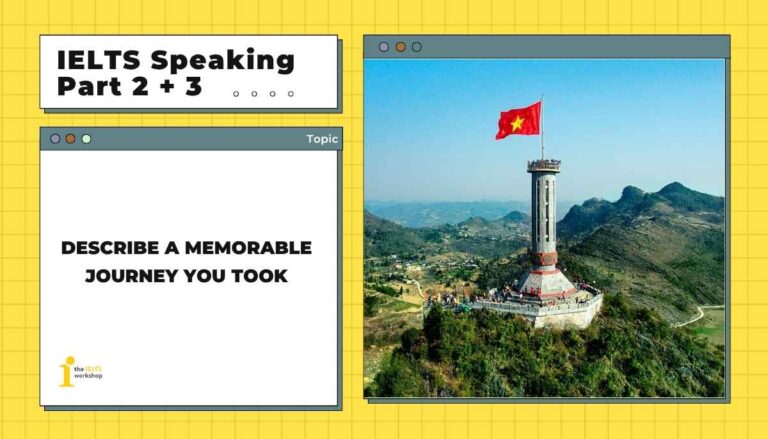
Trong bài giải mẫu lần này, cô Minh Huyền của The IELTS Workshop sẽ hướng dẫn bạn trả lời topic Describe a memorable journey you took. Cùng tham khảo sample, từ vựng và một vài cách diễn đạt ghi điểm trong phần thi IELTS Speaking nhé.
Part 2: Describe a memorable journey you took
Đề bài: Describe a memorable journey you took
You should say:
- Where/When you went
- Why you went
- What happened
- And why it was memorable
1. Bài mẫu (Sample)
One journey that I remember particularly well was a road trip to Ha Giang, which I took with a couple of close friends during the summer of 2023. We had been talking about visiting the northern mountains for months, but we had never actually managed to arrange it because our schedules were so different.
We decided to go there because we wanted to escape the hustle and bustle of city life and experience something completely different. Rather than joining an organised tour, we rented motorbikes and travelled around the area ourselves. Having more freedom to decide where to stop and what to explore made the trip much more exciting.
The journey itself was quite an adventure. On the second day, while we were riding along a winding mountain road, it suddenly started raining heavily. We had no choice but to pull over and wait for the rain to ease off. We were initially worried because the road was becoming extremely slippery, but fortunately, we found a small local café where we could take shelter. By the time the rain had stopped, we had spent nearly two hours there chatting with the owner and trying some local food.
What made the journey particularly memorable was not just the spectacular scenery, but the unexpected experiences we had along the way. If we had travelled as part of a tour group, we probably wouldn’t have had the same opportunity to interact with local people. Looking back, I think the unexpected difficulties actually made the trip more meaningful because they taught me to be more flexible and make the most of an unfamiliar situation.
So, although the journey didn’t go exactly as we had planned, it is precisely because of those unplanned moments that I still remember it so vividly today.
Sample by Minh Huyen– IELTS Teacher at The IELTS Workshop
2. Grammar & Structure Used
Past Simple – kể lại sự kiện trong quá khứ
We decided to go there because we wanted to escape the hustle and bustle of city life.
Dùng để kể các sự kiện chính đã xảy ra và hoàn tất trong quá khứ.
Past Continuous – mô tả hành động đang diễn ra thì có sự việc khác xảy ra
While we were riding along a winding mountain road, it suddenly started raining heavily.
Cấu trúc:
While + S + was/were + V-ing, S + V2/ed
Cách này giúp câu chuyện có tính diễn biến thay vì chỉ liệt kê các sự kiện.
Past Perfect – thể hiện một hành động xảy ra trước một hành động khác trong quá khứ
By the time the rain had stopped, we had spent nearly two hours there.
Dùng Past Perfect để làm rõ thứ tự của các sự kiện trong câu chuyện.
Perfect Gerund / V-ing phrase – rút gọn và tạo sự đa dạng cấu trúc
Having more freedom to decide where to stop and what to explore made the trip much more exciting.
Thay vì viết:
Because we had more freedom…, the trip was…
có thể dùng Having + noun để tạo cấu trúc linh hoạt hơn.
Third Conditional – giả định trái với quá khứ
If we had travelled as part of a tour group, we probably wouldn’t have had the same opportunity…
Cấu trúc:
If + S + had + V3, S + would/could/might have + V3
Dùng để nói về một tình huống trong quá khứ đã không xảy ra.
Cleft/emphatic structure – nhấn mạnh nguyên nhân
It is precisely because of those unplanned moments that I still remember it so vividly today.
Cấu trúc:
It is/was + … + that/who…
Giúp câu trả lời có cách diễn đạt tự nhiên và sophisticated hơn.
Xem thêm: Tổng hợp 30+ chủ đề từ vựng IELTS thông dụng mà bạn cần biết
Part 3:
1. Why do people need to travel every day?
Sample Answer – Band 7.5–8.0
Topic sentence:
I think the main reason people travel every day is that their homes and workplaces or schools are often located in different parts of a city.
Explanation:
Most people cannot afford to live right next to their workplace, while schools and universities are usually concentrated in particular areas. As a result, commuting is simply an unavoidable part of daily life for many people. In addition, people may need to travel for practical purposes, such as shopping, attending appointments or taking their children to school.
Example:
For example, someone who lives in the suburbs of Hanoi may spend an hour or more commuting to the city centre every morning. Although this journey can be tiring, it allows them to live in a relatively quieter and more affordable area while still accessing employment opportunities in the city centre.
Useful vocabulary
- commute – đi lại giữa nhà và nơi làm việc/trường học
- daily commute – việc đi lại hằng ngày
- workplace – nơi làm việc
- suburbs – khu vực ngoại ô
- city centre – trung tâm thành phố
- unavoidable – không thể tránh khỏi
- employment opportunities – cơ hội việc làm
- affordable – có mức giá có thể chi trả được
2. What problems can people have when they are on their daily journey to work or school? Why is this?
Sample Answer – Band 7.5–8.0
Topic sentence:
One of the most common problems is traffic congestion, particularly in large and densely populated cities.
Explanation:
When thousands of people travel at roughly the same time, roads and public transport systems can become overcrowded. This means that commuters may spend a significant amount of time stuck in traffic, which can lead to stress and frustration and fatigue before they even arrive at work or school. Poor public transport infrastructure can make the problem even worse.
Example:
For instance, during rush hour in Hanoi, motorbikes, cars and buses can all be competing for limited road space. Even a relatively short journey can take twice as long as it normally would, leaving people feeling exhausted and less productive when they reach their destination.
Useful vocabulary
- traffic congestion – tắc nghẽn giao thông
- densely populated – đông dân
- overcrowded – quá đông
- rush hour – giờ cao điểm
- public transport infrastructure – cơ sở hạ tầng giao thông công cộng
- limited road space – diện tích đường hạn chế
- stress and frustration – căng thẳng và bực bội
- feel exhausted – cảm thấy kiệt sức
- productive – có năng suất
3. What do you think people can learn from traveling to other countries? Why?
Sample Answer – Band 7.5–8.0
Topic sentence:
I believe international travel can teach people a great deal about cultural differences and different ways of life.
Explanation:
When people visit another country, they are exposed to unfamiliar customs, lifestyles and social norms. This can encourage them to look beyond their own cultural perspective and become more open-minded. Travelling can also help people develop practical skills, such as communication, problem-solving skills and adapting to unfamiliar environments.
Example:
For example, someone travelling alone in a country where they do not speak the local language may initially struggle to communicate. However, by finding alternative ways to express themselves and dealing with unexpected situations independently, they can become more confident and adaptable.
Useful vocabulary
- cultural differences – sự khác biệt văn hóa
- way of life – lối sống
- be exposed to – được tiếp xúc với
- unfamiliar customs – phong tục xa lạ
- social norms – chuẩn mực xã hội
- cultural perspective – góc nhìn văn hóa
- open-minded – cởi mở
- problem-solving skills – kỹ năng giải quyết vấn đề
- adapt to – thích nghi với
- adaptable – có khả năng thích nghi
- deal with unexpected situations – xử lý tình huống bất ngờ
4. Can travel make a positive difference to the economy of a country? How?
Sample Answer – Band 7.5–8.0
Topic sentence:
Absolutely. Tourism can make a significant contribution to a country’s economy by generating income and creating employment.
Explanation:
When international and domestic tourists visit a destination, they spend money on accommodation, restaurants, transportation, entertainment and local products. This creates a multiplier effect, as businesses earn more revenue and may need to hire additional workers. In addition, tourism can provide a source of income for local communities, particularly in areas where there are limited employment opportunities.
Example:
For example, a coastal town that attracts large numbers of tourists may see considerable growth in its hotel, restaurant and transport industries. As demand for these services increases, local businesses are likely to expand, which can create more jobs and increase household income.
However, I think tourism needs to be managed responsibly. If a destination is overly dependent on tourism, it can become vulnerable to economic shocks, such as pandemics or international travel restrictions.
Useful vocabulary
- make a significant contribution to – đóng góp đáng kể vào
- generate income – tạo ra thu nhập
- create employment – tạo việc làm
- tourism industry – ngành du lịch
- local products – sản phẩm địa phương
- multiplier effect – hiệu ứng lan tỏa/số nhân
- revenue – doanh thu
- employment opportunities – cơ hội việc làm
- household income – thu nhập hộ gia đình
- be overly dependent on – phụ thuộc quá mức vào
- be vulnerable to – dễ bị ảnh hưởng bởi
- economic shocks – cú sốc kinh tế
Tạm kết
Hy vọng bài mẫu trên đã giúp bạn hình dung rõ cách triển khai ý tưởng và sử dụng ngôn ngữ phù hợp khi gặp chủ đề Describe a memorable journey you took trong IELTS Speaking Part 2 & 3. Tham khảo các nguồn tài liệu hữu ích như KHO BÀI MẪU IELTS SPEAKING và Bộ đề dự đoán IELTS Speaking cập nhật mới nhất.
HỌC IELTS MIỄN PHÍ – lớp học độc quyền chỉ có trên website của The IELTS Workshop. Đăng ký để bắt đầu lộ trình học bài bản cùng thầy cô tại TIW ngay nhé!