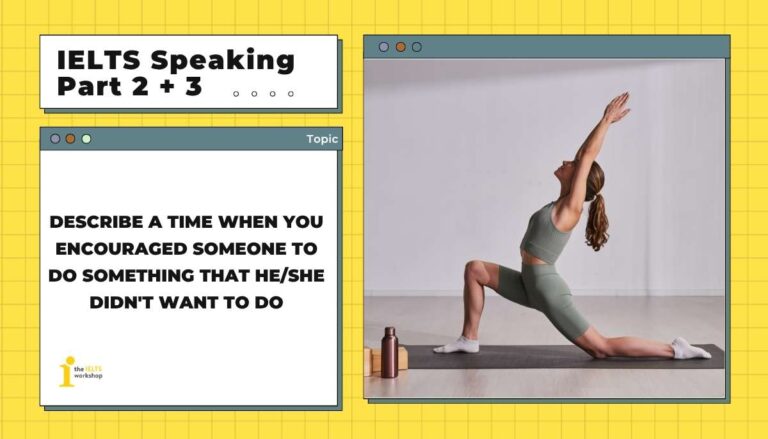
Trong bài giải mẫu lần này, cô Kiều Trinh của The IELTS Workshop sẽ hướng dẫn bạn trả lời topic Describe a time when you encouraged someone to do something that he/she didn’t want to do. Cùng tham khảo sample, từ vựng và một vài cách diễn đạt ghi điểm trong phần thi IELTS Speaking nhé.
Part 2: Describe a time when you encouraged someone to do something that he/she didn’t want to do
Đề bài: Describe a time when you encouraged someone to do something that he/she didn’t want to do
You should say:
- Who he or she is
- What you encouraged him/her to do
- How he/she reacted
- And explain why you encouraged him/her to do it
1. Bài mẫu (Sample)
I must have asked her three or four times, and the answer was always no. She thought Pilates was only for people who were already really fit and flexible, and she was convinced she’d struggle to keep up with the class. I even showed her a few videos to prove that there were beginner options, but if anything the videos put her off even more. She just looked at me and went, “Yeah, there’s absolutely no way I can do that.”
So I changed tactics and asked her to come to just one class. I promised I’d stay next to her, and if she hated it, I’d never bother her about Pilates again. I think she finally agreed just to get me off her back. She was still a bit hesitant when we walked in because everyone else seemed to know what they were doing, but after the first few exercises, I could see her starting to relax. Nobody was watching her, the instructor gave us options to modify certain movements, and she could just go at her own pace.
Afterwards, she admitted, “Okay, that was actually quite fun.” Her legs were shaking and she complained about being sore, but she also laughed about how she’d worked herself up over nothing. It was nowhere near as intimidating as she’d imagined. I obviously couldn’t resist saying, “I told you so.”
And that was really why I kept encouraging her. I genuinely thought she’d enjoy Pilates if she gave it a proper chance. What was holding her back wasn’t that she hated exercise; she was just nervous about walking into a new class and not knowing what she was doing. I think having a friend there helped take the edge off that anxiety and made the first step a little easier.
Sample by Kieu Trinh – IELTS Teacher at The IELTS Workshop
2. Từ vựng (Vocabulary)
- take the edge off something (idiom): làm giảm bớt sự căng thẳng, khó chịu hoặc mức độ nghiêm trọng của điều gì
- struggle to keep up with (v phr): gặp khó khăn trong việc theo kịp
- put someone off (phr v): khiến ai mất hứng hoặc không muốn làm điều gì
- change tactics (v phr): thay đổi cách chiến thuật
- get someone off your back (idiom): làm theo để ai đó thôi làm phiền mình
- hesitant (adj): do dự, ngần ngại
- go at one’s own pace (v phr): làm/tập theo tốc độ phù hợp với bản thân
- work oneself up over something (phr v): tự khiến bản thân lo lắng hoặc căng thẳng quá mức về điều gì
- nowhere near as intimidating as… (phr): hoàn toàn không đáng sợ như…
- give something a proper chance (v phr): thực sự thử/trải nghiệm điều gì trước khi đánh giá
- hold someone back (phr v): cản trở, khiến ai không dám hoặc không thể tiến lên
Xem thêm: Tổng hợp 30+ chủ đề từ vựng IELTS thông dụng mà bạn cần biết
Part 3:
1. Why do people feel compelled to encourage others?
I think one major reason is that people naturally want to support those they care about, especially when they can see someone struggling with self-doubt or lacking motivation. Sometimes an outside perspective can help a person recognize their own potential more clearly. Encouragement can also come from shared experience. For instance, someone who has overcome a similar difficulty may want to reassure others that the same challenge is manageable. More broadly, encouraging others can strengthen interpersonal relationships because it demonstrates empathy and genuine concern for their progress.
- struggle with self-doubt (v phr): gặp khó khăn vì sự nghi ngờ/thiếu niềm tin vào bản thân
- lack motivation (v phr): thiếu động lực
- recognize their own potential (v phr): nhận ra tiềm năng của chính mình
- reassure (v): trấn an, giúp ai cảm thấy bớt lo lắng hoặc tự tin hơn
- manageable (adj): có thể xử lý/vượt qua được, không quá sức
- strengthen interpersonal relationships (v phr): củng cố các mối quan hệ giữa người với người
- empathy (n): sự đồng cảm
- genuine concern (n phr): sự quan tâm chân thành
2. Can you discuss the various methods individuals use to offer encouragement to those around them?
There are several ways to encourage someone, and I think the appropriate method depends largely on the individual. Some people respond well to verbal reassurance, such as being reminded of their previous achievements or strengths. Others benefit more from practical support, for example, having someone help them break a difficult goal into smaller, manageable steps. Another effective approach is leading by example. If people see someone close to them consistently working towards a goal, they may become motivated to do the same. However, encouragement should generally avoid excessive pressure because that can be counterproductive and make people more resistant.
- verbal reassurance (n phr): lời động viên/trấn an bằng lời nói
- practical support (n phr): sự hỗ trợ thiết thực
- lead by example (v phr): làm gương bằng chính hành động của mình
- excessive pressure (n phr): áp lực quá mức
- counterproductive (adj): phản tác dụng, gây ra kết quả ngược với mong muốn
- resistant (adj): có thái độ chống đối/không sẵn sàng tiếp nhận hoặc thay đổi
3. How does encouragement contribute to building confidence and motivation in others?
Encouragement can be particularly powerful because it provides positive reinforcement when someone doubts their own abilities. If a person repeatedly receives sincere recognition for their effort and progress, they may gradually develop greater self-belief. This confidence can then make them more willing to take risks, attempt difficult tasks, and persevere in the face of setbacks. Encouragement can also create a positive cycle: small achievements are recognized, which increases motivation, and that motivation leads to further progress. Over time, people may become less dependent on external encouragement because they have developed stronger intrinsic motivation.
- positive reinforcement (n phr): sự củng cố tích cực, khuyến khích hành vi tốt thông qua sự công nhận/động viên
- sincere recognition (n phr): sự ghi nhận chân thành
- self-belief (n): niềm tin vào bản thân và khả năng của mình
- take risks (v phr): dám chấp nhận rủi ro/thử thách
- persevere in the face of setbacks (v phr): kiên trì khi đối mặt với khó khăn hoặc thất bại
- external encouragement (n phr): sự động viên đến từ người khác/yếu tố bên ngoài
- intrinsic motivation (n phr): động lực nội tại, động lực xuất phát từ chính bản thân
4. In what ways can genuine encouragement foster a positive and supportive environment?
Genuine encouragement can create an environment in which people feel valued and psychologically safe. When individuals know that their efforts will be recognized rather than immediately criticized, they are generally more comfortable expressing ideas, asking for help, and making mistakes. This is particularly important in workplaces and classrooms, where constructive feedback and mutual support can encourage people to participate more actively. It can also promote a culture of cooperation rather than competition, because success is viewed as something people can help one another achieve. Ultimately, this kind of atmosphere can improve both individual well-being and collective performance.
- feel valued (v phr): cảm thấy bản thân được coi trọng
- psychologically safe (adj phr): cảm thấy an toàn về mặt tâm lý
- constructive feedback (n phr): phản hồi mang tính xây dựng
- mutual support (n phr): sự hỗ trợ lẫn nhau
- a culture of cooperation rather than competition (n phr): văn hóa hợp tác thay vì cạnh tranh
- individual well-being (n phr): sức khỏe/trạng thái tích cực của cá nhân
- collective performance (n phr): hiệu quả chung của một tập thể
Tạm kết
Hy vọng bài mẫu trên đã giúp bạn hình dung rõ cách triển khai ý tưởng và sử dụng ngôn ngữ phù hợp khi gặp chủ đề Describe a time when you encouraged someone to do something that he/she didn’t want to do trong IELTS Speaking Part 2 & 3. Tham khảo các nguồn tài liệu hữu ích như KHO BÀI MẪU IELTS SPEAKING và Bộ đề dự đoán IELTS Speaking cập nhật mới nhất.
HỌC IELTS MIỄN PHÍ – lớp học độc quyền chỉ có trên website của The IELTS Workshop. Đăng ký để bắt đầu lộ trình học bài bản cùng thầy cô tại TIW ngay nhé!