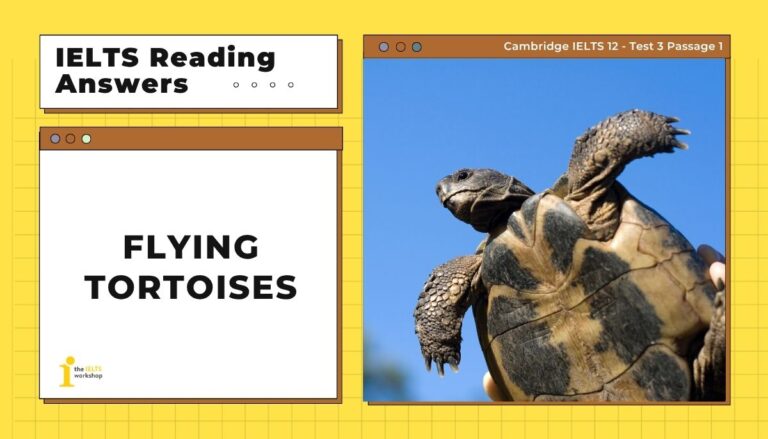
Flying Tortoises là bài đọc thuộc Cambridge IELTS 12 – Test 3 – Reading Passage 1 về chương trình bảo tồn rùa khổng lồ tại quần đảo Galápagos. Trong bài viết này, TIW sẽ tổng hợp Flying Tortoises IELTS Reading Answers, kèm bản dịch và lời giải chi tiết từng câu hỏi, giúp bạn hiểu rõ nội dung bài đọc và cải thiện kỹ năng làm bài IELTS Reading.
1. Đáp án đề Flying Tortoises IELTS Reading
| Câu hỏi | Đáp án |
| 1 | v |
| 2 | iii |
| 3 | viii |
| 4 | i |
| 5 | iv |
| 6 | vi |
| 7 | ii |
| 8 | pirates |
| 9 | food |
| 10 | oil |
| 11 | settlers |
| 12 | species |
| 13 | eggs |
2. Giải thích chi tiết Flying Tortoises IELTS Reading Answers
Dạng bài: Matching Headings ▼
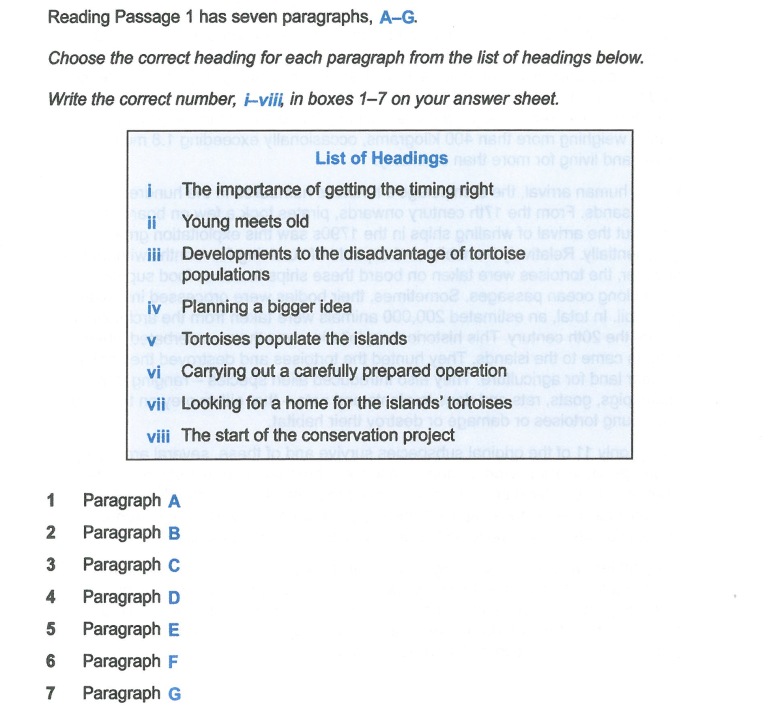
Question 1
Đáp án: v – Tortoises populate the islands (Rùa sinh sống và phát triển quần thể trên các hòn đảo.)
Vị trí trong bài: Đoạn A
“This inhospitable environment is home to the giant Galapagos tortoise. Some time after the Galapagos’s birth, around five million years ago, the islands were colonised by one or more tortoises from mainland South America. As these ancestral tortoises settled on the individual islands […].”
Phân tích:
Đoạn A mô tả quá trình rùa khổng lồ Galápagos (giant Galápagos tortoises) xuất hiện và phát triển trên quần đảo. Khoảng 5 triệu năm trước, rùa từ lục địa Nam Mỹ (mainland South America) đã đến đây sinh sống.
Khi định cư trên từng hòn đảo, các quần thể dần thích nghi với môi trường riêng biệt, hình thành ít nhất 14 phân loài. Vì vậy, ý chính là quá trình rùa định cư và phát triển quần thể trên các đảo.
Các keyword paraphrase:
- populate (sinh sống, hình thành quần thể) → colonised (đến định cư)
- populate the islands (sinh sống trên các đảo) → settled on the individual islands (định cư trên từng hòn đảo)
⇒ Đáp án: v
Question 2
Đáp án: iii – Developments to the disadvantage of tortoise populations (Những diễn biến gây bất lợi cho quần thể rùa.)
Vị trí trong bài: Đoạn B
“From the 17th century onwards, pirates took a few on board for food, but the arrival of whaling ships in the 1790s saw this exploitation grow exponentiall. […] This historical exploitation was then exacerbated when settlers came to the islands.”
Phân tích:
Đoạn B trình bày những hoạt động gây suy giảm quần thể rùa. Từ thế kỷ 17, cướp biển bắt rùa làm thức ăn. Đến những năm 1790, hoạt động khai thác tăng mạnh khi tàu săn cá voi (whaling ships) xuất hiện.
Sau đó, người định cư (settlers) tiếp tục săn bắt rùa, phá hủy môi trường sống và đưa các loài ngoại lai đến đảo. Những diễn biến này đều gây bất lợi cho sự tồn tại của rùa Galápagos.
Các keyword paraphrase:
- developments to the disadvantage (những diễn biến gây bất lợi) → exploitation (sự khai thác)
- to the disadvantage (gây bất lợi) → exacerbated (làm trầm trọng thêm)
- disadvantage of tortoise populations (gây bất lợi cho quần thể rùa) → hunted the tortoises and destroyed their habitat (săn bắt rùa và phá hủy môi trường sống)
⇒ Đáp án: iii
Question 3
Đáp án: viii – The start of the conservation project (Sự khởi đầu của dự án bảo tồn.)
Vị trí trong bài: Đoạn C
“In 1989, work began on a tortoise-breeding centre just outside the town of Puerto Villamil on Isabela, dedicated to protecting the island’s tortoise populations.”
Phân tích:
Đoạn C đề cập đến sự khởi đầu của chương trình bảo tồn rùa Galápagos. Khi chỉ còn 11 phân loài ban đầu tồn tại, năm 1989, người ta bắt đầu xây dựng một trung tâm nhân giống rùa (tortoise-breeding centre) nhằm bảo vệ quần thể rùa trên đảo.
Chương trình nhân giống trong điều kiện nuôi nhốt (captive-breeding programme) thành công đến mức trung tâm phải đối mặt với tình trạng quá tải số lượng rùa.
Các keyword paraphrase:
- the start (sự bắt đầu) → work began (công việc bắt đầu)
- conservation (bảo tồn) → protecting (bảo vệ)
⇒ Đáp án: viii
Question 4
Đáp án: i – The importance of getting the timing right (Tầm quan trọng của việc lựa chọn đúng thời điểm.)
Vị trí trong bài: Đoạn D
“Captive-bred tortoises can’t be reintroduced into the wild until they’re at least five years old and weigh at least 4.5 kilograms… […] But if people wait too long after that point, the tortoises eventually become too large to transport.”
Phân tích:
Đoạn D nhấn mạnh tầm quan trọng của thời điểm thả rùa về tự nhiên. Rùa được nhân giống trong môi trường nuôi nhốt phải đạt ít nhất 5 tuổi và nặng 4,5 kg để có đủ kích thước, trọng lượng và mai cứng giúp bảo vệ chúng khỏi động vật săn mồi.
Tuy nhiên, nếu chờ quá lâu, chúng sẽ phát triển quá lớn và khó vận chuyển. Vì vậy, cần lựa chọn thời điểm phù hợp để đảm bảo cả sự an toàn và khả năng vận chuyển rùa.
⇒ Đáp án: i
Question 5
Đáp án: iv – Planning a bigger idea (Lên kế hoạch cho một ý tưởng có quy mô lớn hơn.)
Vị trí trong bài: Đoạn E
“[…] the environmentalist and Galapagos National Park liaison officer Godfrey Merlin, a visiting private motor yacht captain and a helicopter pilot gathered around a table in a small cafe in Puerto Ayora on the island of Santa Cruz to work out a more ambitious reintroduction.”
Phân tích:
Đoạn E mô tả sự chuyển đổi từ phương pháp vận chuyển rùa với số lượng nhỏ (small numbers) bằng sức người sang một kế hoạch tái thả quy mô lớn hơn (more ambitious reintroduction). Trước đây, người ta phải mang rùa trên lưng qua những con đường nguy hiểm trong nhiều tuần.
Đến năm 2010, một nhóm chuyên gia đã lên kế hoạch sử dụng trực thăng (helicopter) để vận chuyển 300 con rùa đến các khu vực gần Sierra Negra.
Các keyword paraphrase:
- planning (lên kế hoạch) → gathered around a table … to work out (cùng họp bàn để tìm ra phương án)
- bigger idea (ý tưởng lớn hơn) → more ambitious reintroduction (kế hoạch tái thả tham vọng hơn)
- bigger (quy mô lớn hơn) → small numbers / move 300 tortoises (số lượng nhỏ / vận chuyển 300 con rùa)
⇒ Đáp án: iv
Question 6
Đáp án: vi – Carrying out a carefully prepared operation (Triển khai một chiến dịch được chuẩn bị kỹ lưỡng.)
Vị trí trong bài: Đoạn F
“During a period of three days, a group of volunteers from the breeding centre worked around the clock to prepare the young tortoises for transport. Meanwhile, park wardens, dropped off ahead of time in remote locations, cleared landing sites within the thick brush, cacti and lava rocks.”
Phân tích:
Đoạn F tập trung vào quá trình chuẩn bị và triển khai chiến dịch vận chuyển rùa. Trong ba ngày, các tình nguyện viên làm việc suốt ngày đêm (worked around the clock) để chuẩn bị rùa, trong khi nhân viên kiểm lâm dọn dẹp các điểm hạ cánh. Những hoạt động này cho thấy chiến dịch được tổ chức kỹ lưỡng.
Các keyword paraphrase:
- carrying out (triển khai) → worked around the clock (làm việc liên tục / dọn dẹp điểm hạ cánh)
- operation (chiến dịch) → reintroduction effort (nỗ lực tái thả rùa)
⇒ Đáp án: vi
Question 7
Đáp án: ii – Young meets old (Thế hệ trẻ gặp thế hệ già.)
Vị trí trong bài: Đoạn G
“Eventually, one tiny tortoise came across a fully grown giant who had been lumbering around the island for around a hundred years.”
Phân tích:
Đoạn G kể về những con rùa non (juvenile tortoises) sau khi được thả về môi trường tự nhiên. Chúng nhanh chóng khám phá vùng lãnh thổ tổ tiên và tìm kiếm thức ăn.
Đặc biệt, một con rùa nhỏ (tiny tortoise) tình cờ gặp một con rùa khổng lồ trưởng thành (fully grown giant) đã sống trên đảo khoảng 100 năm. Hình ảnh hai con đứng cạnh nhau trở thành biểu tượng cho sự tái sinh của loài rùa cổ xưa (regeneration of an ancient species).
Các keyword paraphrase:
- young (trẻ/non) → juvenile tortoises / tiny tortoise (rùa non/rùa nhỏ)
- old (già) → fully grown giant … around a hundred years (rùa khổng lồ trưởng thành khoảng 100 tuổi)
- meets (gặp gỡ) → came across (tình cờ gặp)
⇒ Đáp án: ii
Dạng bài: Note Completion ▼
Question 8
Đáp án: pirates
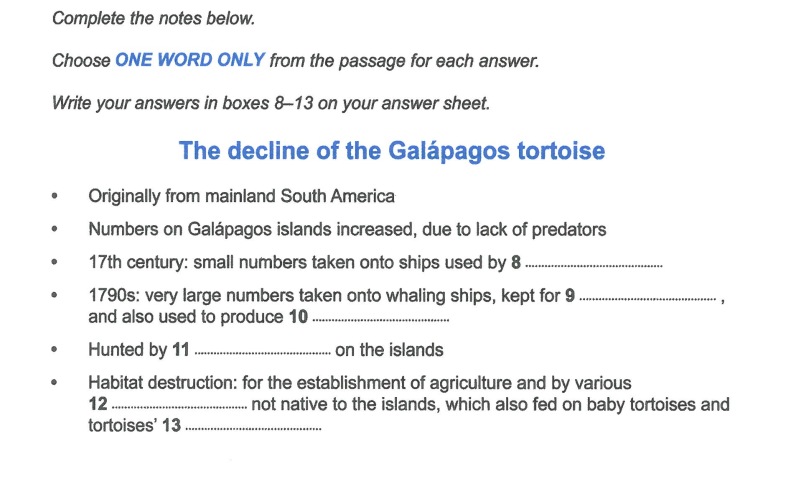
Câu hỏi: 17th century: small numbers taken onto ships used by 8 ______.
(Thế kỷ 17: một số lượng nhỏ rùa bị đưa lên các con tàu được sử dụng bởi ______.)
Vị trí trong bài: Đoạn B
“From the 17th century onwards, pirates took a few on board for food, but the arrival of whaling ships in the 1790s saw this exploitation grow exponentially.”
Phân tích:
Câu hỏi yêu cầu xác định những người đã đưa rùa lên tàu vào thế kỷ 17. Trong bài, tác giả cho biết từ thế kỷ 17 (17th century onwards), cướp biển (pirates) đã bắt một số con rùa và mang lên tàu làm thức ăn. Vì rùa có khả năng sống nhiều tháng mà không cần thức ăn hay nước uống, chúng trở thành nguồn thực phẩm thuận tiện cho những chuyến đi biển dài ngày.
Các keyword paraphrase:
- small numbers (số lượng nhỏ) → a few (một vài)
- taken onto ships (được đưa lên tàu) → took … on board (mang lên tàu)
- ships used by pirates (tàu của cướp biển) → pirates took … on board (cướp biển mang lên tàu)
⇒ Đáp án: pirates
Question 9
Đáp án: food
Câu hỏi: 1790s: very large numbers taken onto whaling ships, kept for 9 ______, and also used to produce 10 ______.
(Những năm 1790: số lượng lớn rùa được đưa lên tàu săn cá voi, giữ lại để làm ______ và sản xuất ______.)
Vị trí trong bài: Đoạn B
“[…] in the 1790s saw this exploitation grow exponentially. Relatively immobile and capable of surviving for months without food or water, the tortoises were taken on board these ships to act as food supplies during long ocean passages.”
Phân tích:
Câu hỏi yêu cầu xác định mục đích rùa được giữ trên tàu săn cá voi (whaling ships). Trong bài, tác giả giải thích rằng rùa di chuyển tương đối chậm (relatively immobile) và có thể sống nhiều tháng không cần thức ăn hay nước uống. Vì vậy, chúng được mang lên tàu để làm nguồn cung cấp thực phẩm (food supplies) trong các chuyến hải trình dài. Đáp án cần điền là food (thức ăn).
Các keyword paraphrase:
- kept for (được giữ lại để làm) → to act as (để đóng vai trò là)
- food (thức ăn) → food supplies (nguồn cung cấp thực phẩm)
⇒ Đáp án: food
Question 10
Đáp án: oil
Câu hỏi: 1790s: very large numbers taken onto whaling ships, kept for 9 ______, and also used to produce 10 ______.
(Những năm 1790: số lượng lớn rùa được đưa lên tàu săn cá voi để làm thức ăn và sản xuất ______.)
Vị trí trong bài: Đoạn B
“Sometimes, their bodies were processed into high-grade oil.”
Phân tích:
Câu hỏi yêu cầu tìm sản phẩm được tạo ra từ rùa ngoài việc sử dụng chúng làm thức ăn. Trong bài, tác giả cho biết đôi khi cơ thể rùa (their bodies) được chế biến thành dầu chất lượng cao (processed into high-grade oil). Điều này cho thấy rùa không chỉ bị khai thác làm thực phẩm mà còn được sử dụng để sản xuất dầu (oil).
Các keyword paraphrase: used to produce (được sử dụng để sản xuất) → processed into (được chế biến thành)
⇒ Đáp án: oil
Question 11
Đáp án: settlers
Câu hỏi: Hunted by 11 ______ on the islands.
(Bị săn bắt bởi ______ trên các hòn đảo.)
Vị trí trong bài: Đoạn B
“This historical exploitation was then exacerbated when settlers came to the islands. They hunted the tortoises and destroyed their habitat to clear land for agriculture.”
Phân tích:
Câu hỏi yêu cầu xác định những người đã săn bắt rùa trên quần đảo Galápagos. Trong bài, tác giả nói tình trạng khai thác rùa trở nên nghiêm trọng hơn khi những người định cư (settlers) đến đảo.
Họ không chỉ săn bắt rùa (hunted the tortoises) mà còn phá hủy môi trường sống (destroyed their habitat) để lấy đất phục vụ nông nghiệp. Đại từ “They” trong câu thứ hai thay thế cho “settlers” ở câu trước.
Các keyword paraphrase:
- hunted by (bị săn bắt bởi) → they hunted the tortoises (họ săn bắt rùa)
- on the islands (trên các hòn đảo) → came to the islands (đến các hòn đảo)
⇒ Đáp án: settlers
Question 12
Đáp án: species
Câu hỏi: Habitat destruction: for the establishment of agriculture and by various 12 ______ not native to the islands, which also fed on baby tortoises and tortoises’ 13 ______.
(Môi trường sống bị phá hủy để phát triển nông nghiệp và bởi nhiều ______ không có nguồn gốc từ các hòn đảo, những loài này còn ăn rùa con và ______ của rùa.)
Vị trí trong bài: Đoạn B
“They also introduced alien species – ranging from cattle, pigs, goats, rats and dogs to plants and ants – that either prey on the eggs and young tortoises or damage or destroy their habitat.”
Phân tích:
Câu hỏi yêu cầu tìm những sinh vật không có nguồn gốc từ quần đảo Galápagos và gây hại cho môi trường sống của rùa. Trong bài, những người định cư đã đưa các loài ngoại lai (introduced alien species) như gia súc, lợn, dê, chuột, chó và kiến đến đảo.
Các loài này có thể ăn trứng, rùa con hoặc phá hủy môi trường sống của chúng. Cụm “not native to the islands” chính là cách diễn đạt lại “alien” (ngoại lai).
Các keyword paraphrase:
- not native to the islands (không có nguồn gốc bản địa) → alien (ngoại lai)
- various species (nhiều loài sinh vật) → ranging from … to … (bao gồm từ … đến …)
- habitat destruction (sự phá hủy môi trường sống) → damage or destroy their habitat (gây hại hoặc phá hủy môi trường sống)
⇒ Đáp án: species
Question 13
Đáp án: eggs
Câu hỏi: …which also fed on baby tortoises and tortoises’ 13 ______.
(…những loài này còn ăn rùa con và ______ của rùa.)
Vị trí trong bài: Đoạn B
“…that either prey on the eggs and young tortoises or damage or destroy their habitat.”
Phân tích:
Câu hỏi yêu cầu xác định thứ mà các loài ngoại lai ăn cùng với rùa con. Trong bài, tác giả cho biết những loài ngoại lai được đưa đến Galápagos có thể săn bắt và ăn (prey on) trứng (eggs) và rùa non (young tortoises).
Đây là một trong những nguyên nhân khiến quần thể rùa suy giảm. Câu hỏi đã đảo thứ tự thông tin trong bài, từ “eggs and young tortoises” thành “baby tortoises and tortoises’ eggs”.
Các keyword paraphrase:
- fed on (ăn/lấy làm thức ăn) → prey on (săn bắt và ăn)
- baby tortoises (rùa con) → young tortoises (rùa non)
⇒ Đáp án: eggs
3. Dịch bài Flying Tortoises IELTS Reading
Flying tortoises
An airborne reintroduction programme has helped conservationists take significant steps to protect the endangered Galapagos tortoise.
Một chương trình tái thả động vật bằng đường hàng không đã giúp các nhà bảo tồn thực hiện những bước tiến quan trọng nhằm bảo vệ loài rùa Galapagos đang có nguy cơ tuyệt chủng.
Từ vựng cần nhớ:
- airborne (adj): trên không, được vận chuyển / thực hiện bằng đường hàng không
- reintroduction (n): sự tái thả, đưa (loài động vật) trở lại môi trường sống tự nhiên
- conservationist (n): nhà bảo tồn thiên nhiên/động vật
- take steps (to do sth) (collocation): tiến hành các bước, thực hiện các biện pháp (để làm gì)
- significant (adj): quan trọng, đáng kể
- endangered (adj): có nguy cơ tuyệt chủng
A
Forests of spiny cacti cover much of the uneven lava plains that separate the interior of the Galapagos island of Isabela from the Pacific Ocean. With its five distinct volcanoes, the island resembles a lunar landscape. Only the thick vegetation at the skirt of the often cloud-covered peak of Sierra Negra offers respite from the barren terrain below.
This inhospitable environment is home to the giant Galapagos tortoise. Some time after the Galapagos’s birth, around five million years ago, the islands were colonised by one or more tortoises from mainland South America. As these ancestral tortoises settled on the individual islands, the different populations adapted to their unique environments, giving rise to at least 14 different subspecies. Island life agreed with them. In the absence of significant predators, they grew to become the largest and longest-living tortoises on the planet, weighing more than 400 kilograms, occasionally exceeding 1.8 metres in length and living for more than a century.
Những cánh rừng xương rồng đầy gai bao phủ phần lớn các đồng bằng dung nham mấp mô ngăn cách phần nội địa của đảo Isabela thuộc quần đảo Galapagos với Thái Bình Dương. Với năm ngọn núi lửa riêng biệt, hòn đảo này trông giống như bề mặt của mặt trăng. Chỉ có thảm thực vật rậm rạp dưới chân đỉnh Sierra Negra quanh năm mây phủ mới mang lại sự dễ chịu khỏi cảnh địa hình cằn cỗi bên dưới.
Môi trường khắc nghiệt này là nơi sinh sống của loài rùa khổng lồ Galapagos. Một thời gian sau khi quần đảo Galapagos hình thành, khoảng 5 triệu năm trước, các hòn đảo đã được chiếm lĩnh bởi một hoặc nhiều con rùa từ lục địa Nam Mỹ. Khi những con rùa tổ tiên này định cư trên từng hòn đảo riêng lẻ, các quần thể khác nhau đã thích nghi với môi trường độc đáo của chúng, làm phát sinh ít nhất 14 phân loài khác nhau. Đời sống trên đảo rất phù hợp với chúng. Khi không có những loài săn mồi đáng kể nào, chúng đã phát triển để trở thành loài rùa lớn nhất và sống thọ nhất trên hành tinh, nặng hơn 400 kg, đôi khi vượt quá chiều dài 1,8 mét và sống thọ hơn một thế kỷ.
Từ vựng cần nhớ:
- spiny (adj): đầy gai, có nhiều gai
- uneven (adj): gồ ghề, không bằng phẳng
- resemble (v): giống với (về hình thức, diện mạo)
- vegetation (n): thảm thực vật, cây cỏ
- respite (n): sự tạm nghỉ, sự giải tỏa / dịu bớt (khỏi điều khó chịu)
- barren (adj): cằn cỗi, trơ trụi
- terrain (n): địa hình, vùng đất
- inhospitable (adj): khắc nghiệt, khó sinh sống
- colonise (v): định cư, chiếm đóng làm nơi sinh sống (loài vật/thực vật)
- ancestral (adj): thuộc tổ tiên, do tổ tiên để lại
- adapt (to sth) (v): thích nghi (với điều gì)
- give rise to (idiom): làm nảy sinh, dẫn đến, tạo ra
- subspecies (n): phân loài (sinh học)
- agree with sb (phr v): hợp với sức khỏe/thể trạng của ai (khí hậu, thức ăn)
- predator (n): động vật ăn thịt, kẻ săn mồi
- exceed (v): vượt quá (số lượng, giới hạn)
B
Before human arrival, the archipelago’s tortoises numbered in the hundreds of thousands. From the 17th century onwards, pirates took a few on board for food, but the arrival of whaling ships in the 1790s saw this exploitation grow exponentially. Relatively immobile and capable of surviving for months without food or water, the tortoises were taken on board these ships to act as food supplies during long ocean passages. Sometimes, their bodies were processed into high-grade oil.
In total, an estimated 200,000 animals were taken from the archipelago before the 20th century. This historical exploitation was then exacerbated when settlers came to the islands. They hunted the tortoises and destroyed their habitat to clear land for agriculture. They also introduced alien species – ranging from cattle, pigs, goats, rats and dogs to plants and ants – that either prey on the eggs and young tortoises or damage or destroy their habitat.
Trước khi con người đặt chân đến, số lượng rùa trên quần đảo lên tới hàng trăm nghìn con. Từ thế kỷ 17 trở đi, những tên cướp biển đã bắt một vài con lên tàu để làm thức ăn, nhưng sự xuất hiện của các tàu săn cá voi vào những năm 1790 đã chứng kiến sự khai thác này gia tăng theo cấp số nhân. Do tương đối chậm chạp và có khả năng sống sót hàng tháng trời mà không cần thức ăn hay nước uống, những con rùa đã bị đưa lên các con tàu này để làm nguồn cung cấp thực phẩm trong suốt các chuyến hải trình dài ngày trên đại dương. Đôi khi, xác của chúng còn được chế biến thành dầu cao cấp.
Tổng cộng, ước tính có khoảng 200.000 cá thể đã bị bắt khỏi quần đảo trước thế kỷ 20. Sự khai thác trong lịch sử này sau đó đã bị làm trầm trọng thêm khi những người định cư đến các hòn đảo. Họ săn lùng rùa và phá hủy môi trường sống của chúng để lấy đất làm nông nghiệp. Họ cũng du nhập các loài ngoại lai – từ gia súc, lợn, dê, chuột và chó cho đến thực vật và kiến – những loài hoặc là săn bắt trứng và rùa con, hoặc làm hư hại và phá hủy môi trường sống của chúng.
Từ vựng cần nhớ:
- archipelago (n): quần đảo
- whaling (n): nghề săn cá voi
- exploitation (n): sự khai thác, bóc lột
- exponentially (adv): theo cấp số nhân, tăng nhanh chóng mặt
- immobile (adj): bất động, không di chuyển
- passage (n): chuyến đi đường biển, hải trình
- process (into) (v): chế biến, xử lý thành
- exacerbate (v): làm trầm trọng thêm, làm xấu đi
- settler (n): người định cư, người khai hoang
- alien species (n phr): loài ngoại lai
- prey on (phr v): săn lùng, ăn thịt (con mồi)
C
Today, only 11 of the original subspecies survive and of these, several are highly endangered. In 1989, work began on a tortoise-breeding centre just outside the town of Puerto Villamil on Isabela, dedicated to protecting the island’s tortoise populations. The centre’s captive-breeding programme proved to be extremely successful, and it eventually had to deal with an overpopulation problem.
Ngày nay, chỉ còn 11 trong số các phân loài nguyên thủy còn tồn tại và trong số này, một vài phân loài đang đứng trước nguy cơ tuyệt chủng cao. Năm 1989, việc xây dựng một trung tâm nhân giống rùa ngay ngoại ô thị trấn Puerto Villamil trên đảo Isabela đã được bắt đầu, chuyên dành riêng cho mục đích bảo vệ các quần thể rùa của hòn đảo. Chương trình nhân giống nuôi nhốt của trung tâm đã cực kỳ thành công, và cuối cùng nó phải đối mặt với vấn đề quá tải cá thể.
Từ vựng cần nhớ:
- dedicated to (adj phr): tận tâm vì, chuyên dùng cho
- captive-breeding (n phr): nuôi nhốt sinh sản / nhân giống trong điều kiện nuôi nhốt
- overpopulation (n): tình trạng quá tải dân số / quá đông cá thể
D
The problem was also a pressing one. Captive-bred tortoises can’t be reintroduced into the wild until they’re at least five years old and weigh at least 4.5 kilograms, at which point their size and weight – and their hardened shells – are sufficient to protect them from predators. But if people wait too long after that point, the tortoises eventually become too large to transport.
Vấn đề này cũng là một vấn đề cấp bách. Rùa sinh sản nuôi nhốt không thể được tái thả về tự nhiên cho đến khi chúng được ít nhất 5 tuổi và nặng ít nhất 4,5 kg, tại thời điểm đó kích thước và cân nặng – cùng với lớp mai đã cứng cáp của chúng – là đủ để bảo vệ chúng khỏi những kẻ săn mồi. Nhưng nếu người ta chờ quá lâu sau mốc thời gian đó, những con rùa cuối cùng sẽ trở nên quá lớn để có thể vận chuyển.
Từ vựng cần nhớ:
- pressing (adj): cấp bách, cấp thiết
- reintroduce (v): tái du nhập, tái thả (về tự nhiên)
- hardened (adj): đã cứng lại, trở nên cứng rắn
- sufficient (adj): đủ, đầy đủ
E
For years, repatriation efforts were carried out in small numbers, with the tortoises carried on the backs of men over weeks of long, treacherous hikes along narrow trails. But in November 2010, the environmentalist and Galapagos National Park liaison officer Godfrey Merlin, a visiting private motor yacht captain and a helicopter pilot gathered around a table in a small cafe in Puerto Ayora on the island of Santa Cruz to work out a more ambitious reintroduction. The aim was to use a helicopter to move 300 of the breeding centre’s tortoises to various locations close to Sierra Negra.
Trong nhiều năm, các nỗ lực đưa rùa về sinh cảnh cũ chỉ được thực hiện với số lượng nhỏ, với những con rùa được cõng trên lưng người qua nhiều tuần đi bộ leo dốc dài ngày đầy nguy hiểm dọc theo những con đường mòn chật hẹp. Nhưng vào tháng 11 năm 2010, nhà môi trường học kiêm cán bộ liên lạc của Vườn quốc gia Galapagos, Godfrey Merlin, cùng với một thuyền trưởng du thuyền tư nhân ghé thăm và một phi công trực thăng đã tập hợp quanh một chiếc bàn trong một quán cà phê nhỏ ở Puerto Ayora trên đảo Santa Cruz để xây dựng một kế hoạch tái thả đầy tham vọng hơn. Mục tiêu là sử dụng một chiếc trực thăng để di chuyển 300 con rùa của trung tâm nhân giống đến nhiều địa điểm khác nhau gần Sierra Negra.
Từ vựng cần nhớ:
- repatriation (n): sự đưa về quê hương / hồi hương (trong sinh học: đưa cá thể về sinh cảnh gốc)
- treacherous (adj): nguy hiểm, hiểm trở, khó lường
- hike (n): chuyến đi bộ đường dài, cuộc leo núi dã ngoại
- liaison officer (n phr): sĩ quan / cán bộ liên lạc
- work out (phr v): tính toán, vạch ra (kế hoạch)
- ambitious (adj): đầy tham vọng, quy mô lớn
F
This unprecedented effort was made possible by the owners of the 67-metre yacht White Cloud, who provided the Galapagos National Park with free use of their helicopter and its experienced pilot, as well as the logistical support of the yacht, its captain and crew. Originally an air ambulance, the yacht’s helicopter has a rear double door and a large internal space that’s well suited for cargo, so a custom crate was designed to hold up to 33 tortoises with a total weight of about 150 kilograms. This weight, together with that of the fuel, pilot and four crew, approached the helicopter’s maximum payload, and there were times when it was clearly right on the edge of the helicopter’s capabilities. During a period of three days, a group of volunteers from the breeding centre worked around the clock to prepare the young tortoises for transport. Meanwhile, park wardens, dropped off ahead of time in remote locations, cleared landing sites within the thick brush, cacti and lava rocks.
Nỗ lực chưa từng có tiền lệ này đã trở thành hiện thực nhờ các chủ sở hữu của chiếc du thuyền dài 67 mét White Cloud, những người đã cung cấp cho Vườn quốc gia Galapagos quyền sử dụng miễn phí máy bay trực thăng của họ và phi công giàu kinh nghiệm, cũng như sự hỗ trợ hậu cần từ du thuyền, thuyền trưởng và thủy thủ đoàn. Ban đầu vốn là một máy bay cứu thương trên không, trực thăng của du thuyền có cửa đôi phía sau và không gian bên trong rộng lớn rất thích hợp để chở hàng hóa, vì vậy một chiếc thùng gỗ được thiết kế riêng có thể chứa tới 33 con rùa với tổng trọng lượng khoảng 150 kg. Trọng lượng này, cùng với trọng lượng của nhiên liệu, phi công và 4 thành viên phi hành đoàn, đã tiến gần đến mức tải trọng tối đa của trực thăng, và có những thời điểm nó rõ ràng chạm sát giới hạn khả năng chịu tải của trực thăng. Trong khoảng thời gian ba ngày, một nhóm tình nguyện viên từ trung tâm nhân giống đã làm việc suốt ngày đêm để chuẩn bị cho các chú rùa con vận chuyển. Trong khi đó, các kiểm lâm viên của công viên, được xuống trước tại các địa điểm xa xôi, đã dọn sạch các bãi đáp giữa những bụi rậm rậm rạp, xương rồng và đá dung nham.
Từ vựng cần nhớ:
- unprecedented (adj): chưa từng có, chưa có tiền lệ
- logistical (adj): thuộc về hậu cần, cung ứng
- cargo (n): hàng hóa (chở trên tàu, máy bay)
- custom (adj): được làm theo yêu cầu, thiết kế riêng
- payload (n): tải trọng hữu ích (của máy bay, phương tiện)
- on the edge of (idiom): bên bờ vực, cận kề giới hạn
- around the clock (idiom): suốt ngày đêm, không ngừng nghỉ
- warden (n): người bảo vệ, nhân viên kiểm lâm khu bảo tồn
- ahead of time (idiom): trước thời hạn, sớm hơn quy định
- brush (n): bụi cây, lùm bụi rậm
G
Upon their release, the juvenile tortoises quickly spread out over their ancestral territory, investigating their new surroundings and feeding on the vegetation. Eventually, one tiny tortoise came across a fully grown giant who had been lumbering around the island for around a hundred years. The two stood side by side, a powerful symbol of the regeneration of an ancient species.
Sau khi được thả ra, những con rùa non nhanh chóng tỏa ra khắp lãnh thổ tổ tiên của chúng, thăm dò môi trường xung quanh mới và ăn cây cỏ. Cuối cùng, một chú rùa bé nhỏ tình cờ bắt gặp một con rùa khổng lồ đã trưởng thành hoàn toàn, vốn đã di chuyển chậm chạp quanh hòn đảo khoảng một trăm năm. Cả hai đứng cạnh nhau, một biểu tượng mạnh mẽ cho sự hồi sinh của một loài sinh vật cổ xưa.
Từ vựng cần nhớ:
- juvenile (adj/n): (loài vật) non, chưa trưởng thành; vị thành niên
- investigate (v): điều tra, tìm hiểu, thám hiểm khám phá
- lumber (v): di chuyển một cách nặng nề, chậm chạp
- regeneration (n): sự tái sinh, sự phục hồi mạnh mẽ
Trên đây là đáp án, giải thích chi tiết và bản dịch bài đọc Flying Tortoises trong Cambridge IELTS 12. Hy vọng nội dung này giúp bạn hiểu rõ bài đọc và nâng cao kỹ năng làm bài IELTS Reading.
Tham gia khóa học IELTS miễn phí tại The IELTS Workshop để rèn luyện cả 4 kỹ năng cùng đội ngũ giáo viên đạt IELTS 8.0 – 9.0 IELTS.

![[PDF +Audio] Cambridge IELTS 8 With Answers](https://onthiielts.com.vn/wp-content/uploads/2020/04/Cam-8-764x400.jpg)
![[PDF +Audio] Cambridge IELTS 7 With Answers](https://onthiielts.com.vn/wp-content/uploads/2020/04/Cam-7-764x400.jpg)