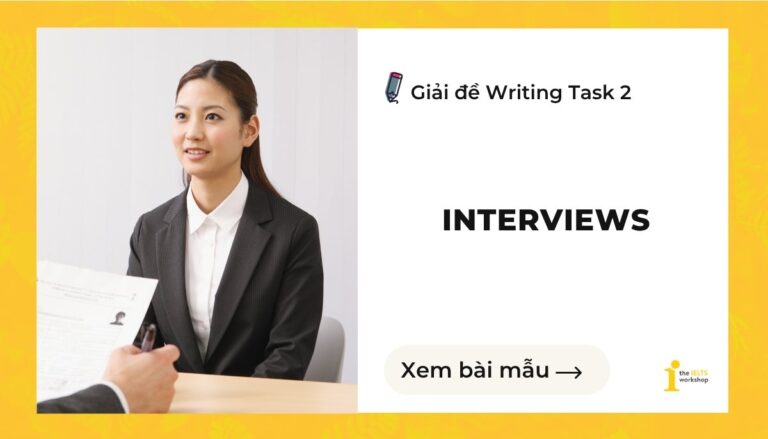
Trong chuyên mục Giải đề IELTS Writing Task 2 tuần này, bạn sẽ cùng thầy Tuấn Ngọc từ The IELTS Workshop khám phá cách xử lý đề bài về chủ đề Interviews trong IELTS Writing Task 2 nhé.
1. Phân tích đề bài
1.1. Đề bài
Interviews form the basic selecting criteria for most large companies. However, some people think that the interview is not a good method of choosing whom to employ. To what extent do you agree or disagree?
(Phỏng vấn là tiêu chí tuyển chọn cơ bản của hầu hết các công ty lớn. Tuy nhiên, một số người cho rằng phỏng vấn không phải là một phương pháp tốt để lựa chọn người được tuyển dụng. Bạn đồng ý hay không đồng ý đến mức độ nào với quan điểm này?)
1.2. Phân tích đề bài
Dạng bài: Opinion
Yêu cầu: đưa ra quan điểm cá nhân về tính hiệu quả của phương pháp phỏng vấn trong tuyển dụng.
Xem thêm: Cách làm dạng Opinion essay IELTS Writing task 2
1.3. Dàn bài chi tiết
Body 1 – Interviews remain valuable
- Benefit 1: Direct interaction
→ Ask follow-up questions, clarify responses, explore candidates in greater depth.
- Benefit 2: Build rapport & facilitate recruitment
→ Foster mutual understanding/cultural fit + flexible formats (face-to-face, phone, online) enable efficient recruitment across locations.
Body 2 – Why interviews are not fully reliable
- Drawback 1: Subjective evaluation
→ Personal bias & interviewer competence may influence hiring decisions more than actual ability.
- Drawback 2: Limited assessment
→ Short conversations cannot fully assess technical expertise, verify information, or predict future performance.
2. Bài mẫu
Job interviews have long been the primary method used by large companies to select new employees. Although some people argue that interviews are not a reliable way of choosing suitable candidates, I believe that they remain an essential part of the recruitment process, provided that they are used alongside other assessment methods.
To begin with, interviews provide an opportunity for direct two-way interaction, allowing both employers and candidates to learn more about each other. Unlike written applications, interviews are highly interactive and flexible, enabling interviewers to ask follow-up questions, clarify ambiguous responses, and explore specific areas of a candidate’s background in greater depth based on how the conversation develops. Moreover, the highly interpersonal nature of interviews helps both parties establish rapport and develop mutual trust, creating a positive first impression and increasing the likelihood of a good cultural fit. This is particularly important in today’s workplace, where qualities such as attitude, mindset, and interpersonal skills are often valued as highly as, if not more than, technical expertise or professional experience. Another major advantage of interviews is their efficiency. Compared with other recruitment methods, they require relatively little preparation or specialised resources while allowing employers to evaluate a large number of applicants within a short period of time. In addition, interviews can be conducted in various formats, ranging from face-to-face meetings and telephone interviews to online video calls, enabling companies to overcome geographical barriers and recruit talent for overseas or remote positions.
Despite these advantages, interviews still suffer from several limitations. Firstly, interview outcomes can be highly subjective, as they are heavily influenced by the interviewer’s personal judgement. Hiring decisions may be affected by factors that have little to do with a candidate’s actual competence or suitability for the role. For example, some applicants may receive preferential treatment because they are relatives of the employer or share similar backgrounds, interests, or personal values with the interviewer, despite these factors having little relevance to their future job performance. In addition, some interviewers may lack the experience, interviewing skills, or professional expertise required to evaluate candidates fairly and effectively, leading to poor hiring decisions. Another limitation is that the relatively short duration of an interview rarely allows employers to gain a comprehensive understanding of a candidate’s abilities, let alone verify the accuracy of the information provided. Furthermore, for highly specialised professions such as doctors, teachers, or technicians, practical competence and technical expertise often cannot be adequately assessed through conversation alone and usually require practical tests or job-related assessments.
In conclusion, I believe that interviews remain an efficient and indispensable stage of the recruitment process. Their interactive and flexible nature enables employers to evaluate candidates from different perspectives and makes them suitable for various recruitment purposes. However, interviews should not be used in isolation. When combined with other selection methods, such as aptitude tests, panel interviews, and probationary periods, employers are able to make more comprehensive and well-informed hiring decisions, greatly improving the reliability, consistency, and fairness of interview outcomes.
Sample by Nguyen Tuan Ngoc– IELTS Teacher at The IELTS Workshop
3. Từ vựng (Vocabulary)
- direct two-way interaction: sự trao đổi trực tiếp giữa hai bên, nhấn mạnh việc cả hai cùng đặt câu hỏi và phản hồi.
- ask follow-up questions: đặt các câu hỏi khai thác thêm để làm rõ hoặc đào sâu câu trả lời.
- clarify ambiguous responses: làm rõ những câu trả lời còn mơ hồ hoặc chưa cụ thể.
- explore a candidate’s background in greater depth: tìm hiểu kỹ hơn về nền tảng, kinh nghiệm hoặc năng lực của ứng viên.
- establish rapport: tạo sự kết nối và bầu không khí thoải mái giữa người phỏng vấn và ứng viên.
- assess cultural fit: đánh giá xem ứng viên có phù hợp với văn hóa và môi trường của tổ chức hay không.
- be heavily influenced by personal judgement: bị chi phối nhiều bởi đánh giá hoặc cảm nhận chủ quan của người phỏng vấn.
- have little relevance to job performance: hầu như không liên quan đến khả năng làm việc thực tế.
- gain a comprehensive understanding of a candidate: có được cái nhìn toàn diện về ứng viên.
- assess technical expertise: đánh giá năng lực chuyên môn hoặc kỹ năng kỹ thuật.
- conduct practical assessments: tổ chức các bài kiểm tra thực hành để đánh giá năng lực thực tế.
- make well-informed hiring decisions: đưa ra quyết định tuyển dụng dựa trên đầy đủ thông tin và cơ sở.
- be used in isolation: được sử dụng như phương pháp duy nhất, không kết hợp với công cụ đánh giá khác.
- standardised assessment criteria: bộ tiêu chí đánh giá được chuẩn hóa nhằm đảm bảo tính nhất quán và công bằng.
- overcome geographical barriers: vượt qua rào cản về khoảng cách địa lý trong tuyển dụng.
Xem thêm: Tổng hợp 30+ chủ đề từ vựng IELTS thông dụng mà bạn cần biết
Tạm kết
Hy vọng bài viết từ thầy Tuấn Ngọc đã giúp bạn hình dung rõ cách triển khai ý cho bài IELTS Writing Task 2 dạng Opinion chủ đề Interviews một cách chặt chẽ và thuyết phục.
Nếu bạn muốn luyện tập thêm các dạng bài tương tự, đừng quên theo dõi chuyên mục [Cập nhật liên tục] Tổng hợp đề thi IELTS Writing 2026 kèm bài mẫu và Bài mẫu Writing Task 2 từ The IELTS Workshop nhé!
Học IELTS ngay tại HỌC IELTS MIỄN PHÍ cùng các thầy cô 9.0 IELTS tại Website của The IELTS Workshop !