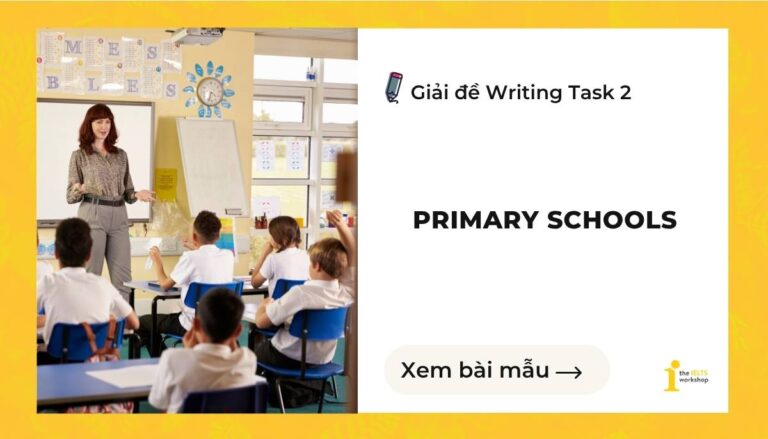
Trong chuyên mục Giải đề IELTS Writing Task 2 tuần này, bạn sẽ cùng thầy Thành Công từ The IELTS Workshop khám phá cách xử lý đề bài về chủ đề Primary schools focus too much on formal learning trong IELTS Writing Task 2 nhé.
1. Phân tích đề bài
1.1. Đề bài
Some people argue that primary schools focus too much on formal learning. To what extent do you agree with this opinion? How important do you think it is for children to play as well as learn in the primary school classroom?
(Một số người cho rằng các trường tiểu học đang quá tập trung vào việc học tập mang tính chính quy/học thuật. Bạn đồng ý với quan điểm này ở mức độ nào? Theo bạn, việc trẻ em được vui chơi bên cạnh việc học trong lớp học ở trường tiểu học quan trọng như thế nào?)
1.2. Phân tích đề bài
Dạng bài: Opinion + 2-part question
Từ khoá chính:
- primary schools: elementary schools / primary education
- formal learning: academic learning / formal education / structured academic instruction
- play: play-based learning / educational games / collaborative activities
- classroom: learning environment / lessons / formal lessons
Yêu cầu đề bài: Đưa ra quan điểm về việc các trường tiểu học có quá chú trọng vào học tập chính quy hay không, đồng thời đánh giá mức độ quan trọng của việc vui chơi bên cạnh học tập trong lớp học
→ Đồng ý phần lớn; play nên được tích hợp vào quá trình học tập thay vì chỉ được xem là hoạt động giải trí
Xem thêm: Cách làm dạng Opinion essay IELTS Writing task 2
1.3. Dàn bài chi tiết
Body 1: Đồng ý rằng formal learning đang được nhấn mạnh quá mức
- Lí do: áp lực đạt được các kết quả học tập có thể đo lường được khiến giáo viên & phụ huynh ưu tiên các môn học cốt lõi
- Hậu quả: trẻ dành nhiều thời gian làm bài, ghi nhớ kiến thức và chuẩn bị cho kiểm tra → không có sự phát triển toàn diện
Body 2: Chơi rất quan trọng và nên được tích hợp vào lớp học
- Chơi giúp trẻ giảm sự mệt mỏi khi học liên tục, tái tạo năng lượng và duy trì khả năng tiếp thu
- Các trò chơi bổ ích có thể giúp củng cố kiến thức, đồng thời phát triển soft skills
2. Bài mẫu
It is often argued that primary schools place excessive emphasis on academic learning. I largely agree with this view, as an overreliance on formal education can come at the expense of children’s holistic development. In addition, I believe play should be integrated into the learning process as an important complement to formal education.
The primary reason why formal learning is overemphasised is the pressure on schools to achieve measurable academic outcomes. Core subjects such as mathematics, literature and science are generally used in important tests to assess students, so teachers and parents may prioritize them over activities whose benefits are less immediately quantifiable. Consequently, children have to spend much of their school day completing exercises, memorising information and preparing for examinations, while little time is devoted to creative, physical or social activities. This can result in a less comprehensive education in which children acquire academic knowledge but have fewer opportunities to develop skills such as creativity, communication and teamwork.
On the other hand, play is equally important in classrooms because it can contribute to children’s overall cognitive and social development while making learning more engaging. Firstly, learning continuously without any breaks or forms of entertainment can be counterproductive as youngsters may not only struggle to retain information but may also suffer from mental health problems. Therefore, play time can provide children with opportunities to replenish their energy, thus enhancing their productivity and ability to absorb knowledge during the main lessons. Play can also be utilized to reinforce academic concepts in a more engaging way. Participating in educational games or collaborative activities, for example, can encourage children to solve problems, make decisions and think creatively rather than passively memorising information. At the same time, playing with classmates requires them to communicate, negotiate and resolve disagreements, all of which are valuable interpersonal skills. In this sense, play should not be viewed merely as a break from learning; it can itself be an effective method of learning.
In conclusion, I agree that primary schools can place too much emphasis on formal learning, particularly when academic performance is prioritised over children’s broader development. Moreover, play is also highly important because it can develop cognitive and interpersonal skills as well as reinforce academic knowledge. Rather than treating play and learning as competing priorities, schools should integrate them to provide a more well-rounded education.
Sample by Nguyen Thanh Cong – IELTS Teacher at The IELTS Workshop
3. Từ vựng (Vocabulary)
- Well-rounded (adj): toàn diện, phát triển cân bằng
- Overreliance (n): sự phụ thuộc quá mức
- Holistic (adj): toàn diện
- Measurable (adj): có thể đo lường được
- Quantifiable (adj): có thể định lượng / đo đếm được
- Cognitive (adj): thuộc nhận thức / tư duy
- Reinforce (v): củng cố, tăng cường
- Collaborative (adj): mang tính hợp tác
- Interpersonal (adj): thuộc về mối quan hệ giữa người với người
- Counterproductive (adj): phản tác dụng
- Replenish (v): bổ sung, phục hồi
- Resolve (v): giải quyết
Xem thêm: Tổng hợp 30+ chủ đề từ vựng IELTS thông dụng mà bạn cần biết
Tạm kết
Hy vọng bài viết từ thầy Thành Công đã giúp bạn hình dung rõ cách triển khai ý cho bài IELTS Writing Task 2 chủ đề Primary schools focus too much on formal learning một cách chặt chẽ và thuyết phục.
Nếu bạn muốn luyện tập thêm các dạng bài tương tự, đừng quên theo dõi chuyên mục [Cập nhật liên tục] Tổng hợp đề thi IELTS Writing 2026 kèm bài mẫu và Bài mẫu Writing Task 2 từ The IELTS Workshop nhé!
Học IELTS ngay tại HỌC IELTS MIỄN PHÍ cùng các thầy cô 9.0 IELTS tại Website của The IELTS Workshop !