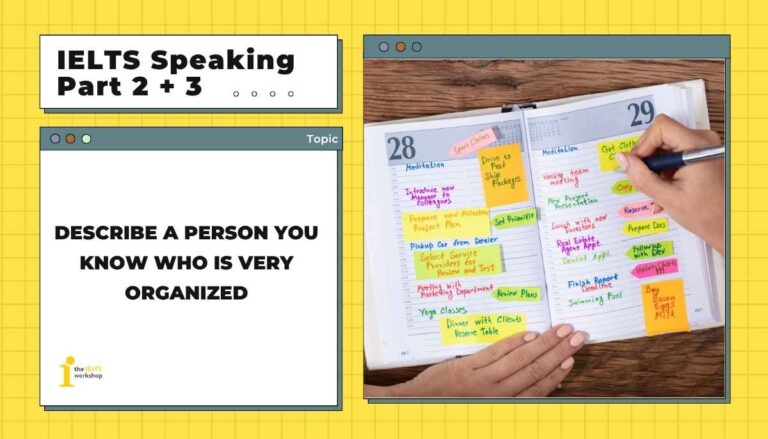
Trong bài giải mẫu lần này, giáo viên Kiều Trinh của The IELTS Workshop sẽ hướng dẫn bạn trả lời topic Describe a person you know who is very organized. Cùng tham khảo sample, từ vựng và một vài cách diễn đạt ghi điểm trong phần thi IELTS Speaking nhé.
Part 2: Describe a person you know who is very organized
Đề bài: Describe a person you know who is very organized.
You should say:
- Who this person is
- What this person usually does to stay organized
- In what situations you have noticed this quality
- And explain why you think being organized is important to him/her
1. Bài mẫu (Sample)
While I’m very much a go-with-the-flow kind of person, my friend Linh is your stereotypical Type A. She plans absolutely everything, and by “everything”, I actually mean everything. We’ve been friends for years, and I swear, even her weekends are scheduled down to the minute.
Her Google Calendar is colour-coded, she has separate to-do lists for work and personal stuff, and she even sets reminders for things most people wouldn’t think twice about. I honestly don’t know how she manages to stay on top of everything, but somehow, she does.
I think the best example would be this trip we took to Da Nang a while back. While the rest of us were busy deciding what outfits to pack, Linh had already mapped out our entire itinerary, complete with restaurant recommendations, travel times, and even backup plans in case it rained. She’d literally thought of everything.
And thank God she had, because our flight ended up getting delayed. I was already mentally preparing myself for our plans to go out the window, but Linh barely batted an eye. She just pulled out her phone, rearranged a few things, and went, “Relax, we’re still on track.” I remember thinking, “How on earth is she this calm?”
She’s exactly the same at work, apparently. She’s always one step ahead, getting things done well before the deadline instead of leaving everything until the last minute like I sometimes do.
I think being organized is almost second nature to her at this point. She absolutely hates feeling overwhelmed or like things are spiralling out of control, so having a clear plan gives her peace of mind. And I guess it also means she can actually switch off and enjoy her free time without constantly worrying about what she might have forgotten.
The funny thing is, I used to think people like her were a bit too rigid. But after travelling with Linh, I’ve come to realize that having everything figured out can actually give you more freedom to enjoy yourself. Especially when you’re travelling with someone like me, who’s perfectly happy to just wing it.
Sample by Kieu Trinh – IELTS Teacher at The IELTS Workshop
2. Từ vựng (Vocabulary)
- go-with-the-flow kind of person (n phr): kiểu người thoải mái, tùy cơ ứng biến, không quá đặt nặng kế hoạch
- stereotypical Type A (n phr): hình mẫu điển hình của người có tính cách Type A – tham vọng, có tổ chức, thích kiểm soát và lên kế hoạch
- scheduled down to the minute (adj phr): được lên lịch chi tiết đến từng phút
- colour-coded (adj): được phân loại hoặc đánh dấu bằng màu sắc
- to-do lists (n phr): danh sách những việc cần làm
- stay on top of everything (idiom): kiểm soát và xử lý tốt mọi công việc, không để bị tồn đọng
- map out an entire itinerary (v phr): lên kế hoạch chi tiết cho toàn bộ lịch trình
- think of everything (v phr): tính đến mọi chi tiết hoặc tình huống có thể xảy ra
- go out the window (idiom): bị phá vỡ, không còn thực hiện được như dự định
- not bat an eye (idiom): không hề nao núng, ngạc nhiên hay lo lắng
- on track (adj phr): đang đi đúng kế hoạch hoặc tiến độ
- one step ahead (idiom): luôn đi trước một bước, có sự chuẩn bị trước
- leave everything until the last minute (v phr): để mọi việc đến phút chót mới làm
- second nature (n phr): thói quen đã trở nên tự nhiên, gần như không cần suy nghĩ
- spiral out of control (idiom): dần trở nên mất kiểm soát
- peace of mind (n phr): cảm giác yên tâm, không phải lo lắng
- have everything figured out (v phr): đã tính toán, sắp xếp hoặc biết rõ cách xử lý mọi việc
- rigid (adj): cứng nhắc, thiếu linh hoạt
- wing it (idiom): làm gì đó tùy hứng, không chuẩn bị hoặc lên kế hoạch trước
Xem thêm: Tổng hợp 30+ chủ đề từ vựng IELTS thông dụng mà bạn cần biết
Part 3:
1. Why is it important for people to be organized?
I think being organized is important because it allows people to manage their time and resources more efficiently. When someone has a clear idea of what needs to be done, they’re less likely to waste time on unnecessary tasks or miss important deadlines. It can also help reduce mental stress, since they don’t have to constantly worry about forgetting something. That being said, I don’t think being organized necessarily means planning every minute of the day. It’s more about setting priorities and making sure important responsibilities are taken care of without becoming overwhelmed.
- manage time and resources efficiently (v phr): quản lý thời gian và nguồn lực một cách hiệu quả
- miss important deadlines (v phr): bỏ lỡ những thời hạn quan trọng
- reduce mental stress (v phr): giảm căng thẳng tinh thần
- set priorities (v phr): xác định thứ tự ưu tiên
- take care of responsibilities (v phr): hoàn thành hoặc đảm đương các trách nhiệm
2. Do you think children should learn to be organized from a young age?
Yes, I think developing organizational skills early in life can be extremely beneficial. Simple habits like keeping school supplies in order, preparing their bags the night before, or following a daily routine can help children develop self-discipline and a sense of responsibility. These habits can also encourage them to become more independent rather than constantly relying on adults. However, I think it’s important that parents and teachers introduce these skills gradually. Children still need time for unstructured play and spontaneous activities, so organization shouldn’t come at the expense of their creativity or enjoyment.
- organizational skills (n phr): kỹ năng tổ chức và sắp xếp công việc
- self-discipline (n): tính tự giác, khả năng tự kỷ luật
- a sense of responsibility (n phr): ý thức trách nhiệm
- become more independent (v phr): trở nên độc lập và tự chủ hơn
- unstructured play (n phr): hoạt động vui chơi tự do, không theo kế hoạch cố định
- come at the expense of something (idiom): đạt được điều gì nhưng phải đánh đổi bằng một điều khác
3. Are organized people more likely to be successful at work or in their studies?
To some extent, yes. People who are well-organized generally find it easier to prioritize tasks and meet deadlines consistently, which can give them an advantage in both academic and professional settings. For example, students who follow a structured revision schedule are usually better prepared for exams than those who leave everything until the last minute. However, I wouldn’t say organization alone guarantees success. Qualities like creativity, adaptability, and problem-solving abilities are equally important. Someone might be extremely organized but still struggle if they lack the necessary knowledge or skills.
- prioritize tasks (v phr): sắp xếp công việc theo mức độ ưu tiên
- meet deadlines consistently (v phr): luôn hoàn thành công việc đúng hạn
- academic and professional settings (n phr): môi trường học tập và làm việc
- structured revision schedule (n phr): lịch trình ôn tập có hệ thống
- guarantee success (v phr): đảm bảo sự thành công
- problem-solving abilities (n phr): khả năng giải quyết vấn đề
4. What can people do to become more organized?
I think the key is to start with small, manageable changes rather than trying to completely transform your routine overnight. For instance, people could begin by making a daily to-do list or using a digital calendar to keep track of appointments and deadlines. Another useful strategy is to break larger tasks into smaller steps, which makes them feel less overwhelming. It’s also important to establish consistent routines, like spending ten minutes each evening planning the following day. Over time, these small habits can become second nature, making it easier to stay organized without constantly having to think about it.
- start with small, manageable changes (v phr): bắt đầu bằng những thay đổi nhỏ, dễ thực hiện
- transform one’s routine overnight (v phr): thay đổi hoàn toàn thói quen trong thời gian rất ngắn
- keep track of appointments and deadlines (v phr): theo dõi các cuộc hẹn và thời hạn công việc
- break larger tasks into smaller steps (v phr): chia nhiệm vụ lớn thành những bước nhỏ
- establish consistent routines (v phr): xây dựng những thói quen đều đặn
- second nature (n phr): thói quen đã trở nên tự nhiên, gần như không cần suy nghĩ
5. Should parents teach their children to be organized?
Definitely, although I think the way parents teach these skills matters just as much as the skills themselves. Children often learn by observing and imitating adult behaviour, so parents can lead by example by keeping their own belongings organized or following consistent routines. They can also give children age-appropriate responsibilities, such as tidying their rooms or preparing their school materials. These activities help children develop independence and take ownership of their responsibilities. However, parents should avoid being overly controlling, because children need opportunities to make mistakes and figure out what organizational methods work best for them.
- observe and imitate adult behaviour (v phr): quan sát và bắt chước hành vi của người lớn
- lead by example (v phr): làm gương bằng chính hành động của mình
- age-appropriate responsibilities (n phr): những trách nhiệm phù hợp với độ tuổi
- take ownership of one’s responsibilities (v phr): chủ động nhận và chịu trách nhiệm với công việc của mình
- overly controlling (adj phr): kiểm soát quá mức
6. Do you think it is important for managers to be well organized?
Absolutely. Managers are often responsible for coordinating multiple tasks, supervising employees, and ensuring that projects are completed on schedule. Without strong organizational skills, they may struggle to allocate resources effectively or communicate expectations clearly, which can lead to confusion and unnecessary delays. A well-organized manager, on the other hand, can establish clear priorities, delegate responsibilities appropriately, and help their team work more efficiently. I also think good organization contributes to a healthier working environment because employees are less likely to experience last-minute pressure caused by poor planning.
- coordinate multiple tasks (v phr): điều phối nhiều công việc cùng lúc
- allocate resources effectively (v phr): phân bổ nguồn lực hiệu quả
- unnecessary delays (n phr): những sự chậm trễ không cần thiết
- delegate responsibilities appropriately (v phr): phân công trách nhiệm một cách phù hợp
- last-minute pressure (n phr): áp lực vào phút chót do công việc gấp hoặc thiếu chuẩn bị
Tạm kết
Hy vọng bài mẫu trên đã giúp bạn hình dung rõ cách triển khai ý tưởng và sử dụng ngôn ngữ phù hợp khi gặp chủ đề Describe a person you know who is very organized trong IELTS Speaking Part 2 & 3. Tham khảo các nguồn tài liệu hữu ích như KHO BÀI MẪU IELTS SPEAKING và Bộ đề dự đoán IELTS Speaking cập nhật mới nhất.
HỌC IELTS MIỄN PHÍ – lớp học độc quyền chỉ có trên website của The IELTS Workshop. Đăng ký để bắt đầu lộ trình học bài bản cùng thầy cô tại TIW ngay nhé!