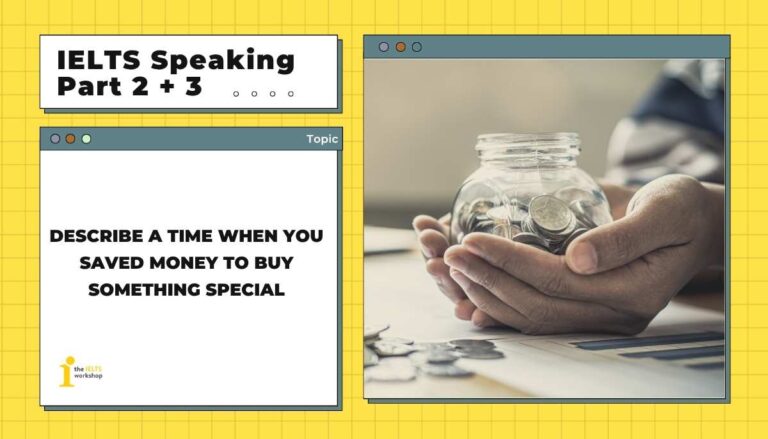
Trong bài giải mẫu lần này, giáo viên Minh Huyền của The IELTS Workshop sẽ hướng dẫn bạn trả lời topic Describe a time when you saved money to buy something special. Cùng tham khảo sample, từ vựng và một vài cách diễn đạt ghi điểm trong phần thi IELTS Speaking nhé.
Part 2: Describe a time when you saved money to buy something special
Đề bài: Describe a time when you saved money to buy something special
You should say:
- What the special thing was
- Why you wanted to buy it
- How you saved money for it
- And explain how you felt after buying it
Tip: Kể câu chuyện theo trình tự Background → Motivation → Challenge → Action → Result → Reflection. Kết hợp Past Simple, Past Perfect và Present Simple để bài nói có chiều sâu về thời gian.
Storytelling structure & tense variety
| Story stage | Useful language | Tense / Grammar |
| Introduction | I’d like to talk about a time when… | Past simple |
| Background | I had always dreamed of having… | Past perfect |
| Motivation | Instead of asking…, I decided to… | Gerund + past simple |
| Saving process | I started putting aside… | Past simple |
| Difficulty | There were times when I was tempted… | Past simple + passive |
| Turning point | After six months, I had finally saved… | Past perfect |
| Feelings | I had never spent that much money… | Past perfect |
| Reflection | Even now, whenever I use it… | Present simple |
1. Bài mẫu (Sample)
I’d like to talk about a time when I saved up for months to buy my very first laptop, which was something I’d wanted for ages.
It happened about two years ago, when I was in high school. Back then, I had to share an old computer with my younger brother, which was quite inconvenient, especially when we both had homework to finish. I had always dreamed of having a laptop of my own, but my parents thought it was too expensive and suggested that I should wait until university.
Instead of asking them to buy it for me, I decided to take matters into my own hands. I started putting aside a small amount of my weekly allowance and stopped spending money on unnecessary things like bubble tea and snacks. On top of that, I took a part-time job tutoring a younger student at weekends, which helped me earn a little extra cash.
To be honest, it wasn’t easy at first. There were times when I was tempted to spend my savings, especially when my friends invited me out. However, whenever I felt like giving up, I reminded myself of my goal. After about six months, I had finally saved enough money to buy the laptop.
I still remember the day I walked into the electronics store. My heart was racing as I handed over the money. I had never spent that much money on anything before, so I felt both nervous and incredibly excited.
Looking back, it was definitely worth every penny. Not only did the laptop make studying much more convenient, but the whole experience also taught me the importance of patience and financial discipline. Even now, whenever I use it, I feel a sense of pride because I know how much effort I put into earning it.
Sample by Minh Huyen – IELTS Teacher at The IELTS Workshop
2. Từ vựng (Vocabulary)
- Save up for something: Tiết kiệm, dành dụm để mua thứ gì
- For ages: Từ rất lâu rồi
- Dream of having something: Mơ ước sở hữu thứ gì
- Take matters into my own hands: Tự mình giải quyết vấn đề
- Put aside money: Để dành tiền
- Weekly allowance: Tiền tiêu vặt hằng tuần
- Unnecessary expenses: Những khoản chi không cần thiết
- Part-time job: Công việc bán thời gian
- Earn extra cash: Kiếm thêm tiền
- Be tempted to do something: Bị cám dỗ làm gì
- Feel like giving up: Muốn bỏ cuộc
- My heart was racing: Tim tôi đập rất nhanh
- Worth every penny: Rất đáng đồng tiền bỏ ra
- Financial discipline: Kỷ luật tài chính
- A sense of pride: Cảm giác tự hào
- Put effort into something: Bỏ công sức vào việc gì
Xem thêm: Tổng hợp 30+ chủ đề từ vựng IELTS thông dụng mà bạn cần biết
Part 3:
Structure: Bắt đầu bằng một topic sentence thể hiện rõ quan điểm, sau đó triển khai theo công thức:
Point → Explain → Example → Result
1. Should schools teach children how to manage money from a young age?
Absolutely. I believe financial education should be introduced at an early age because it equips children with essential life skills.
For one thing, learning how to budget and save money helps children understand the difference between needs and wants. Without this knowledge, they might develop poor spending habits as they grow older.
For example, schools could give students a small imaginary budget and ask them to plan their monthly expenses. This would teach them how to make sensible financial decisions in a practical way.
Ultimately, I think introducing financial literacy early on would help young people become more financially responsible in adulthood.
- Financial education: Giáo dục tài chính
- Equip someone with something: Trang bị cho ai kiến thức/kỹ năng
- Essential life skills: Kỹ năng sống thiết yếu
- Budget: Lập ngân sách
- Needs and wants: Nhu cầu thiết yếu và mong muốn
- Poor spending habits: Thói quen chi tiêu không tốt
- Sensible financial decisions: Quyết định tài chính hợp lý
- Financial literacy: Kiến thức, hiểu biết về tài chính
- Financially responsible: Có trách nhiệm trong quản lý tiền bạc
2. Should parents teach their children to spend money freely or to save money?
I think parents should encourage a balance between spending and saving rather than focusing entirely on one or the other.
On the one hand, teaching children to save money helps them develop self-control and prepare for future expenses. On the other hand, being overly strict about spending could make children feel that they should never enjoy their money.
For instance, parents could encourage their children to save a certain percentage of their allowance while allowing them to spend the rest on things they enjoy.
In this way, children can learn to be financially disciplined without feeling deprived of life’s small pleasures.
- Strike a balance: Tìm được sự cân bằng
- Focus entirely on: Chỉ tập trung vào
- Develop self-control: Phát triển khả năng tự kiểm soát
- Future expenses: Các khoản chi tiêu trong tương lai
- Overly strict: Quá nghiêm khắc
- A certain percentage: Một tỷ lệ phần trăm nhất định
- Feel deprived of something: Cảm thấy bị thiếu thốn điều gì
- Life’s small pleasures: Những niềm vui nhỏ trong cuộc sống
3. Do you think it is easier to teach teenagers how to manage money when they are around 16 or 17 years old?
Yes, I think 16 or 17 is an ideal age to teach financial management because teenagers are becoming more independent and are better able to understand the consequences of their decisions.
At this stage, many teenagers begin receiving larger allowances or even earning money from part-time jobs. As a result, financial lessons become more relevant to their everyday lives.
For example, a 17-year-old who earns money from tutoring may be more motivated to learn how to budget, because they have experienced firsthand how much effort it takes to earn that money.
However, I wouldn’t say financial education should only begin at this age. Younger children can still learn basic concepts, while older teenagers are ready for more complex topics such as saving, debt and interest rates.
- An ideal age: Độ tuổi lý tưởng
- Financial management: Quản lý tài chính
- Become more independent: Trở nên độc lập hơn
- Consequences of decisions: Hệ quả của các quyết định
- Part-time jobs: Công việc bán thời gian
- Relevant to everyday life: Liên quan đến cuộc sống hằng ngày
- Experience firsthand: Trực tiếp trải nghiệm
- Basic concepts: Các khái niệm cơ bản
4. Is it easier to spend money or save money?
Generally speaking, I think spending money is much easier than saving it, mainly because people are constantly exposed to temptation.
These days, online shopping platforms and social media advertisements make it incredibly convenient to buy things with just a few clicks. As a result, many people end up making impulsive purchases without considering whether they actually need those products.
Saving money, by contrast, requires long-term planning and self-discipline. People often have to sacrifice immediate satisfaction in order to achieve a bigger financial goal.
That said, I believe saving becomes easier once it turns into a habit, especially if people automatically set aside part of their income every month.
- Be exposed to temptation: Tiếp xúc với nhiều cám dỗ
- Online shopping platforms: Nền tảng mua sắm trực tuyến
- With just a few clicks: Chỉ với vài cú nhấp chuột
- Impulsive purchases: Những lần mua sắm bốc đồng
- Long-term planning: Lập kế hoạch dài hạn
- Self-discipline: Tính kỷ luật bản thân
- Immediate satisfaction: Sự thỏa mãn tức thời
- Financial goal: Mục tiêu tài chính
- Set aside part of one’s income: Dành ra một phần thu nhập
5. What kind of things do people usually save money for?
I think people generally save money for three main purposes: major purchases, future security and personal experiences.
First of all, many people put money aside for expensive items such as a car, a house or a new electronic device. These purchases often require months or even years of careful financial planning.
Another common reason is to prepare for unexpected expenses. For example, having an emergency fund can help people cope with sudden medical bills or unemployment without falling into debt.
Finally, some people save for meaningful experiences, such as travelling abroad or pursuing further education. Personally, I think these experiences can be just as valuable as material possessions because they create lasting memories and opportunities for personal growth.
- Major purchases: Những khoản mua sắm lớn
- Future security: Sự an toàn tài chính trong tương lai
- Put money aside: Để dành tiền
- Careful financial planning: Lập kế hoạch tài chính cẩn thận
- Unexpected expenses: Những khoản chi bất ngờ
- Emergency fund: Quỹ dự phòng khẩn cấp
- Cope with: Đối phó với
- Fall into debt: Rơi vào cảnh nợ nần
- Pursue further education: Theo đuổi việc học cao hơn
- Material possessions: Tài sản, đồ vật sở hữu
- Lasting memories: Những kỷ niệm lâu dài
- Personal growth: Sự phát triển bản thân
6. Should people spend time on charity, or just money?
I believe both time and money are valuable forms of charitable contribution, but volunteering can sometimes have a more direct and meaningful impact.
Donating money is certainly important because charities need financial resources to provide food, education and medical assistance to disadvantaged communities. It also allows busy people to support good causes even if they cannot participate in person.
However, volunteering offers something that money alone cannot always provide: personal interaction and emotional support. For example, spending a few hours teaching underprivileged children can make a real difference to their education and confidence.
Ideally, people should contribute in whatever way suits their circumstances. After all, the most important thing is not how much someone gives, but whether their contribution genuinely helps those in need.
- Charitable contribution: Đóng góp từ thiện
- Volunteering: Hoạt động tình nguyện
- Meaningful impact: Tác động có ý nghĩa
- Donate money: Quyên góp tiền
- Financial resources: Nguồn lực tài chính
- Medical assistance: Hỗ trợ y tế
- Disadvantaged communities: Cộng đồng có hoàn cảnh khó khăn
- Support good causes: Ủng hộ những mục đích tốt đẹp
- Emotional support: Hỗ trợ tinh thần
- Underprivileged children: Trẻ em thiệt thòi
- Suit one’s circumstances: Phù hợp với hoàn cảnh của ai
- Those in need: Những người cần được giúp đỡ
Tạm kết
Hy vọng bài mẫu trên đã giúp bạn hình dung rõ cách triển khai ý tưởng và sử dụng ngôn ngữ phù hợp khi gặp chủ đề Describe a time when you saved money to buy something special trong IELTS Speaking Part 2 & 3. Tham khảo các nguồn tài liệu hữu ích như KHO BÀI MẪU IELTS SPEAKING và Bộ đề dự đoán IELTS Speaking cập nhật mới nhất.
HỌC IELTS MIỄN PHÍ – lớp học độc quyền chỉ có trên website của The IELTS Workshop. Đăng ký để bắt đầu lộ trình học bài bản cùng thầy cô tại TIW ngay nhé!