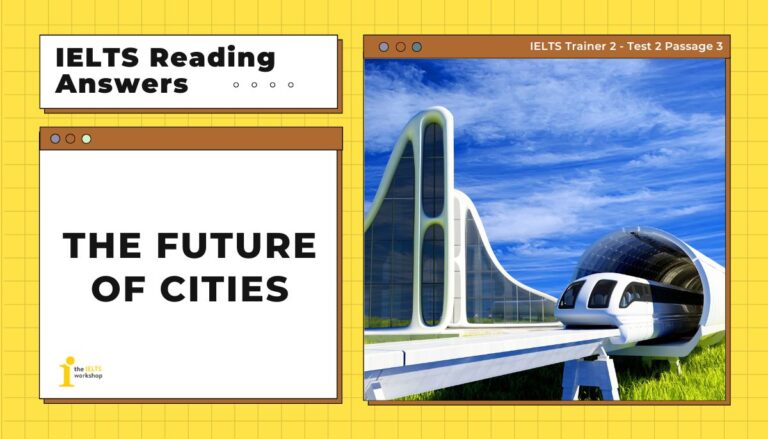
The future of cities là bài đọc thuộc Reading Passage 3 – Test 2 trong cuốn IELTS Trainer 2, với nhiều câu hỏi yêu cầu người học xác định và phân tích thông tin trong bài. Trong bài viết này, TIW sẽ cung cấp The future of cities IELTS Reading Answers, dịch nội dung và giải thích chi tiết từng câu hỏi, giúp bạn hiểu rõ đáp án và nâng cao kỹ năng làm bài.
1. Đáp án đề The future of cities
| Câu hỏi | Đáp án |
| 1 | E |
| 2 | F |
| 3 | H |
| 4 | A |
| 5 | C |
| 6 | A |
| 7 | C |
| 8 | D |
| 9 | B |
| 10 | YES |
| 11 | NOT GIVEN |
| 12 | NO |
| 13 | NO |
| 14 | YES |
2. Giải thích chi tiết The future of cities IELTS Reading Answers
Dạng bài: Summary completion ▼
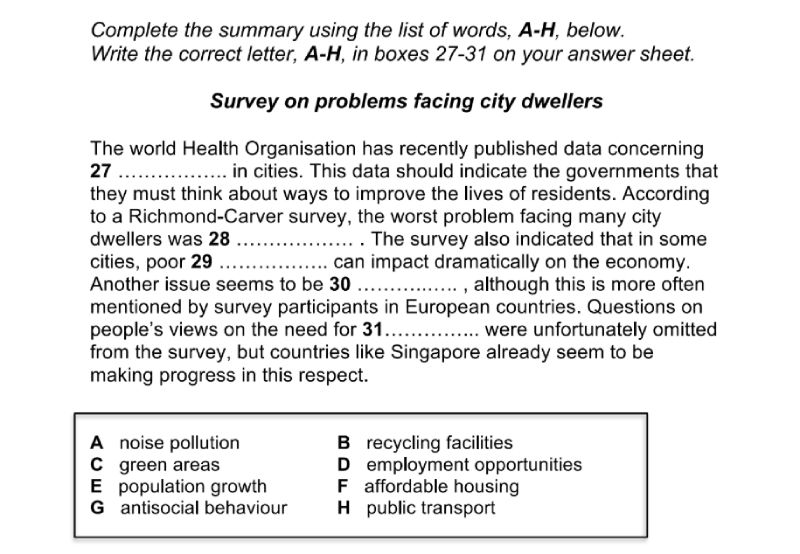
Question 1
Đáp án: E. population growth
Câu hỏi: The world Health Organisation has recently published data concerning 27…………. in cities. (Tổ chức Y tế Thế giới gần đây đã công bố dữ liệu liên quan đến… tại các thành phố.)
Vị trí: Đoạn (Dòng 1 – 3)
“The World Health Organisation has produced a report predicting that 9.8 billion of us will be living on this planet by 2050. Of that number, 72% will be living in urban areas – a higher proportion than ever before.”
Giải thích:
- Cụm từ “produced a report” tương đương với “recently published data” (công bố dữ liệu/báo cáo).
- Dữ liệu trong bài đề cập đến việc dân số thế giới đạt 9,8 tỷ người và 72% sống ở đô thị (urban areas = cities), tỷ lệ này cao hơn bao giờ hết, phản ánh sự gia tăng dân số (population growth).
⇒ Đáp án: E. population growth
Question 2
Đáp án: F. affordable housing
Câu hỏi: According to a Richmond-Carver survey, the worst problem facing many city dwellers was 28………….. (Theo một cuộc khảo sát của Richmond-Carver, vấn đề tồi tệ nhất mà nhiều cư dân thành phố phải đối mặt là….)
Vị trí: Đoạn 1 (Dòng 5 – 7)
“At the top of the list of survey respondents’ concerns is the fact that competition amongst tenants for rental properties has driven the median price up – so much so people need to hold down two or more jobs to meet all their expenses.”
Giải thích:
- Cụm từ “At the top of the list” (đứng đầu danh sách mối lo ngại) được paraphrase thành “the worst problem” (vấn đề tồi tệ/nghiêm trọng nhất).
- Mối lo ngại này là giá thuê nhà bị đẩy lên quá cao khiến người dân phải làm 2–3 công việc mới đủ tiền trang trải sinh hoạt phí phản ánh việc thiếu thốn nhà ở giá cả phải chăng (affordable housing).
⇒ Đáp án: F. affordable housing
Question 3
Đáp án: H. public transport
Câu hỏi: The survey also indicated that in some cities, poor 29………… can impact dramatically on the economy. (Khảo sát cũng chỉ ra rằng ở một số thành phố, hệ thống ……. kém có thể tác động nghiêm trọng đến nền kinh tế.)
Vị trí: Đoạn 1 (Dòng 7 – 10)
“Another issue the survey highlighted is the difficulty commuters face. Overcrowding means that seats are often not available on long journeys, but more significant is that schedules are unreliable. Many studies have shown the effect that has on a country’s productivity.”
Giải thích:
- Commuters (người đi làm bằng phương tiện công cộng) gặp khó khăn do xe/tàu quá tải và lịch trình không đáng tin cậy (unreliable schedules), ám chỉ chất lượng giao thông công cộng kém (poor public transport).
- Ảnh hưởng tới năng suất của một quốc gia (a country’s productivity) đồng nghĩa với việc tác động mạnh đến nền kinh tế (impact dramatically on the economy)
⇒ Đáp án: H. public transport’
Question 4
Đáp án: A. noise pollution
Câu hỏi: Another issue seems to be 30…………… , although this is more often mentioned by survey participants in European countries. (Một vấn đề khác dường như là….., mặc dù điều này thường được nhắc đến bởi những người tham gia khảo sát ở các quốc gia châu Âu.)
Vị trí: Đoạn 1 (Dòng 10 – 13)
“…respondents from increasingly crowded European cities, including Manchester and Barcelona, commented on how their quality of life was affected by loud machinery, other people’s music and car alarms.”
Giải thích:
- Bài đọc liệt kê các âm thanh gây ảnh hưởng đến chất lượng sống của cư dân châu Âu như tiếng máy móc ồn ào (loud machinery), nhạc của người khác (other people’s music) và còi báo động ô tô (car alarms).
- Tất cả các yếu tố trên đều cấu thành nên hiện tượng ô nhiễm tiếng ồn (noise pollution).
⇒ Đáp án: A. noise pollution
Question 5
Đáp án: C. green areas
Câu hỏi: Questions on people’s view on the need for 31………. were unfortunately omitted from the survey, but countries like Singapore already seem to be making progress in this respect. (Các câu hỏi về quan điểm của người dân đối với nhu cầu về….. đáng tiếc đã bị bỏ sót trong cuộc khảo sát, nhưng các quốc gia như Singapore dường như đã và đang đạt được nhiều tiến bộ ở khía cạnh này.)
Vị trí: Đoạn 1 (Dòng 13 – 15)
“Something the survey failed to ask about was the value people placed on having access to nature in urban neighbourhoods. However, some countries are already moving forward. Singapore is a prime example; its rooftop gardens…”
Giải thích:
- Cụm từ “failed to ask about” tương đương với “were omitted from the survey” (bị bỏ sót, không hỏi đến).
- Khái niệm “access to nature” (tiếp cận thiên nhiên) và ví dụ về “rooftop gardens” (vườn trên sân thượng) tại Singapore chính là nói về không gian xanh / mảng xanh đô thị (green areas).
⇒ Đáp án: C. green areas
Dạng bài: Multiple Choice ▼
Question 6
Đáp án: A. healthy food cannot easily be obtained.
Câu hỏi: When staying in New York, the writer is frustrated by the fact that (Khi lưu trú tại New York, tác giả cảm thấy thất vọng/bực bội vì thực tế là….)
Vị trí: Đoạn 2 (Dòng 5 – 7)
“But whenever I leave my room in search of an outlet providing fruit or anything with nutritional value, none can be found. It seems ridiculous that this should be the case.”
Giải thích: Tác giả bày tỏ sự bức xúc (“It seems ridiculous…” = frustrated) vì mỗi khi ra ngoài tìm chỗ mua hoa quả hoặc đồ có giá trị dinh dưỡng (nutritional value = healthy food) thì đều không tìm thấy quán nào (none can be found = cannot easily be obtained).
Loại trừ phương án gây nhiễu:
- B: Tác giả được đón tận nơi nên không phải bận tâm về tắc đường, chứ không hề bức xúc về việc này.
- C: Tác giả chỉ đi bộ quanh phạm vi khách sạn chứ không phàn nàn về việc không thể đi xa hơn.
- D: Tác giả khen ngợi các bảo tàng và trung tâm nghệ thuật chứ không thất vọng về chúng.
⇒ Đáp án: A.
Question 7
Đáp án: C. It discourages people from taking exercises.
Câu hỏi: What point does the writer make about the use of security features? (Tác giả đưa ra quan điểm gì về việc sử dụng các tính năng/hàng rào an ninh?)
Vị trí: Đoạn 3 (Dòng 3 – 5)
“…we do know they make residents feel reluctant to go outside and walk around their neighbourhood. Instead they are more likely to remain inactive indoors.”
Giải thích: Tính năng an ninh làm cư dân ngại ra ngoài đi bộ (reluctant to go outside and walk around = discouraged), thay vào đó họ lười vận động ở trong nhà (remain inactive indoors = don’t take exercise).
Loại trừ phương án gây nhiễu:
- A: Không có bằng chứng cho thấy hàng rào làm cư dân cảm thấy an toàn hơn thực sự.
- B & D: Cảm giác bị cô lập (cut off) là về mặt xã hội, không phải nỗi sợ hãi hay bị cộng đồng khác xua đuổi.
⇒ Đáp án: C
Question 8
Đáp án: D. rely on the opinions of a narrow range of people.
Câu hỏi: According to the writer, the problem with some planners and developers is that they (Theo tác giả, vấn đề đối với một số nhà quy hoạch và phát triển đô thị là họ…)
Vị trí: Đoạn 4 (Dòng 1 – 3)
“Inviting a group of locals to attend a consultation event is the conventional method for discovering what a community might want. The issue here is that it often attracts the same few voices with the same few wishes.”
Giải thích: Vấn đề là các buổi lấy ý kiến truyền thống thường chỉ thu hút một vài gương mặt quen thuộc với những nguyện vọng lặp đi lặp lại (the same few voices with the same few wishes = a narrow range of people).
Loại trừ: Các đáp án khác nói về việc không tin tưởng mạng xã hội (A) hay cố tình phớt lờ nhu cầu (C) đều không được tác giả khẳng định trong bài.
⇒ Đáp án: D
Question 9
Đáp án: B. emphasising the importance of clever design in small spaces.
Câu hỏi: What is the writer doing in the fifth paragraph? (Tác giả đang làm gì trong đoạn văn thứ 5?
Vị trí: Đoạn 5
“…despite their limited size, some come with a bed, shower and kitchen unit. Smart planning and skillful construction mean they take up very little room. Furniture and fittings are made from recycled products… show how work and living areas can effectively be combined.”
Giải thích: Tác giả lấy ví dụ về Container City, miêu tả cách các thùng container nhỏ hẹp được tối ưu hóa bằng thiết kế thông minh (Smart planning, skillful construction) để vừa làm nơi làm việc vừa làm nơi sinh hoạt đầy đủ tiện nghi dù diện tích rất khiêm tốn (limited size, take up very little room).
⇒ Đáp án: B
Dạng bài: Yes/ No/ Not given ▼
Question 10
Đáp án: YES
Câu hỏi: City planners should travel to urban areas that are good models of development. (Các nhà quy hoạch đô thị nên đến thăm những khu đô thị là hình mẫu phát triển tốt.)
Vị trí: Đoạn 6 (Dòng 1 – 3)
“Successful development is taking place in many urban areas around the world, and city planners have a duty to see for themselves the transforming effect this can have on residents’ lives. There is no better way to do this than to visit these places in person.”
Giải thích:
- “Successful development” = “good models of development” (hình mẫu phát triển tốt).
- “have a duty” & “no better way… than to visit these places in person” đồng nghĩa với việc các nhà quy hoạch nên trực tiếp đến thăm (should travel to).
Nhận định trùng khớp hoàn toàn với quan điểm của tác giả.
⇒ Đáp án: YES
Question 11
Đáp án: NOT GIVEN
Câu hỏi: It is easier to plan an entirely new neighbourhood than redevelop an existing one. (Quy hoạch một khu phố hoàn toàn mới thì dễ dàng hơn so với việc tái phát triển một khu phố đã có sẵn.)
Vị trí: Đoạn 6 (Dòng 3 – 4)
“These might be neighbourhoods constructed for the first time, or developers might have transformed what was already there.”
Giải thích:
- Tác giả chỉ đề cập rằng các dự án có thể là xây dựng mới (constructed for the first time) hoặc cải tạo lại cái đã có sẵn (transformed what was already there).
- Bài đọc hoàn toàn không đưa ra sự so sánh nào về việc loại hình nào “dễ hơn” (easier).
⇒ Đáp án: NOT GIVEN
Question 12
Đáp án: NO
Câu hỏi: In future, planners must think about the needs of car drivers as they design urban areas. (Trong tương lai, các nhà quy hoạch phải cân nhắc đến nhu cầu của người lái xe ô tô khi thiết kế các khu đô thị.)
Vị trí: Đoạn 6 (Dòng 4 – 7)
“In either case, the idea of cars determining urban planning, and indeed the whole concept of private car ownership, is now outdated and must be abandoned. Instead, the layout of an area under development must make it easier for people to meet up in pedestrianised zones and community spaces.”
Giải thích: Tác giả khẳng định quan điểm lấy ô tô làm trung tâm để quy hoạch đã lỗi thời và cần phải từ bỏ (must be abandoned), thay vào đó phải ưu tiên khu phố đi bộ (pedestrianised zones). Do đó, nhận định trong câu hỏi trái ngược hoàn toàn với quan điểm của tác giả.
⇒ Đáp án: NO
Question 13
Đáp án: NO
Câu hỏi: Cultural venues need to take second place to retail opportunities when developing a neighbourhood. (Các địa điểm văn hóa cần phải xếp sau các cơ hội bán lẻ/thương mại khi phát triển một khu phố.)
Vị trí: Đoạn 6 (Dòng 7 – 10)
“At the heart of the development should be a cultural area… do far more for positive relations than a new mall or shopping precinct. For this reason, these kinds of performance spaces should be prioritised.”
Giải thích:
- Tác giả cho rằng không gian văn hóa mang lại nhiều lợi ích hơn một trung tâm thương mại mới (shopping precinct = retail opportunities) và cần phải được ưu tiên hàng đầu (prioritised).
- Câu hỏi nói rằng địa điểm văn hóa phải “đứng thứ hai / xếp sau” (take second place) là mâu thuẫn trực tiếp với bài đọc.
⇒ Đáp án: NO
Question 14
Đáp án: YES
Câu hỏi: It is important that new housing developments encourage social diversity. (Điều quan trọng là các khu phát triển nhà ở mới phải khuyến khích sự đa dạng xã hội.)
Vị trí: Đoạn 6 (Dòng 10 – 13)
“…planners and developers must be obliged to create, within the same neighbourhood, different types of homes for wealthy professionals, for families, for the elderly and for young people just starting out. This kind of mix is essential…”
Giải thích:
- Việc tạo ra nhiều loại nhà ở trong cùng một khu vực dành cho nhiều tầng lớp khác nhau (người giàu, gia đình, người già, người trẻ) chính là minh họa cho sự đa dạng xã hội (social diversity).
- Tác giả khẳng định sự hòa trộn này là điều cốt yếu (essential = important).
- Nhận định trùng khớp hoàn toàn với quan điểm của tác giả.
⇒ Đáp án: YES
3. Dịch bài IELTS Reading The future of cities
The future of cities
Professor of Urban Planning Sarah Holmes looks at the challenges of urban living.
Giáo sư Quy hoạch Đô thị Sarah Holmes xem xét những thách thức của cuộc sống đô thị.
The World Health Organisation has produced a report predicting that 9.8 billion of us will be living on this planet by 2050. Of that number, 72% will be living in urban areas – a higher proportion than ever before. Presented with this information, governments have a duty to consider how best to meet the needs of city residents, and not just for the short-term. Certain problems associated with urban living have been highlighted by research company Richmond-Carver in its latest global survey. At the top of the list of survey respondents‘ concerns is the fact that competition amongst tenants for rental properties has driven the median price up – so much so people need to hold down two or more jobs to meet all their expenses. Another issue the survey highlighted is the difficulty commuters face. Overcrowding means that seats are often not available on long journeys, but more significant is that schedules are unreliable. Many studies have shown the effect that has on a country’s productivity. Interestingly, certain problems seem more common in some cities than others: respondents from increasingly crowded European cities, including Manchester and Barcelona, commented on how their quality of life was affected by loud machinery, other people’s music and car alarms. Something the survey failed to ask about was the value people placed on having access to nature in urban neighbourhoods. However, some countries are already moving forward. Singapore is a prime example, its rooftop gardens make the city a far more desirable place to live. It is the Singaporean government that is behind this push for sustainable living.
Tổ chức Y tế Thế giới đã đưa ra một báo cáo dự đoán rằng sẽ có 9,8 tỷ người sống trên hành tinh này vào năm 2050. Trong số đó, 72% sẽ sinh sống ở các khu vực đô thị – một tỷ lệ cao hơn bao giờ hết. Khi đối mặt với thông tin này, chính phủ các nước có trách nhiệm xem xét cách tốt nhất để đáp ứng nhu cầu của cư dân thành phố, và không chỉ trong ngắn hạn. Một số vấn đề liên quan đến cuộc sống đô thị đã được nêu bật bởi công ty nghiên cứu Richmond-Carver trong cuộc khảo sát toàn cầu mới nhất. Đứng đầu danh sách mối quan tâm của những người tham gia khảo sát là thực tế cạnh tranh giữa những người thuê nhà đã đẩy mức giá trung vị lên cao – đến mức mọi người phải làm từ hai công việc trở lên mới trang trải đủ chi phí. Một vấn đề khác mà cuộc khảo sát nêu bật là khó khăn mà những người đi làm xa phải đối mặt. Tình trạng quá tải đồng nghĩa với việc thường không có chỗ ngồi trên các chặng đường dài, nhưng điều đáng kể hơn là lịch trình không đáng tin cậy. Nhiều nghiên cứu đã chỉ ra tác động của điều này đến năng suất của một quốc gia. Điều thú vị là một số vấn đề dường như phổ biến hơn ở một vài thành phố: những người được hỏi từ các thành phố châu Âu ngày càng đông đúc, bao gồm Manchester và Barcelona, nhận xét về việc chất lượng cuộc sống của họ bị ảnh hưởng bởi máy móc ồn ào, âm nhạc của người khác và còi báo động ô tô. Một điều mà cuộc khảo sát đã không đề cập đến là giá trị mà mọi người đặt vào việc tiếp cận thiên nhiên ở các khu dân cư đô thị. Tuy nhiên, một số quốc gia đã và đang tiến về phía trước. Singapore là một ví dụ điển hình, các khu vườn trên sân thượng khiến thành phố này trở thành một nơi đáng sống/hấp dẫn hơn nhiều. Chính chính phủ Singapore là người đứng sau nỗ lực thúc đẩy lối sống bền vững này.
Từ vựng cần nhớ:
- proportion (n): tỷ lệ, phần
- associated with (adj phr): liên quan đến, gắn liền với
- highlight (v): làm nổi bật, nhấn mạnh
- respondent (n): người trả lời (khảo sát)
- hold down (a job) (phr v): duy trì, làm (một công việc)
- commuter (n): người đi làm xa (hằng ngày bằng phương tiện công cộng)
- overcrowding (n): tình trạng quá tải, đông đúc
- unreliable (adj): không đáng tin cậy, không chuẩn xác
- productivity (n): năng suất, hiệu suất lao động
- prime example (collocation): ví dụ điển hình / tiêu biểu
- desirable (adj): đáng khao khát, hấp dẫn, đáng mong muốn
- sustainable (adj): bền vững
Perhaps some clearer government direction would benefit other cities. Take New York City, a place where I frequently meet up with other researchers in my field. Luckily for me, I am driven from the airport to the research centre, so do not need to navigate the freeways and constant congestion. Admittedly my experience of the urban lifestyle here is limited to the hotels I stay in, and the blocks within a three-kilometre walk. But whenever I leave my room in search of an outlet providing fruit or anything with nutritional value, none can be found. It seems ridiculous that this should be the case. New York has made great advances in redeveloping its museums and arts centres, but authorities must recognise that people’s basic needs must be met first.
Có lẽ một định hướng rõ ràng hơn từ chính phủ sẽ đem lại lợi ích cho các thành phố khác. Hãy lấy Thành phố New York làm ví dụ, một nơi mà tôi thường xuyên gặp gỡ các nhà nghiên cứu khác trong lĩnh vực của mình. Thật may mắn cho tôi, tôi được đưa đón từ sân bay đến trung tâm nghiên cứu, vì vậy không cần phải tự định hướng đường đi qua các đường cao tốc và cảnh tắc nghẽn triền miên. Phải thừa nhận rằng trải nghiệm của tôi về lối sống đô thị ở đây chỉ giới hạn trong các khách sạn tôi ở và các dãy nhà trong phạm vi đi bộ 3 km. Nhưng bất cứ khi nào tôi rời phòng để tìm một cửa hàng cung cấp trái cây hoặc bất cứ thứ gì có giá trị dinh dưỡng, tôi đều không tìm thấy. Thật nực cười khi điều này lại xảy ra. New York đã có những bước tiến lớn trong việc tái phát triển các bảo tàng và trung tâm nghệ thuật, nhưng các nhà chức trách phải nhận thức được rằng các nhu cầu cơ bản của người dân cần phải được đáp ứng trước tiên.
Từ vựng cần nhớ:
- navigate (v): định hướng di chuyển, tìm đường đi
- congestion (n): sự ùn tắc, tắc nghẽn giao thông
- admittedly (adv): phải thừa nhận rằng
- outlet (n): cửa hàng bán lẻ, điểm bán
- nutritional (adj): (thuộc) dinh dưỡng
- ridiculous (adj): vô lý, nực cười
- redevelop (v): quy hoạch lại, tái phát triển
- recognise (v): nhận thức, công nhận
Sometimes these basic needs are misunderstood. In some urban areas, new residential developments are provided with security features such as massive metal fences and multiple gates in the belief that these will make residents safer. There is little evidence such steps make a difference in this way, but we do know they make residents feel reluctant to go outside and walk around their neighbourhood. Instead they are more likely to remain inactive indoors. Grassy areas inside fenced developments are hardly used by householders or tenants either. All this adds up to a feeling of being cut off from others.
Đôi khi những nhu cầu cơ bản này bị hiểu sai. Ở một số khu vực đô thị, các dự án nhà ở mới được trang bị các tính năng an ninh như hàng rào kim loại khổng lồ và nhiều cổng với niềm tin rằng những điều này sẽ giúp cư dân an toàn hơn. Có rất ít bằng chứng cho thấy các biện pháp như vậy tạo ra sự khác biệt, nhưng chúng ta biết rằng chúng khiến cư dân cảm thấy ngần ngại khi ra ngoài và đi dạo quanh khu phố của mình. Thay vào đó, họ có xu hướng ở trong nhà và ít vận động. Các khu vực bãi cỏ bên trong các khu quy hoạch có hàng rào hầu như cũng không được chủ nhà hay người thuê nhà sử dụng. Tất cả những điều này tích tụ lại tạo nên cảm giác bị tách biệt / cô lập với những người khác.
Từ vựng cần nhớ:
- residential (adj): thuộc khu dân cư, nhà ở
- massive (adj): to lớn, đồ sộ, khổng lồ
- reluctant (adj): miễn cưỡng, ngần ngại
- inactive (adj): thụ động, không vận động thể chất
- householder (n): chủ hộ, chủ nhà
- cut off (from sb/sth) (phr v): bị cô lập, bị tách biệt
So where are planners and developers going wrong? Inviting a group of locals to attend a consultation event is the conventional method for discovering what a community might want. The issue here is that it often attracts the same few voices with the same few wishes. But the internet now makes it possible for others to contribute. A community website can be a place where local people propose ideas for making their neighbourhood a better place to live. Developers that pay attention to these ideas can get a clearer picture of the things residents actually want and reduce the risk of throwing away money on things they don’t.
Vậy các nhà quy hoạch và nhà phát triển đang sai ở đâu? Mời một nhóm người dân địa phương tham dự một buổi tham vấn ý kiến là phương pháp truyền thống để tìm hiểu xem cộng đồng có thể muốn gì. Vấn đề ở đây là nó thường chỉ thu hút một số ít tiếng nói giống nhau với cùng một vài mong muốn. Nhưng internet hiện nay giúp những người khác có thể đóng góp ý kiến. Một trang web cộng đồng có thể là nơi người dân địa phương đề xuất các ý tưởng để biến khu phố của họ thành một nơi đáng sống hơn. Các nhà phát triển chú ý đến những ý tưởng này có thể có được bức tranh rõ ràng hơn về những gì cư dân thực sự muốn và giảm nguy cơ lãng phí tiền bạc vào những thứ họ không cần.
Từ vựng cần nhớ:
- consultation (n): sự tham vấn, hỏi ý kiến
- conventional (adj): thông thường, truyền thống theo lối mòn
- propose (v): đề xuất, đưa ra ý kiến
- throw away money (idiom): ném tiền qua cửa sổ, lãng phí tiền bạc
An example of a project that truly meets the needs of residents is Container City – a development in London’s Docklands area. Constructed from metal containers once used to transport cargo on ships, it is a five-storey architectural masterpiece. The containers have been turned into sunny work studios, and despite their limited size, some come with a bed, shower and kitchen unit. Smart planning and skillful construction mean they take up very little room. Furniture and fittings are made from recycled products. Other countries have their own versions of Container City – Amsterdam and Copenhagen have created container dormitories to house students – but the Docklands site shows how work and living areas can effectively be combined. The units are ideal for young entrepreneurs hoping to establish a business while keeping costs down.
Một ví dụ về dự án thực sự đáp ứng nhu cầu của người dân là Container City – một dự án phát triển tại khu vực Docklands của London. Được xây dựng từ các thùng container kim loại từng dùng để vận chuyển hàng hóa trên tàu thủy, đây là một kiệt tác kiến trúc năm tầng. Các container đã được biến thành các xưởng làm việc ngập tràn ánh nắng, và dù kích thước có hạn, một số căn vẫn có giường, phòng tắm và khu vực bếp. Quy hoạch thông minh và việc xây dựng khéo léo / lành nghề giúp chúng chiếm rất ít không gian. Nội thất và trang thiết bị được làm từ các sản phẩm tái chế. Các quốc gia khác cũng có những phiên bản Container City của riêng mình – Amsterdam và Copenhagen đã tạo ra các ký túc xá container làm nơi ở cho sinh viên – nhưng khu Docklands cho thấy cách kết hợp hiệu quả giữa khu vực làm việc và sinh hoạt. Các căn hộ này là lý tưởng cho các doanh nhân trẻ với mong muốn thành lập doanh nghiệp trong khi vẫn giữ chi phí ở mức thấp.
Từ vựng cần nhớ:
- masterpiece (n): kiệt tác, tác phẩm xuất sắc
- skillful (adj): khéo léo, tài giỏi, lành nghề
- fittings (n): trang thiết bị nội thất cố định (đèn, vòi nước, tủ bếp…)
- dormitory (n): ký túc xá
- entrepreneur (n): doanh nhân, người khởi nghiệp
- establish (v): thành lập, thiết lập
Successful development is taking place in many urban areas around the world, and city planners have a duty to see for themselves the transforming effect this can have on residents’ lives. There is no better way to do this than to visit these places in person. These might be neighbourhoods constructed for the first time, or developers might have transformed what was already there. In either case, the idea of cars determining urban planning, and indeed the whole concept of private car ownership, is now outdated and must be abandoned. Instead, the layout of an area under development must make it easier for people to meet up in pedestrianised zones and community spaces. At the heart of the development should be a cultural area, providing venues for art, music and street theatre. Such activities bring communities together, and do far more for positive relations than a new mall or shopping precinct. For this reason, these kinds of performance spaces should be prioritised. Finally, planners and developers must be obliged to create, within the same neighbourhood, different types of homes for wealthy professionals, for families, for the elderly and for young people just starting out. This kind of mix is essential to ensure people can buy a home in an area convenient for work, and for a community to stay alive.
Sự phát triển thành công đang diễn ra ở nhiều khu vực đô thị trên khắp thế giới, và các nhà quy hoạch đô thị có trách nhiệm tự mình chứng kiến tác động biến đổi to lớn mà điều này có thể mang lại cho đời sống cư dân. Không có cách nào tốt hơn để làm điều này ngoài việc đích thân đến thăm những nơi này. Đây có thể là những khu phố được xây dựng lần đầu tiên, hoặc các nhà phát triển đã cải tạo lại những gì đã có sẵn. Trong cả hai trường hợp, ý tưởng ô tô quyết định quy hoạch đô thị, và thậm chí toàn bộ khái niệm về sở hữu ô tô cá nhân, hiện đã lỗi thời và phải bị từ bỏ. Thay vào đó, bố cục quy hoạch của một khu vực đang phát triển phải giúp mọi người dễ dàng gặp gỡ nhau hơn trong các khu vực dành cho người đi bộ và các không gian cộng đồng. Nằm ở trung tâm của khu phát triển nên là một khu văn hóa, cung cấp các địa điểm tổ chức nghệ thuật, âm nhạc và kịch đường phố. Những hoạt động như vậy giúp gắn kết cộng đồng và mang lại nhiều mối quan hệ tích cực hơn so với một trung tâm thương mại hay một khu phức hợp mua sắm mới. Vì lý do này, các không gian biểu diễn kiểu này nên được ưu tiên. Cuối cùng, các nhà quy hoạch và phát triển phải có nghĩa vụ tạo ra, trong cùng một khu dân cư, các loại nhà ở khác nhau dành cho giới chuyên gia giàu có, cho các gia đình, người cao tuổi và những người trẻ mới bắt đầu lập nghiệp. Sự kết hợp này là thiết yếu để đảm bảo mọi người có thể mua nhà ở khu vực thuận tiện cho công việc, và để một cộng đồng luôn duy trì được sức sống.
Từ vựng cần nhớ:
- transforming / transformative (adj): có tính biến đổi sâu sắc, thay đổi hoàn toàn
- outdated (adj): lỗi thời, lạc hậu
- abandon (v): từ bỏ, bãi bỏ
- layout (n): bố cục, mặt bằng quy hoạch
- pedestrianised (adj): (khu vực) dành riêng cho người đi bộ
- venue (n): địa điểm tổ chức (sự kiện, biểu diễn)
- precinct (n): khu phức hợp mua sắm / khu vực quy hoạch riêng
- prioritise (v): ưu tiên
- obliged (adj): có nghĩa vụ, bắt buộc phải làm gì
- essential (adj): thiết yếu, cốt yếu
Bạn có thể tham gia khóa học IELTS miễn phí tại website của The IELTS Workshop để được các giáo viên 9.0 IELTS hướng dẫn phương pháp làm bài hiệu quả cho kỳ thi.