Làm thế nào để xử lý chính xác các câu hỏi trong Cambridge 21 Test 4 Reading Passage 2: How could multilingualism benefit India’s poorest schoolchildren? Trong bài viết này, TIW sẽ cung cấp cho bạn đáp án, transcript và hướng dẫn phân tích từng câu hỏi giúp bạn xây dựng tư duy làm bài và khắc phục lỗ hổng kiến thức.
Đáp án IELTS Cambridge 21 Test 4 Reading Passage 2
| Question | Đáp án |
| 14 | I |
| 15 | J |
| 16 | H |
| 17 | B |
| 18 | E |
| 19 | F |
| 20 | NO |
| 21 | NOT GIVEN |
| 22 | YES |
| 23 | NO |
| 24 | C |
| 25 | D |
| 26 | D |
Phân tích chi tiết IELTS Cambridge 21 Test 4 Reading Passage 2
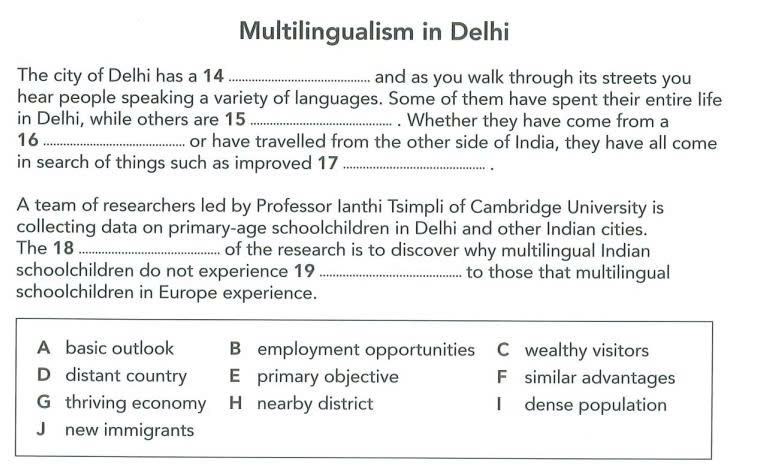
Dạng: Summary Completion ▼
Câu 14
Đáp án: I. dense population
Câu hỏi: The city of Delhi has a 14…………….. and as you walk through its streets you hear people speaking a variety of languages. (Thành phố Delhi có ……………. và khi bạn đi bộ trên đường phố, bạn sẽ nghe thấy mọi người nói nhiều thứ tiếng khác nhau.)
Vị trí trong bài: Đoạn 1
“The crowded and bustling streets of Delhi teem with life. Stop to listen and, above the din of rickshaws and buses,…”
Phân tích: Đoạn mở đầu mô tả Delhi là một thành phố đông đúc với hơn 20 triệu dân. “Crowded”, “bustling” và “20 million people” đều diễn tả mật độ dân số cao.
⇒ dense population = dân số đông đúc là đáp án phù hợp nhất. .
Câu 15
Đáp án: J. new immigrants
Câu hỏi: Some of them have spent their entire life in Delhi, while others are 15……………… (Một số người đã sống cả đời ở Delhi, trong khi những người khác là ……………..)
Vị trí trong bài: Đoạn 1
“Many were born and raised here, and many millions more have recently made India’s capital their home…”
Phân tích: Bài đọc đối lập hai nhóm người:
- born and raised here → sinh ra và lớn lên tại Delhi
- recently made India’s capital their home → mới chuyển đến
“Recently moved” được tóm tắt thành new immigrants.
⇒ Đáp án J.
Câu 16
Đáp án: H. nearby district
Câu hỏi: Whether they have come from a 16…………….. or have travelled from the other side of India… (Dù họ đến từ …………….. hay từ phía bên kia của Ấn Độ…)
Vị trí trong bài: Đoạn 1
“…having moved from surrounding neighbourhoods, cities and states or across the country…”
Phân tích:
Bài đọc mô tả nguồn gốc của những người đến đây. Họ có thể đến từ các khu vực lân cận (neighbourhoods, cities, states xung quanh) hoặc đến từ những nơi rất xa trên khắp Ấn Độ.
Một số paraphrase:
- nearby district → surrounding neighbourhoods, cities and states
- have come from → having moved from
- have travelled from the other side of India → across the country
⇒ Câu hỏi diễn đạt lại ý “đến từ khu vực lân cận hoặc từ những nơi rất xa trong cả nước”, nên đáp án là H. nearby district.
Câu 17
Đáp án: B. employment opportunities
Câu hỏi: They have all come in search of things such as improved 17______. (Họ đều đến đây để tìm kiếm những điều như ______ tốt hơn.)
Vị trí trong bài: Đoạn 1
“…cities and states or across the country, often in the hope of gaining better jobs and a better life“
Phân tích: Tác giả giải thích rằng nhiều người chuyển đến Delhi với hy vọng tìm được công việc tốt hơn và có cuộc sống tốt hơn. Cụm từ better jobs trong bài được diễn đạt lại bằng employment opportunities (cơ hội việc làm) trong câu tóm tắt, nên đây là đáp án đúng.
Câu 18
Đáp án: E. primary objective
Câu hỏi: The 18 ______ of the research is to discover why… (______ của nghiên cứu là tìm hiểu tại sao…)
Vị trí trong bài: Đoạn 2
“The overriding aim of the four-year project, called ‘Multilingualism and Multiliteracy’…”
Phân tích: Bài đọc nêu rõ rằng mục tiêu của nghiên cứu là tìm hiểu vì sao trẻ em đa ngôn ngữ ở Ấn Độ không nhận được những lợi ích giống như trẻ em đa ngôn ngữ ở châu Âu. Từ aim trong bài được paraphrase thành primary objective, đều mang nghĩa là “mục tiêu chính”.
Câu 19
Đáp án: F. similar advantages
Câu hỏi: …why multilingual Indian schoolchildren do not experience 19______ to those that multilingual schoolchildren in Europe experience.
(…tại sao học sinh đa ngôn ngữ ở Ấn Độ không trải nghiệm ______ như học sinh đa ngôn ngữ ở châu Âu.)
Vị trí trong bài: Đoạn 2
“the many benefits of speaking more than one language, observed in schools in Europe … do not apply to many of India’s schoolchildren”
Phân tích: Bài đọc nói các lợi ích của việc đa ngôn ngữ ở châu Âu không xuất hiện tương tự ở học sinh Ấn Độ. Vì vậy đáp án là F. similar advantages.
Dạng: Yes/No/Not Given ▼
Câu 20
Đáp án: NO
Câu hỏi: Ten-year-old Indian schoolchildren tend to perform better in literacy tests than in numeracy tests. (Học sinh Ấn Độ 10 tuổi thường làm tốt hơn ở bài kiểm tra đọc hiểu so với bài kiểm tra toán.)
Vị trí trong bài: Đoạn 3
“Each year across India, 600,000 children are tested, and year after year over 50% of children… and just under 50% of them cannot solve a Standard 2 subtraction task“
Phân tích:
Tỷ lệ không đọc được là hơn 50%, còn tỷ lệ không làm được phép trừ là dưới 50%. Điều này cho thấy các em làm toán tốt hơn đọc hiểu, ngược lại với phát biểu trong đề.
Vì vậy đáp án là NO.
Câu 21
Đáp án: NOT GIVEN
Câu hỏi: Tsimpli had problems convincing some female students to take part in the study. (Tsimpli gặp khó khăn trong việc thuyết phục một số nữ sinh tham gia nghiên cứu.)
Vị trí trong bài: Không có thông tin.
Phân tích:
Bài đọc chỉ nói: “She explains that low educational achievement can lead to many of these students dropping out of school – a problem disproportionately affecting female students“
Nghĩa là nữ sinh bị ảnh hưởng nhiều hơn bởi tình trạng bỏ học. Không có thông tin nào nói Tsimpli phải thuyết phục các em tham gia nghiên cứu. Vì vậy đáp án là NOT GIVEN.
Câu 22
Đáp án: YES
Câu hỏi: Tsimpli and her team wanted to know if there is a connection between poor academic performance and being taught in an unfamiliar language.
(Tsimpli và nhóm nghiên cứu muốn biết liệu có mối liên hệ giữa kết quả học tập thấp và việc được dạy bằng một ngôn ngữ không quen thuộc hay không.)
Vị trí trong bài: Đoạn 4
“Tsimpli and her colleagues are investigating whether these low learning outcomes could be caused by an Indian school system where the language that children are taught in often differs from the language used at home.”
Phân tích:
Đoạn văn giới thiệu mục tiêu nghiên cứu của Tsimpli và các cộng sự. Họ muốn tìm hiểu liệu kết quả học tập thấp của học sinh có phải xuất phát từ việc ngôn ngữ giảng dạy ở trường khác với ngôn ngữ các em sử dụng ở nhà hay không.
Đây chính xác là điều nhóm nghiên cứu đang điều tra. Vì vậy đáp án là YES.
Câu 23
Đáp án: NO
Câu hỏi: The researchers have decided against investigating the impact teaching methodology may have on learning outcomes. (Các nhà nghiên cứu đã quyết định không điều tra ảnh hưởng của phương pháp giảng dạy đối với kết quả học tập.)
Vị trí trong bài: Đoạn 5
“They intend to look not only at test results, but also at variables such as the standard of schooling, the environment and the teaching practices themselves.”
Phân tích: Nhóm nghiên cứu không chỉ xem xét kết quả bài kiểm tra mà còn điều tra nhiều yếu tố khác, trong đó có phương pháp giảng dạy (teaching practices). Điều này cho thấy họ vẫn sẽ nghiên cứu ảnh hưởng của phương pháp giảng dạy đến kết quả học tập. Vì vậy phát biểu “không điều tra” là sai.
⇒ Đáp án là NO
Câu 24
Đáp án: C. Poor children may be disadvantaged further by being instructed in English.
Câu hỏi: What point does the writer make about primary schools in India in the sixth paragraph? (Tác giả đưa ra nhận định gì về các trường tiểu học ở Ấn Độ trong đoạn 6?)
Vị trí trong bài: Đoạn 6
- “…English, may hold back those children who have little familiarity with, or exposure to, the language…”
- “…English instruction for children from low socio-economic areas might not be the best way for them to learn…”
Phân tích:
Việc giảng dạy bằng tiếng Anh có thể cản trở việc học của những trẻ ít tiếp xúc hoặc không quen thuộc với tiếng Anh trước khi đi học. Tác giả còn nhấn mạnh rằng đối với trẻ em đến từ các khu vực có điều kiện kinh tế – xã hội thấp, việc học bằng tiếng Anh có thể không phải phương pháp tốt nhất, đặc biệt trong những năm đầu tiểu học.
⇒ Điều này cho thấy trẻ em nghèo có thể gặp bất lợi hơn khi được dạy bằng tiếng Anh, nên đáp án là C.
Câu 25
Đáp án: D. It is too late to remove English completely as a language of instruction in schools.
Câu hỏi: What is Tsimpli suggesting when she uses the phrase ‘that ship has sailed‘? (Tsimpli muốn nói gì khi dùng cụm ‘that ship has sailed’?)
Vị trí trong bài: Đoạn 7
“We are not suggesting that English be withdrawn – that ship has sailed – but we perhaps have to think more about learner needs”
Phân tích: That ship has sailed” là thành ngữ nghĩa là “đã quá muộn để thay đổi”. Bà muốn nói rằng việc loại bỏ hoàn toàn tiếng Anh khỏi trường học không còn khả thi nữa.
⇒ D. It is too late to remove English completely as a language of instruction in schools.
Câu 26
Đáp án: D. The literacy and numeracy skills of slum children are not lower than those of children from other urban poor backgrounds.
Câu hỏi: In the eighth paragraph, what do we learn has surprised researchers? (Ở đoạn 8, điều gì khiến các nhà nghiên cứu ngạc nhiên?)
Vị trí trong bài: Đoạn 8
“…an unanticipated finding has been that children from slum backgrounds do not seem to lag behind children from other urban poor backgrounds – and in some cases outperform them.”
Phân tích: Phát hiện bất ngờ là trẻ em ở khu ổ chuột không hề kém hơn trẻ em nghèo đô thị khác, thậm chí đôi khi còn làm tốt hơn ở các bài kiểm tra đọc viết và toán học.
⇒ Đáp án là D
Dịch chi tiết IELTS Cambridge 20 Test 4 Reading Passage 2
How could multilingualism benefit India’s poorest schoolchildren?
The crowded and bustling streets of Delhi teem with life. Stop to listen and, above the din of rickshaws and buses, you’ll hear a multitude of languages, as more than 20 million people go about their daily lives. Many were born and raised here, and many millions more have recently made India’s capital their home, having moved from surrounding neighbourhoods, cities and states or across the country, often in the hope of gaining better jobs and a better life. Some arrive speaking fluent Hindi, the dominant language in Delhi (and the official language of government), but many arrive speaking any number of India’s 22 officially recognised languages, let alone the hundreds of regional languages in a country of more than 1.3 billion people.
Những con phố đông đúc và nhộn nhịp của Delhi luôn tràn đầy sức sống. Chỉ cần dừng lại để lắng nghe, bên trên tiếng ồn của xe kéo và xe buýt, bạn sẽ nghe thấy vô số ngôn ngữ khác nhau khi hơn 20 triệu người sinh hoạt hằng ngày. Nhiều người sinh ra và lớn lên tại đây, trong khi hàng triệu người khác mới chuyển đến thủ đô của Ấn Độ từ các khu dân cư, thành phố và bang lân cận hoặc từ khắp nơi trên cả nước, với hy vọng tìm được công việc tốt hơn và có cuộc sống tốt đẹp hơn. Một số người nói tiếng Hindi lưu loát – ngôn ngữ chủ đạo ở Delhi và cũng là ngôn ngữ chính thức của chính phủ. Tuy nhiên, nhiều người khác lại sử dụng một trong 22 ngôn ngữ được công nhận chính thức của Ấn Độ, chưa kể đến hàng trăm ngôn ngữ địa phương được sử dụng trên khắp quốc gia hơn 1,3 tỷ dân này.
Từ vựng cần nhớ
- multitude (n): vô số, rất nhiều
- dominant language: ngôn ngữ chủ đạo
- officially recognised languages: ngôn ngữ được công nhận chính thức
- regional languages: ngôn ngữ địa phương
- fluent (adj): lưu loát, thành thạo
A team of researchers led by Professor Ianthi Tsimpli of Cambridge University is currently working on a project to collect data on 1,000 primary-age children in Delhi and the cities of Hyderabad and Bihar. The overriding aim of the four-year project, called ‘Multilingualism and Multiliteracy’, is to find out why in a country where multilingualism is so common (more than 255 million people in India speak at least two languages, and nearly 90 million speak three or more languages), the many benefits of speaking more than one language, observed in schools in Europe for instance, do not apply to many of India’s schoolchildren.
Một nhóm nhà nghiên cứu do Giáo sư Ianthi Tsimpli của Đại học Cambridge dẫn đầu hiện đang thực hiện một dự án thu thập dữ liệu từ 1.000 học sinh tiểu học tại Delhi, Hyderabad và Bihar. Mục tiêu chính của dự án kéo dài bốn năm mang tên “Multilingualism and Multiliteracy” là tìm hiểu lý do tại sao ở một quốc gia mà sự đa ngôn ngữ rất phổ biến (hơn 255 triệu người nói ít nhất hai ngôn ngữ và gần 90 triệu người nói từ ba ngôn ngữ trở lên), những lợi ích của việc sử dụng nhiều ngôn ngữ – vốn đã được ghi nhận ở các trường học châu Âu – lại không xuất hiện rõ ràng ở nhiều học sinh Ấn Độ.
Từ vựng cần nhớ
- researcher (n): nhà nghiên cứu
- collect data (v phrase): thu thập dữ liệu
- overriding aim (n phrase): mục tiêu chính
- multilingualism (n): sự đa ngôn ngữ
Each year across India, 600,000 children are tested, and year after year over 50% of children in Standard 5 [ten-year-olds] cannot read a Standard 2 [seven-year-olds] task fluently, and just under 50% of them cannot solve a Standard 2 subtraction task,’ says Tsimpli. She explains that low educational achievement can lead to many of these students dropping out of school – a problem disproportionately affecting female students.
Theo Tsimpli, mỗi năm có khoảng 600.000 trẻ em trên khắp Ấn Độ được kiểm tra. Tuy nhiên, năm này qua năm khác, hơn 50% học sinh lớp 5 không thể đọc trôi chảy một bài đọc ở trình độ lớp 2, và gần 50% không thể giải được một bài toán trừ ở trình độ lớp 2. Bà giải thích rằng thành tích học tập thấp có thể khiến nhiều học sinh bỏ học, và vấn đề này ảnh hưởng không cân xứng đến nữ sinh nhiều hơn nam sinh.
Từ vựng cần nhớ
- fluently (adv): một cách lưu loát
- subtraction task: bài toán phép trừ
- drop out of school: bỏ học
- disproportionately (adv): không cân xứng, ảnh hưởng nhiều hơn
Tsimpli and her colleagues are investigating whether these low learning outcomes could be caused by an Indian school system where the language that children are taught in often differs from the language used at home. The research project, which focuses on 8 to 11-year-old schoolchildren in rural and urban areas, collects data on whether the schoolchildren live in slum or non-slum areas. Many of the children have moved from remote rural areas to urban areas. They are so poor they have to live in slums and, as a result of migration, they may speak languages that are different from the regional language.
Tsimpli và các đồng nghiệp đang điều tra liệu những kết quả học tập thấp này có phải xuất phát từ hệ thống giáo dục Ấn Độ, nơi ngôn ngữ được sử dụng để giảng dạy thường khác với ngôn ngữ được sử dụng tại nhà hay không. Dự án tập trung vào học sinh từ 8 đến 11 tuổi ở cả nông thôn và thành thị, đồng thời thu thập dữ liệu về việc các em có sống trong khu ổ chuột hay không. Nhiều em đã chuyển từ những vùng nông thôn xa xôi đến các khu vực thành thị. Do hoàn cảnh quá nghèo khó, các em phải sống trong khu ổ chuột và vì quá trình di cư, ngôn ngữ các em sử dụng có thể khác với ngôn ngữ phổ biến của địa phương.
Từ vựng cần nhớ
- investigate (v): điều tra, nghiên cứu
- learning outcomes (n phrase): kết quả học tập
- slum (n): khu ổ chuột
- remote rural area: vùng nông thôn xa xôi
- urban areas: khu vực thành thị
Having already tested 1,000 children, the researchers will now embark on retesting them. They intend to look not only at test results, but also at variables such as the standard of schooling, the environment and the teaching practices themselves. It’s possible that one of the causes of low performance is the lack of pupil-centred teaching methods; in many Indian primary schools the teacher dominates and there is little room for independent learning.
Sau khi đã kiểm tra 1.000 học sinh, các nhà nghiên cứu sẽ bắt đầu tiến hành kiểm tra lại các em. Họ dự định xem xét không chỉ kết quả kiểm tra mà còn nhiều biến số khác như chất lượng giáo dục, môi trường học tập và chính các phương pháp giảng dạy. Một nguyên nhân có thể dẫn đến thành tích thấp là sự thiếu vắng các phương pháp dạy học lấy học sinh làm trung tâm; trong nhiều trường tiểu học ở Ấn Độ, giáo viên giữ vai trò áp đảo và học sinh có rất ít cơ hội để học tập độc lập.
Từ vựng cần nhớ
- embark on (v): bắt đầu thực hiện
- variable (n): biến số
- pupil-centred teaching methods: phương pháp dạy học lấy học sinh làm trung tâm
- teaching practices: thực tiễn giảng dạy
- independent (adj): độc lập
Although the findings are at a preliminary stage, Tsimpli and her team have found that the medium of instruction used in schools, especially English, may hold back those children who have little familiarity with, or exposure to, the language before starting school and outside of school life. According to Tsimpli, most of the evidence from this and other projects shows that English instruction for children from low socio-economic areas might not be the best way for them to learn, at least in the first three years of primary education.
Mặc dù kết quả nghiên cứu vẫn đang ở giai đoạn ban đầu, nhóm của Tsimpli phát hiện rằng ngôn ngữ giảng dạy được sử dụng trong trường học, đặc biệt là tiếng Anh, có thể cản trở những học sinh ít có sự quen thuộc hoặc tiếp xúc với ngôn ngữ này trước khi đi học và ngoài môi trường học đường. Theo Tsimpli, phần lớn bằng chứng từ dự án này và các dự án khác cho thấy việc dạy bằng tiếng Anh đối với trẻ em thuộc nhóm kinh tế – xã hội thấp có thể không phải là phương pháp học tập hiệu quả nhất, ít nhất là trong ba năm đầu của bậc tiểu học.
Từ vựng cần nhớ
- preliminary stage (n phrase): giai đoạn ban đầu
- medium of instruction (n phrase): ngôn ngữ giảng dạy
- hold back (v): cản trở
- familiarity (n): sự quen thuộc
- exposure (n): sự tiếp xúc
What we would recommend for everyone, not just low socio-economic status children, would be to start learning in the language they feel comfortable learning in… English can still be used, but perhaps not as the medium of instruction in primary schools. It could, for example, be one of the subjects that are being taught alongside other subjects. We are not suggesting that English be withdrawn – that ship has sailed – but we perhaps have to think more about learner needs. There is perhaps too much uniformity in teaching and less tailoring to the children’s language abilities and needs,’ says Tsimpli.
Tsimpli cho rằng điều bà khuyến nghị cho tất cả học sinh, không chỉ những em có hoàn cảnh kinh tế – xã hội khó khăn, là nên bắt đầu học bằng ngôn ngữ mà các em cảm thấy thoải mái nhất. Tiếng Anh vẫn có thể được sử dụng, nhưng có lẽ không nên là ngôn ngữ giảng dạy chính ở bậc tiểu học. Thay vào đó, tiếng Anh có thể được dạy như một môn học bên cạnh các môn khác. Tuy nhiên, bà nhấn mạnh rằng không nên loại bỏ tiếng Anh khỏi chương trình học, vì điều đó không còn có thể thay đổi được nữa. Theo bà, điều quan trọng là hệ thống giáo dục cần quan tâm nhiều hơn đến nhu cầu của người học, thay vì áp dụng một cách dạy quá đồng nhất và chưa điều chỉnh phù hợp với năng lực ngôn ngữ cũng như nhu cầu của từng học sinh.
Từ vựng cần nhớ
- low socio-economic status (n): hoàn cảnh kinh tế – xã hội thấp
- medium of instruction (n): ngôn ngữ giảng dạy
- primary school (n): trường/bậc tiểu học
- alongside (prep/adv): bên cạnh, song song với
- withdraw (v): loại bỏ, rút khỏi
- that ship has sailed (idiom): chuyện đó đã qua rồi, không còn có thể thay đổi được nữa
- learner needs (n): nhu cầu của người học
- uniformity (n): sự đồng nhất
- tailoring (n/v): sự điều chỉnh cho phù hợp, cá nhân hóa
- language abilities (n): năng lực ngôn ngữ
While the preliminary results show there is no difference in general intelligence among boys and girls from slum areas versus those from urban poor backgrounds, an unanticipated finding has been that children from slum backgrounds do not seem to lag behind children from other urban poor backgrounds – and in some cases outperform them (e.g. in numeracy and literacy tasks). According to the researchers, this unexpected finding may be down to the life experiences of children growing up in slums. They are likely to mature faster and come into closer contact with the numeracy skills essential for day-to-day survival.
Mặc dù các kết quả sơ bộ cho thấy không có sự khác biệt về trí thông minh tổng quát giữa các bé trai và bé gái đến từ khu ổ chuột và những trẻ có hoàn cảnh nghèo ở thành thị, nhưng một phát hiện bất ngờ là trẻ em lớn lên trong khu ổ chuột dường như không thua kém những trẻ em nghèo khác ở thành thị, và trong một số trường hợp còn vượt trội hơn (ví dụ như ở các bài kiểm tra về kỹ năng tính toán và kỹ năng đọc viết). Theo các nhà nghiên cứu, phát hiện bất ngờ này có thể bắt nguồn từ những trải nghiệm trong cuộc sống của những đứa trẻ lớn lên ở khu ổ chuột. Các em có xu hướng trưởng thành sớm hơn và thường xuyên tiếp xúc với các kỹ năng tính toán thiết yếu cho cuộc sống hằng ngày.
Từ vựng cần nhớ
- preliminary results (n): kết quả sơ bộ
- general intelligence (n): trí thông minh tổng quát
- slum area (n): khu ổ chuột
- urban poor background (n): hoàn cảnh nghèo ở thành thị
- unanticipated finding (n): phát hiện bất ngờ
- lag behind (v): thua kém, tụt lại phía sau
- outperform (v): vượt trội hơn, làm tốt hơn
- numeracy (n): kỹ năng tính toán
- literacy (n): kỹ năng đọc viết
- be down to (phr): bắt nguồn từ, là do
- mature (v): trưởng thành
- numeracy skills (n): kỹ năng tính toán
- day-to-day survival (n): cuộc sống sinh tồn hằng ngày
The project has already caught the attention of government ministers, who are keen to use the findings of the study to inform and adjust school policy in Delhi and the wider state.’They are as keen as us to understand how the challenging context of deprivation can be attenuated when focusing on the languages children learn and use while at school. Our findings don’t mean you’re doomed if you’re poor. It may be that these low learning outcomes are because of the way education is provided, with a huge focus on Hindi and English as the mediums of instruction, to the potential detriment of children unfamiliar with those languages,’ explains Tsimpli.
Dự án này đã thu hút sự chú ý của các bộ trưởng chính phủ, những người rất mong muốn sử dụng kết quả nghiên cứu để định hướng và điều chỉnh chính sách giáo dục ở Delhi và trên toàn bang. Tsimpli giải thích: “Họ cũng mong muốn như chúng tôi tìm hiểu xem bối cảnh đầy thách thức của tình trạng thiếu thốn có thể được giảm bớt như thế nào khi tập trung vào những ngôn ngữ mà trẻ em học và sử dụng ở trường. Kết quả nghiên cứu của chúng tôi không có nghĩa là bạn sẽ không có cơ hội thành công nếu sinh ra trong hoàn cảnh nghèo khó. Có thể những kết quả học tập thấp này bắt nguồn từ cách giáo dục được triển khai, với sự tập trung quá nhiều vào tiếng Hindi và tiếng Anh như các ngôn ngữ giảng dạy, điều này có thể gây bất lợi cho những trẻ không quen thuộc với các ngôn ngữ đó.”
Từ vựng cần nhớ
- government minister (n): bộ trưởng chính phủ
- be keen to (adj): rất mong muốn, nhiệt tình muốn
- inform (v): định hướng, làm cơ sở cho
- adjust (v): điều chỉnh
- deprivation (n): tình trạng thiếu thốn, thiệt thòi
- attenuate (v): làm giảm bớt, làm dịu
- doomed (adj): không có cơ hội thành công, rơi vào tình thế tuyệt vọng
- low learning outcomes (n): kết quả học tập thấp
- medium of instruction (n): ngôn ngữ giảng dạy
- potential detriment (n): nguy cơ gây bất lợi
- unfamiliar with (adj): không quen thuộc với
‘Language is central to the way knowledge is transferred – so the medium of instruction is obviously hugely influential. We hope to show that problem solving, numeracy and literacy can and do improve in children who are educated in a language of instruction they know. The trick may be to bridge school skills with life skills and make use of the richness of a child’s life experience to help them learn in the most effective ways possible,’ says Tsimpli.
Theo Tsimpli, ngôn ngữ đóng vai trò trung tâm trong quá trình truyền đạt kiến thức, vì vậy ngôn ngữ giảng dạy có ảnh hưởng vô cùng lớn đến việc học tập. Bà hy vọng nghiên cứu sẽ chứng minh rằng khả năng giải quyết vấn đề, kỹ năng toán học và kỹ năng đọc viết có thể được cải thiện khi trẻ em được học bằng ngôn ngữ mà các em đã biết. Bí quyết có thể nằm ở việc kết nối kỹ năng học tập với kỹ năng sống và tận dụng những trải nghiệm sống phong phú của trẻ để giúp các em học tập hiệu quả nhất.
Từ vựng cần nhớ
- problem solving (n phrase): khả năng giải quyết vấn đề
- bridge school skills with life skills (v phrase): kết nối kỹ năng học tập với kỹ năng sống
- make use of (v phrase): tận dụng
- richness of life experience (n phrase): sự phong phú của trải nghiệm sống
- influential (adj): có ảnh hưởng lớn
Series giải đề IELTS Cambridge 21
- [PDF + Audio] Cambridge IELTS 21: Cập nhật mới nhất (Bản đẹp)
- Đáp án Cambridge 21 & Lời giải chi tiết: Test 1 đến Test 4
- Giải chi tiết Cambridge 21 Test 4 Listening Part 1: Survey about shopping in Broadbeach
- Giải chi tiết Cambridge 21 Test 4 Listening Part 2
- Giải chi tiết Cambridge 21 Test 4 Listening Part 3: Presentation on houses of the future
- Giải chi tiết Cambridge 21 Test 4 Listening Part 4: Music therapy for surgical patients
- Giải chi tiết IELTS Cambridge 21 Test 4 Reading Passage 1: The water hyacinth in Kenya
- Giải chi tiết IELTS Cambridge 21 Test 4 Reading Passage 2: Multilingualism
- Giải chi tiết IELTS Cambridge 21 Test 4 Reading Passage 3: The Globemakers
- [PDF + Audio] Trọn bộ Cambridge Practice Tests For IELTS 1 – 21 mới nhất
Đừng quên đăng ký khóa học IELTS miễn phí được phát triển bởi The IELTS Workshop với lộ trình cá nhân hóa, tài liệu chất lượng và sự hướng dẫn từ đội ngũ giáo viên đạt 8.0+ IELTS.

![[PDF +Audio] Cambridge IELTS 8 With Answers](https://onthiielts.com.vn/wp-content/uploads/2020/04/Cam-8-764x400.jpg)
![[PDF +Audio] Cambridge IELTS 7 With Answers](https://onthiielts.com.vn/wp-content/uploads/2020/04/Cam-7-764x400.jpg)