Trong bài viết này, The IELTS Workshop sẽ cung cấp đáp án chi tiết, transcrpit và giải thích từng câu trong Cambridge 21 Test 3 Reading Passage 1 chủ đề Saving the saiga. Thông qua việc đối chiếu đáp án sẽ giúp bạn cải thiện kỹ năng làm bài và khắc phục những lỗ hổng kiến thức trong dạng bài Reading nhé!
Đáp án IELTS Cambridge 21 Test 3 Reading Passage 1
| Question | Đáp án |
| 1 | dust |
| 2 | blood |
| 3 | coat |
| 4 | horns |
| 5 | habitat |
| 6 | routes |
| 7 | streams |
| 8 | FALSE |
| 9 | FALSE |
| 10 | TRUE |
| 11 | NOT GIVEN |
| 12 | TRUE |
| 13 | NOT GIVEN |
Phân tích chi tiết IELTS Cambridge 21 Test 3 Reading Passage 1
Dạng: Sentence Completion ▼
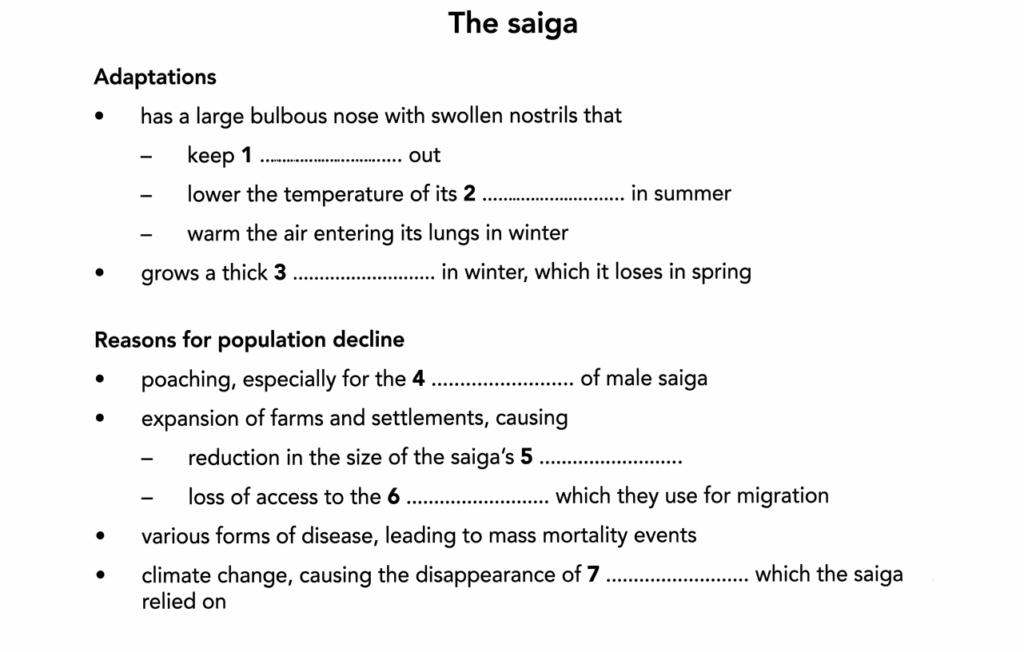
Câu 1
Đáp án: dust
Câu hỏi: Adaptations
- has a large bulbous nose with swollen nostrils that (có chiếc mũi to và phồng với lỗ mũi sưng tấy.)
- Keep 1 ________ out. (Ngăn ________ xâm nhập vào.)
Vị trí trong bài: Đoạn 2
The swollen nostrils of the nose serve several purposes: they filter out dust and cool the blood during hot, dry summers, and they warm the cold air before it enters the saiga’s lungs in winter.
Phân tích: Sau động từ keep cần điền một danh từ. Đoạn văn cho biết chiếc mũi đặc biệt của loài saiga có khả năng lọc bụi, giúp ngăn bụi xâm nhập vào cơ thể. Vì vậy đáp án đúng là dust.
Câu 2
Đáp án: blood
Câu hỏi: lower the temperature of its 2 ________ in summer. (Làm giảm nhiệt độ của ________ vào mùa hè.)
Vị trí trong bài: Đoạn 2
….they filter out dust and cool the blood during hot, dry summers, and they warm the cold air before it enters the saiga’s lungs in winter.
Phân tích: Sau tính từ sở hữu its cần một danh từ. Bài đọc cho biết chiếc mũi của saiga giúp làm mát máu trong những mùa hè nóng và khô. Vì vậy đáp án là blood.
Câu 3
Đáp án: coat
Câu hỏi: grows a thick 3 ________ in winter, which it loses in spring. (Mọc một lớp ________ dày vào mùa đông và rụng đi vào mùa xuân.)
Vị trí trong bài: Đoạn 2
Other seasonal adaptations include a heavy winter coat that the saiga sheds when the weather warms up.
Phân tích: Sau tính từ thick cần một danh từ. Theo bài đọc, vào mùa đông loài saiga phát triển một bộ lông dày để thích nghi với thời tiết lạnh, sau đó sẽ thay lông khi trời ấm lên.
Vì vậy đáp án là coat.
Câu 4
Đáp án: horns
Câu hỏi: poaching, especially for the 4 ________ of male saiga. (Nạn săn bắt trái phép, đặc biệt nhằm lấy ________ của những con saiga đực.)
Vị trí trong bài: Đoạn 4
Male saiga are a particular target, because their horns are highly prized by traditional medicine practitioners.
Phân tích: Sau mạo từ the cần một danh từ. Bài đọc cho biết saiga đực thường bị săn bắt vì cặp sừng của chúng rất được coi trọng trong y học cổ truyền. Lưu ý đáp án phải ở dạng số nhiều là horns.
Câu 5
Đáp án: habitat
Câu hỏi: expansion of farms and settlements, causing reduction in the size of the saiga’s 5 ________. (Việc mở rộng đất nông nghiệp và khu dân cư làm thu hẹp ________ của loài saiga.)
Vị trí trong bài: Đoạn 5
Another threat to the survival of the saiga is loss of habitat, as a result of agricultural expansion and human settlement.
Phân tích: Sau sở hữu cách saiga’s cần một danh từ. Người viết cho biết việc mở rộng hoạt động nông nghiệp và các khu dân cư khiến môi trường sống của loài saiga ngày càng bị thu hẹp.
Vì vậy đáp án là habitat.
Câu 6
Đáp án: routes
Câu hỏi: loss of access to the 6 ________ which they use for migration. (Mất khả năng tiếp cận các ________ mà chúng sử dụng để di cư.)
Vị trí trong bài: Đoạn 5
Physical barriers such as railways, pipelines and fences can block the seasonal migration routes of this transboundary species.
Phân tích: Sau mạo từ the cần một danh từ. Bài đọc cho biết các tuyến đường sắt, đường ống và hàng rào đã cản trở những tuyến đường di cư theo mùa của loài saiga.
Vì vậy đáp án đúng là routes.
Câu 7
Đáp án: streams
Câu hỏi: climate change, causing the disappearance of 7 ________ which the saiga relied on. (Biến đổi khí hậu làm biến mất những ________ mà loài saiga từng phụ thuộc.)
Vị trí trong bài: Đoạn 7
The steppe region has also become increasingly arid in recent years, and many of the smaller streams that the species normally depended on have dried up and vanished.
Phân tích: Sau giới từ of cần một danh từ số nhiều. Đoạn văn cho biết nhiều con suối nhỏ mà saiga thường dựa vào đã khô cạn và biến mất do khí hậu ngày càng khô hạn.
Vì vậy đáp án là streams.
Dạng: TRUE/FALSE/NOT GIVEN ▼
Câu 8
Đáp án: FALSE
Câu hỏi: Today, numbers of saiga are distributed evenly across four nations in Central Asia: Kazakhstan, Russia, Mongolia and Uzbekistan. (Hiện nay, số lượng linh dương saiga được phân bố đồng đều ở bốn quốc gia Trung Á: Kazakhstan, Nga, Mông Cổ và Uzbekistan.)
Vị trí trong bài: Đoạn 1
Today, the saiga is largely confined to a single country: Kazakhstan. This country is estimated to be home to well over 90% of the global saiga population, with Russia, Mongolia and Uzbekistan accounting for the rest.
Phân tích: Bài đọc cho biết hơn 90% số lượng saiga trên thế giới sinh sống tại Kazakhstan, còn Nga, Mông Cổ và Uzbekistan chỉ chiếm phần còn lại. Điều này trái ngược với nhận định rằng số lượng được phân bố đồng đều ở bốn quốc gia.
Vì vậy đáp án là FALSE.
Câu 9
Đáp án: FALSE
Câu hỏi: For most of the 20th century, the population of saiga was falling. (Trong phần lớn thế kỷ 20, số lượng linh dương saiga liên tục suy giảm.)
Vị trí trong bài: Đoạn 3
It was almost driven to extinction by hunters in the 19th century. Legal protection ensured its survival for a while, and numbers steadily recovered throughout most of the 20th century.
Phân tích: Bài đọc cho biết sau khi được bảo vệ bằng pháp luật, số lượng saiga phục hồi ổn định trong phần lớn thế kỷ 20. Như vậy, thông tin trong câu hỏi trái ngược với nội dung bài đọc.
Đáp án đúng là FALSE.
Câu 10
Đáp án: TRUE
Câu hỏi: Efforts to protect rhinos in Africa had a significant effect on saiga populations. (Các nỗ lực bảo vệ tê giác ở châu Phi đã tạo ra ảnh hưởng đáng kể đến quần thể linh dương saiga.)
Vị trí trong bài: Đoạn 4
Poaching reached epidemic levels after misguided conservationists tried to relieve the pressure on threatened African rhinos by actively encouraging the use of saiga horns in traditional medicine as an alternative to those of rhinos. Male saiga were almost wiped out, leading to a population crash from which the species has been struggling to recover ever since.
Phân tích: Bài đọc giải thích rằng để giảm áp lực săn bắt tê giác châu Phi, một số người đã khuyến khích sử dụng sừng saiga thay thế. Điều này khiến nạn săn bắt saiga gia tăng mạnh và quần thể của chúng sụt giảm nghiêm trọng.
Vì vậy phát biểu trong câu hỏi là TRUE.
Câu 11
Đáp án: NOT GIVEN
Câu hỏi: Unpredictable fluctuations in climate are threatening the wildlife of Central Asia more than in other parts of the world. (Những biến động khí hậu khó lường đang đe dọa động vật hoang dã ở Trung Á nhiều hơn so với các khu vực khác trên thế giới.)
Vị trí trong bài: Đoạn 7
Climate change poses a further threat. Although well adapted to cold winters and hot summers, saiga struggle to cope with temperature extremes and unpredictable fluctuations in climate.
Phân tích: Bài đọc chỉ đề cập rằng loài saiga gặp khó khăn trước những biến động khí hậu và thời tiết cực đoan. Không có thông tin nào so sánh mức độ ảnh hưởng ở Trung Á với các khu vực khác trên thế giới.
Vì vậy đáp án là NOT GIVEN.
Câu 12
Đáp án: TRUE
Câu hỏi: The Altyn Dala Conservation Initiative was formed for the benefit of a number of different animals. (Sáng kiến Bảo tồn Altyn Dala được thành lập nhằm mang lại lợi ích cho nhiều loài động vật khác nhau.)
Vị trí trong bài: Đoạn 8
Its purpose is to protect and restore Kazakhstan’s steppe, semi-desert and desert ecosystems and the many species they support, including the critically endangered saiga.
Phân tích: Mục tiêu của dự án không chỉ là bảo tồn linh dương saiga mà còn khôi phục các hệ sinh thái và bảo vệ nhiều loài sinh vật sinh sống trong đó. Vì vậy phát biểu này phù hợp với nội dung bài đọc.
Đáp án là TRUE.
Câu 13
Đáp án: NOT GIVEN
Câu hỏi: The Altyn Dala Conservation Initiative’s recognition as a World Restoration Flagship project attracted additional international funding for the scheme. (Việc Sáng kiến Bảo tồn Altyn Dala được công nhận là Dự án Tiêu biểu về Phục hồi Thế giới đã thu hút thêm nguồn tài trợ quốc tế cho dự án.)
Vị trí trong bài: Đoạn 9
In 2022 the United Nations recognised the initiative as a World Restoration Flagship project, an accolade reserved for the ten best examples of large-scale ecosystem restoration around the globe.
Phân tích: Bài đọc chỉ cho biết dự án được Liên Hợp Quốc công nhận là một World Restoration Flagship project. Không có thông tin nào đề cập việc sự công nhận này giúp dự án nhận thêm nguồn tài trợ quốc tế.
Vì vậy đáp án đúng là NOT GIVEN.
Dịch chi tiết IELTS Cambridge 20 Test 1 Reading Passage 1
Saving the saiga
The saiga, a species of antelope native to Central Asia, once roamed the vast grasslands of this region in enormous herds, many millions strong. Regrettably, such spectacular sights are a thing of the past. Today, the saiga is largely confined to a single country: Kazakhstan. This country is estimated to be home to well over 90% of the global saiga population, with Russia, Mongolia and Uzbekistan accounting for the rest.
(Saiga là một loài linh dương có nguồn gốc từ Trung Á, từng lang thang trên những đồng cỏ rộng lớn của khu vực này theo các đàn khổng lồ với số lượng lên tới hàng triệu cá thể. Đáng tiếc, khung cảnh ngoạn mục ấy giờ chỉ còn là quá khứ. Ngày nay, saiga chủ yếu chỉ còn phân bố tại một quốc gia là Kazakhstan. Ước tính hơn 90% quần thể saiga trên toàn thế giới sinh sống tại đây, trong khi Nga, Mông Cổ và Uzbekistan chiếm phần còn lại.)
Từ vựng cần nhớ:
- native (to) (adj): có nguồn gốc từ
- roam (v): di chuyển, lang thang trên một khu vực rộng
- confined (to) (adj): bị giới hạn trong
- account for (v): chiếm, cấu thành
The saiga is perfectly adapted to the tough conditions of the remote wilderness of the steppes of Central Asia. One such adaptation is its bizarre bulbous nose, which enables the animal to survive the extreme seasonal temperature swings of the region. The swollen nostrils of the nose serve several purposes: they filter out dust and cool the blood during hot, dry summers, and they warm the cold air before it enters the saiga’s lungs in winter. Other seasonal adaptations include a heavy winter coat that the saiga sheds when the weather warms up.
(Saiga thích nghi rất tốt với điều kiện khắc nghiệt của vùng thảo nguyên hoang dã hẻo lánh ở Trung Á. Một trong những đặc điểm thích nghi nổi bật là chiếc mũi to, phình khác thường, giúp chúng chịu được sự thay đổi nhiệt độ khắc nghiệt giữa các mùa trong khu vực. Phần lỗ mũi sưng phồng đảm nhiệm nhiều chức năng: lọc bụi và làm mát máu vào những mùa hè nóng, khô, đồng thời làm ấm luồng không khí lạnh trước khi đi vào phổi trong mùa đông. Ngoài ra, saiga còn mọc một lớp lông dày vào mùa đông và sẽ rụng lớp lông này khi thời tiết ấm lên.)
Từ vựng cần nhớ:
- remote wilderness (n): vùng hoang dã hẻo lánh
- bizarre (adj): kỳ lạ
- bulbous (adj): phình to, có dạng củ
- filter out (phr.v): lọc bỏ
- shed (v): rụng (lông, da…)
Despite these superb adaptations to harsh conditions, the saiga has no defence against the threats posed by humans. It was almost driven to extinction by hunters in the 19th century. Legal protection ensured its survival for a while, and numbers steadily recovered throughout most of the 20th century. But the respite was only temporary. In the ten years following the break-up of the former Soviet Union in 1991, over 95% of the global population was lost – one of the fastest examples of species loss ever recorded for a mammal.
(Mặc dù sở hữu những đặc điểm thích nghi tuyệt vời với môi trường khắc nghiệt, saiga lại không có khả năng chống lại các mối đe dọa từ con người. Vào thế kỷ 19, loài này gần như bị săn bắt đến mức tuyệt chủng. Các biện pháp bảo vệ bằng pháp luật đã giúp chúng tồn tại trong một thời gian và số lượng cá thể dần phục hồi trong phần lớn thế kỷ 20. Tuy nhiên, sự phục hồi đó chỉ mang tính tạm thời. Trong mười năm sau khi Liên Xô cũ tan rã vào năm 1991, hơn 95% quần thể saiga trên toàn cầu đã biến mất, trở thành một trong những trường hợp suy giảm số lượng loài động vật có vú nhanh nhất từng được ghi nhận.)
Từ vựng cần nhớ:
- harsh conditions (n): điều kiện khắc nghiệt
- pose a threat (phr): gây ra mối đe dọa
- drive … to extinction (phr): đẩy … đến bờ vực tuyệt chủng
- respite (n): sự tạm ngưng, khoảng thời gian phục hồi ngắn ngủi
The dramatic decline during this decade was due to illegal poaching on an industrial scale. Male saiga are a particular target, because their horns are highly prized by traditional medicine practitioners. Poaching reached epidemic levels after misguided conservationists tried to relieve the pressure on threatened African rhinos by actively encouraging the use of saiga horns in traditional medicine as an alternative to those of rhinos. Male saiga were almost wiped out, leading to a population crash from which the species has been struggling to recover ever since.
(Sự suy giảm nghiêm trọng trong giai đoạn này chủ yếu bắt nguồn từ hoạt động săn bắt trái phép diễn ra trên quy mô lớn. Saiga đực trở thành mục tiêu đặc biệt vì cặp sừng của chúng được những người hành nghề y học cổ truyền đánh giá rất cao. Tình trạng săn trộm trở nên nghiêm trọng sau khi một số nhà bảo tồn có cách tiếp cận sai lầm, khuyến khích sử dụng sừng saiga trong y học cổ truyền để giảm áp lực săn bắt đối với tê giác châu Phi đang bị đe dọa. Hậu quả là số lượng saiga đực gần như bị xóa sổ, dẫn đến sự sụt giảm nghiêm trọng về số lượng cá thể khiến loài này chật vật phục hồi kể từ đó.)
Từ vựng cần nhớ:
- dramatic decline (n): sự suy giảm nghiêm trọng
- poaching (n): hoạt động săn bắt trái phép
- on an industrial scale (phr): trên quy mô lớn
- be prized by (phr): được đánh giá cao bởi
- misguided (adj): sai lầm, thiếu đúng đắn
- wipe out (phr.v): xóa sổ, tiêu diệt hoàn toàn
- population crash (n): sự sụt giảm nghiêm trọng của quần thể
Another threat to the survival of the saiga is loss of habitat, as a result of agricultural expansion and human settlement. Physical barriers such as railways, pipelines and fences can block the seasonal migration routes of this transboundary species. In the worst cases, herds may starve to death after being trapped.
(Một mối đe dọa khác đối với sự tồn tại của saiga là việc môi trường sống bị thu hẹp do hoạt động mở rộng đất nông nghiệp và sự phát triển của các khu dân cư. Những rào cản vật lý như đường sắt, đường ống dẫn và hàng rào có thể cản trở các tuyến di cư theo mùa của loài động vật di chuyển xuyên biên giới này. Trong những trường hợp nghiêm trọng nhất, cả đàn có thể chết đói sau khi bị mắc kẹt.)
Từ vựng cần nhớ:
- loss of habitat (n): sự mất môi trường sống
- agricultural expansion (n): sự mở rộng đất nông nghiệp
- human settlement (n): khu dân cư; sự định cư của con người
- physical barrier (n): rào cản vật lý
- migration route (n): tuyến đường di cư
- transboundary (adj): xuyên biên giới
- starve to death (phr): chết đói
Then there is the risk of disease. In 2015, an outbreak of haemorrhagic septicaemia, caused by the normally harmless bacterium Pasteurella multocida, killed over 75% of the global adult saiga population in just three weeks. In 2017, 60% of the Mongolian saiga population – a subspecies found nowhere else in the world – was killed by a virus that spilled over from livestock. These so-called mass mortality events represent an unpredictable and serious threat to the species.
(Bên cạnh đó, dịch bệnh cũng là một mối nguy lớn. Năm 2015, một đợt bùng phát bệnh nhiễm khuẩn huyết xuất huyết do vi khuẩn Pasteurella multocida – vốn thường vô hại – đã cướp đi sinh mạng của hơn 75% số saiga trưởng thành trên toàn thế giới chỉ trong vòng ba tuần. Đến năm 2017, 60% quần thể saiga Mông Cổ – một phân loài không xuất hiện ở bất kỳ nơi nào khác trên thế giới – đã chết vì một loại virus lây truyền từ gia súc. Những hiện tượng được gọi là các đợt tử vong hàng loạt này là mối đe dọa nghiêm trọng và rất khó dự đoán đối với loài saiga.)
Từ vựng cần nhớ:
- outbreak (n): sự bùng phát (dịch bệnh)
- haemorrhagic septicaemia (n): bệnh nhiễm khuẩn huyết xuất huyết
- bacterium (n): vi khuẩn
- subspecies (n): phân loài
- spill over (phr.v): lây truyền (từ động vật sang loài khác)
- livestock (n): gia súc
- mass mortality event (n): sự kiện chết hàng loạt
Climate change poses a further threat. Although well adapted to cold winters and hot summers, saiga struggle to cope with temperature extremes and unpredictable fluctuations in climate. Experts believe that unusually warm weather may have triggered the 2015 mass mortality event. The steppe region has also become increasingly arid in recent years, and many of the smaller streams that the species normally depended on have dried up and vanished.
(Biến đổi khí hậu tiếp tục là một mối đe dọa nghiêm trọng đối với loài saiga. Dù đã thích nghi rất tốt với mùa đông lạnh giá và mùa hè nóng bức, chúng vẫn gặp nhiều khó khăn khi phải đối mặt với những mức nhiệt cực đoan và các biến động khí hậu khó lường. Các chuyên gia cho rằng thời tiết ấm lên bất thường có thể đã góp phần gây ra sự kiện tử vong hàng loạt vào năm 2015. Bên cạnh đó, vùng thảo nguyên trong những năm gần đây ngày càng trở nên khô hạn, khiến nhiều con suối nhỏ – nguồn nước mà saiga vốn phụ thuộc – đã cạn kiệt và biến mất.)
Từ vựng cần nhớ:
- cope with (phr.v): đối phó với
- temperature extremes (n): điều kiện nhiệt độ khắc nghiệt
- fluctuations (n): sự biến động
- trigger (v): gây ra, kích hoạt
- increasingly arid (adj): ngày càng khô hạn
- dry up (phr.v): cạn kiệt
Recent efforts to save the saiga have been spearheaded by the Altyn Dala Conservation Initiative, a project led by the Association for the Conservation of Biodiversity of Kazakhstan, working in partnership with the Kazakh government’s Committee for Forestry and Wildlife, Frankfurt Zoological Society and Fauna and Flora, an international conservation charity. Its purpose is to protect and restore Kazakhstan’s steppe, semi-desert and desert ecosystems and the many species they support, including the critically endangered saiga. In 2022 the United Nations recognised the initiative as a World Restoration Flagship project, an accolade reserved for the ten best examples of large-scale ecosystem restoration around the globe.
(Trong những năm gần đây, các nỗ lực bảo tồn saiga chủ yếu được dẫn đầu bởi Sáng kiến Bảo tồn Altyn Dala. Dự án này do Hiệp hội Bảo tồn Đa dạng Sinh học Kazakhstan chủ trì và phối hợp thực hiện cùng Ủy ban Lâm nghiệp và Động vật Hoang dã của Chính phủ Kazakhstan, Hội Động vật học Frankfurt và tổ chức bảo tồn quốc tế Fauna and Flora. Mục tiêu của sáng kiến là bảo vệ và phục hồi các hệ sinh thái thảo nguyên, bán hoang mạc và hoang mạc của Kazakhstan, cũng như các loài sinh vật sinh sống trong những hệ sinh thái này, bao gồm cả loài saiga đang ở tình trạng cực kỳ nguy cấp. Năm 2022, Liên Hợp Quốc đã công nhận Altyn Dala là một Dự án Tiêu biểu về Phục hồi Hệ sinh thái Thế giới – danh hiệu chỉ dành cho mười mô hình phục hồi hệ sinh thái quy mô lớn tiêu biểu nhất trên toàn cầu.)
Từ vựng cần nhớ:
- spearhead (v): dẫn đầu, tiên phong
- in partnership with (phr): phối hợp với
- ecosystem (n): hệ sinh thái
- critically endangered (adj): cực kỳ nguy cấp
- accolade (n): danh hiệu, sự ghi nhận
- large-scale (adj): quy mô lớn
- ecosystem restoration (n): phục hồi hệ sinh thái
So, how many saiga are there now? By 2000, the global saiga population had hit an all-time low of just 21,000 individuals. There was some recovery in the first decade of the new millennium but this was then crushed by devastating mass mortality events that saw the loss of hundreds of thousands of the species. But thanks to the intervention of the Altyn Dala Conservation Initiative, the most recent episodes in the ongoing story of the saiga have been relatively uplifting. Three years ago, the Ustyurt Plateau population in Kazakhstan experienced its largest mass birth of saiga calves in many years. An aerial census two years ago recorded an estimated 842,000 saiga across Kazakhstan as a whole, and according to an aerial survey earlier this year, the saiga population in Kazakhstan now exceeds 1.9 million. The world’s strangest-looking antelope remains critically endangered, but the direction of travel is positive.
(Vậy hiện nay còn bao nhiêu cá thể saiga? Đến năm 2000, quần thể saiga trên toàn thế giới đã giảm xuống mức thấp nhất trong lịch sử với chỉ khoảng 21.000 cá thể. Mặc dù số lượng có dấu hiệu phục hồi trong thập kỷ đầu của thiên niên kỷ mới, những đợt tử vong hàng loạt nghiêm trọng sau đó đã khiến hàng trăm nghìn cá thể biến mất. Tuy nhiên, nhờ sự can thiệp của Sáng kiến Bảo tồn Altyn Dala, những diễn biến gần đây trong hành trình bảo tồn loài saiga đã trở nên đầy hy vọng hơn. Ba năm trước, quần thể saiga tại cao nguyên Ustyurt của Kazakhstan ghi nhận mùa sinh sản thành công nhất trong nhiều năm với số lượng con non rất lớn. Một cuộc điều tra bằng máy bay cách đây hai năm ước tính có khoảng 842.000 cá thể saiga trên khắp Kazakhstan. Theo kết quả khảo sát trên không được thực hiện đầu năm nay, số lượng saiga tại Kazakhstan hiện đã vượt mốc 1,9 triệu cá thể. Mặc dù vẫn được xếp vào nhóm loài cực kỳ nguy cấp, loài linh dương có ngoại hình kỳ lạ nhất thế giới đang cho thấy những xu hướng phát triển đầy tích cực.)
Từ vựng cần nhớ:
- hit an all-time low (phr): chạm mức thấp nhất trong lịch sử
- devastating (adj): tàn khốc, nghiêm trọng
- intervention (n): sự can thiệp
- uplifting (adj): đầy hy vọng, tích cực
- mass birth (n): đợt sinh sản hàng loạt
- aerial census (n): cuộc điều tra bằng đường hàng không
- aerial survey (n): cuộc khảo sát trên không
- direction of travel (n): xu hướng phát triển, triển vọng trong tương lai
Series giải đề IELTS Cambridge 21
- [PDF + Audio] Cambridge IELTS 21: Cập nhật mới nhất (Bản đẹp)
- Đáp án Cambridge 21 & Lời giải chi tiết: Test 1 đến Test 4
- Giải chi tiết Cambridge 21 Test 3 Listening Part 1: Ferry to Shetland Islands
- Giải chi tiết Cambridge 21 Test 3 Listening Part 2
- Giải chi tiết Cambridge 21 Test 3 Listening Part 3
- Giải chi tiết Cambridge 21 Test 3 Listening Part 4: Invasive species
- Giải chi tiết IELTS Cambridge 21 Test 3 Reading Passage 1: Saving the saiga
- Giải chi tiết IELTS Cambridge 21 Test 3 Reading Passage 2: Dar es Salaam
- Giải chi tiết IELTS Cambridge 21 Test 3 Reading Passage 3: Rethinking the Past
- [PDF + Audio] Trọn bộ Cambridge Practice Tests For IELTS 1 – 21 mới nhất
Ngoài ra, đừng quên tham gia khóa học IELTS miễn phí trên website The IELTS Workshop để trải nghiệm bài giảng chất lượng và sự hướng dẫn từ đội ngũ giáo viên đạt 8.0+ IELTS.

![[PDF +Audio] Cambridge IELTS 8 With Answers](https://onthiielts.com.vn/wp-content/uploads/2020/04/Cam-8-764x400.jpg)
![[PDF +Audio] Cambridge IELTS 7 With Answers](https://onthiielts.com.vn/wp-content/uploads/2020/04/Cam-7-764x400.jpg)